
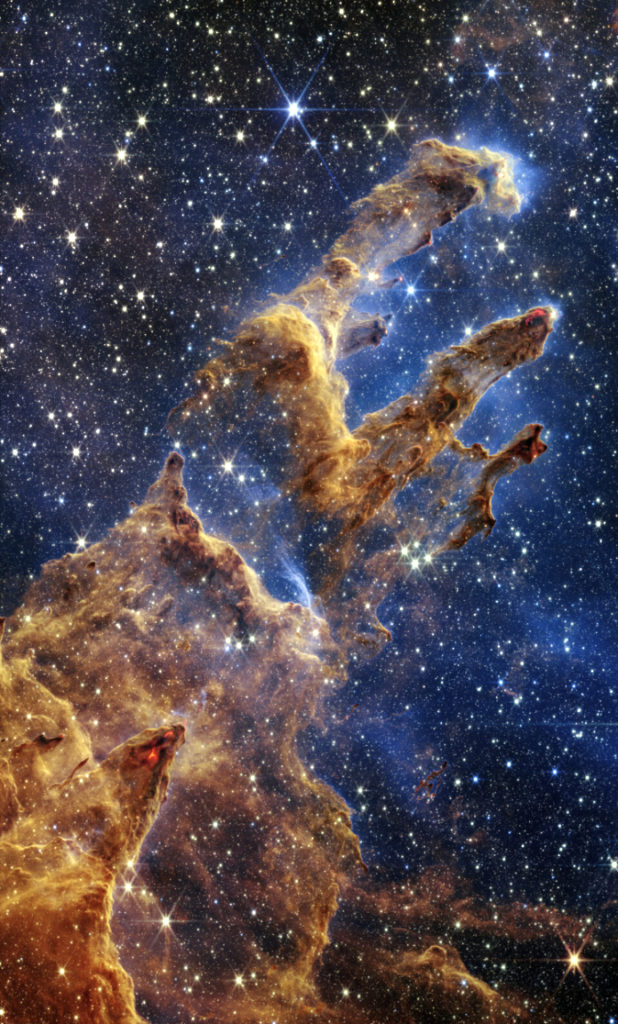
By early 2026, the data streaming back from our expanded orbital neighborhood has moved beyond merely filling in gaps in our knowledge; it is fundamentally challenging long-held scientific certainties.
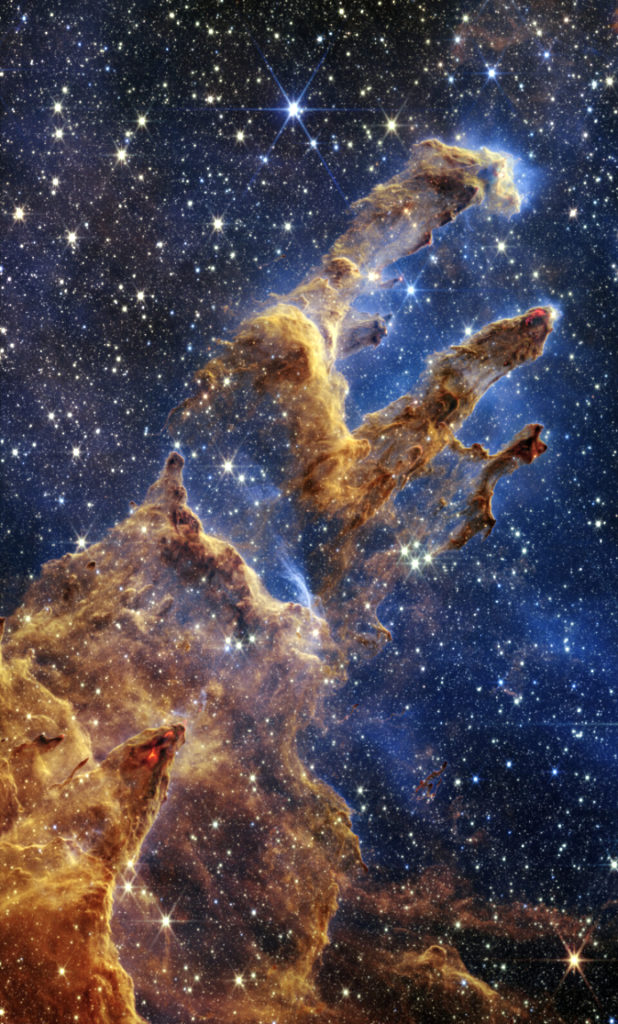
From the earliest moments of the universe to the chemical makeup of interstellar visitors, the “known” is being rewritten in real-time through observations that defy previous model predictions.
The “Impossible” Early Universe
The James Webb Space Telescope (JWST) continues to be the primary architect of this scientific disruption. In late January and early February 2026, astronomers announced several landmark discoveries that force a rethink of cosmic history. One such finding is MoM-z14, a galaxy observed as it appeared just 280 million years after the Big Bang.
Standard cosmological models predicted that galaxies at this “cosmic dawn” should be small, chaotic, and chemically simple. Instead, MoM-z14 is unexpectedly luminous and contains elevated levels of nitrogen, suggesting that massive stars formed and evolved much more rapidly than current models allow. This discovery, along with the identification of JADES-ID1—the most distant galaxy protocluster ever confirmed—indicates that the universe was in a “huge hurry to grow up,” assembling massive structures billions of years earlier than previously thought possible.
Interstellar Visitors and Alien Chemistry
Planetary science is similarly being upended by the passage of the interstellar comet 3I/ATLAS. Observations finalized in February 2026 by JWST and the jointly developed NASA-Korea SPHEREx mission revealed an unprecedented chemical “fingerprint” that drastically differentiates it from any comet native to our solar system.
Spectroscopic analysis showed an extreme carbon dioxide enrichment—nearly eight times higher than water ice levels—which is over four standard deviations away from typical solar system trends. This unique composition suggests 3I/ATLAS formed in a stellar environment with conditions vastly different from our own, disproving the assumption of a universal chemical blueprint for cometary bodies and providing a literal “DNA sample” from another star system.
Mapping the Invisible Scaffolding
Even the “invisible” parts of our universe are coming into sharper focus. On January 26, 2026, researchers published the most detailed high-resolution map of dark matter to date, utilizing JWST data to peer 8 to 11 billion years into the past. By tracking nearly 800,000 galaxies in the constellation Sextans, the map reveals the “cosmic web” with twice the detail of Hubble’s previous work. While it reinforces the theory that dark matter acts as the gravitational scaffolding for galaxies, it also reveals smaller-scale structures and “clumpiness” that were previously invisible.
These finer details are allowing theorists to search for subtle deviations from the Standard Model (ΛCDM), with some researchers proposing that interactions between dark matter and neutrinos could resolve long-standing discrepancies in how quickly the universe expands.
A New Era of Fundamental Physics
Fundamental physics is also facing its own set of tests. While social media rumors about “Project Anchor” and the Earth losing gravity in August 2026 have been thoroughly debunked as misinformation, legitimate research into gravity is pushing boundaries.
Analysis of satellite data and weak lensing surveys are being used to test General Relativity at unprecedented precision. Scientists are increasingly looking toward a “non-algorithmic” understanding of the universe, with new mathematical research suggesting that the fundamental laws of physics may exist on an informational layer deeper than space and time themselves. This shift suggests that the next decade of space exploration won’t just find new things; it will redefine the very laws we use to look for them.