
Unlock the Editor’s Digest for free
Roula Khalaf, Editor of the FT, selects her favourite stories in this weekly newsletter.
Many events have occurred on Unst, the UK’s northernmost island, over the centuries. Viking longboats landed there in the ninth century as their crews raided Britain and there is a Bronze Age ritual burial ground on the island’s Lamba Ness peninsula. So far, a space rocket has not taken off.
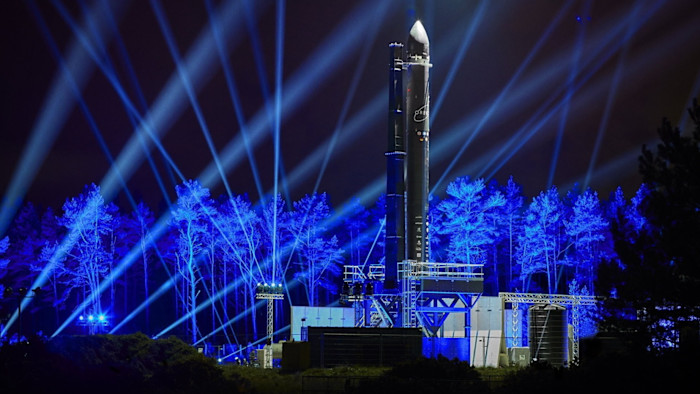
That could change this year, as the German start-up Rocket Factory Augsburg attempts a test flight of its RFA One rocket from the SaxaVord spaceport. But it could be a long time before a British rocket launches from Unst to fulfil former prime minister Boris Johnson’s 2021 vision of “Global Britain becoming Galactic Britain”.
The latter may not happen at all, since the Scottish rocket start-up Orbex, which also plans to launch from SaxaVord, is close to losing its independence. Despite multiple capital injections from the UK government, Orbex is in talks to sell its business to The Exploration Company, a Franco-German group.
There have been many ambitious ministerial proclamations about the UK regaining its sovereign space capability, more than half a century after the launch of the Black Arrow rocket from Woomera in Australia. The government has tried to turn Orbex into its successor, enabling the UK to lead Europe’s space efforts in putting small commercial satellites into space.
 A CGI illustration shows a launch from the SaxaVord spaceport on Unst. But it could be a long time before a British rocket launches © SaxaVord/PA
But progress has been painfully slow, with the last attempt failing in 2023: a Virgin Orbit plane that took off from Cornwall carrying a rocket did not complete its satellite mission. Paul Bate, chief executive of the UK Space Agency, announced his resignation last week after the government decided to fold it back into the Department for Science, Innovation and Technology.
While government talk is cheap, launching rockets into space is not. Elon Musk’s SpaceX plans to raise $50bn at a valuation of about $1.5tn in an initial public offering this year, but the government is quietly throttling back its ambitions for a UK equivalent. “I have never seen the evidence that they were really serious,” says Bleddyn Bowen, associate professor in astropolitics at Durham University.
Ministers have not yet decided, but the UK may keep supporting Orbex’s attempts to launch from SaxaVord under European ownership and treat British control of a strategic rocket base as sufficient. That would fall short of Johnson’s aspirations but it would save money. Britain would remain, as a House of Lords report put it last year, “a middle-sized space power with a limited budget”.
This is not disastrous as long as the UK maintains co-operation with the US and Europe. UK defence satellites have been launched by SpaceX and most of the UK Space Agency’s budget is funnelled through the European Space Agency. UK funding for the ESA’s European Launcher Challenge for rockets could finance Orbex’s launch, while Germany backs RFA and Isar Aerospace.
The UK has an innovative space industry, including Glasgow’s cluster of companies manufacturing small satellites of the kind that could be carried to space from SaxaVord. The sector has expanded from about 200 companies two decades ago to 1,900 today, although more than 60 per cent of them are small, with annual turnovers of less than £260,000.
But there are good reasons why other countries are investing more than the UK in establishing space sovereignty (Germany plans to spend €35bn on military uses by 2030). The war in Ukraine and weakening US support for Nato have made defence autonomy critical, and orbital satellites are integral to many industries, from communications to energy and transport.
Recommended

Not only is Britain spending less, but the Ministry of Defence appears content to use others for its satellites and is less committed to a sovereign launch programme than the UK Space Agency. Bowen argues that the government’s failure to become the anchor launch customer for a British company, rather than just injecting capital, has contributed to Orbex’s problems.
The UK may have picked the wrong company by betting so heavily on Orbex. Skyrora, a start-up founded by Volodymyr Levykin, a Ukrainian-born British citizen, was granted a licence last year to launch from SaxaVord, but the spaceport’s capacity is limited and it may look abroad instead. Britain’s hopes are fragmenting.
One day, a rocket will take off from Unst and put its satellites into orbit. It will be a big step for a small island but it is unlikely to be the return to space that prime ministers imagined.
john.gapper@ft.com