
A group of scientists claims to have solved the mystery of the enigmatic “little red dots” discovered by the James Webb Space Telescope in the early Universe. They believe that these are supermassive black holes formed from gas and dust clouds through direct collapse.
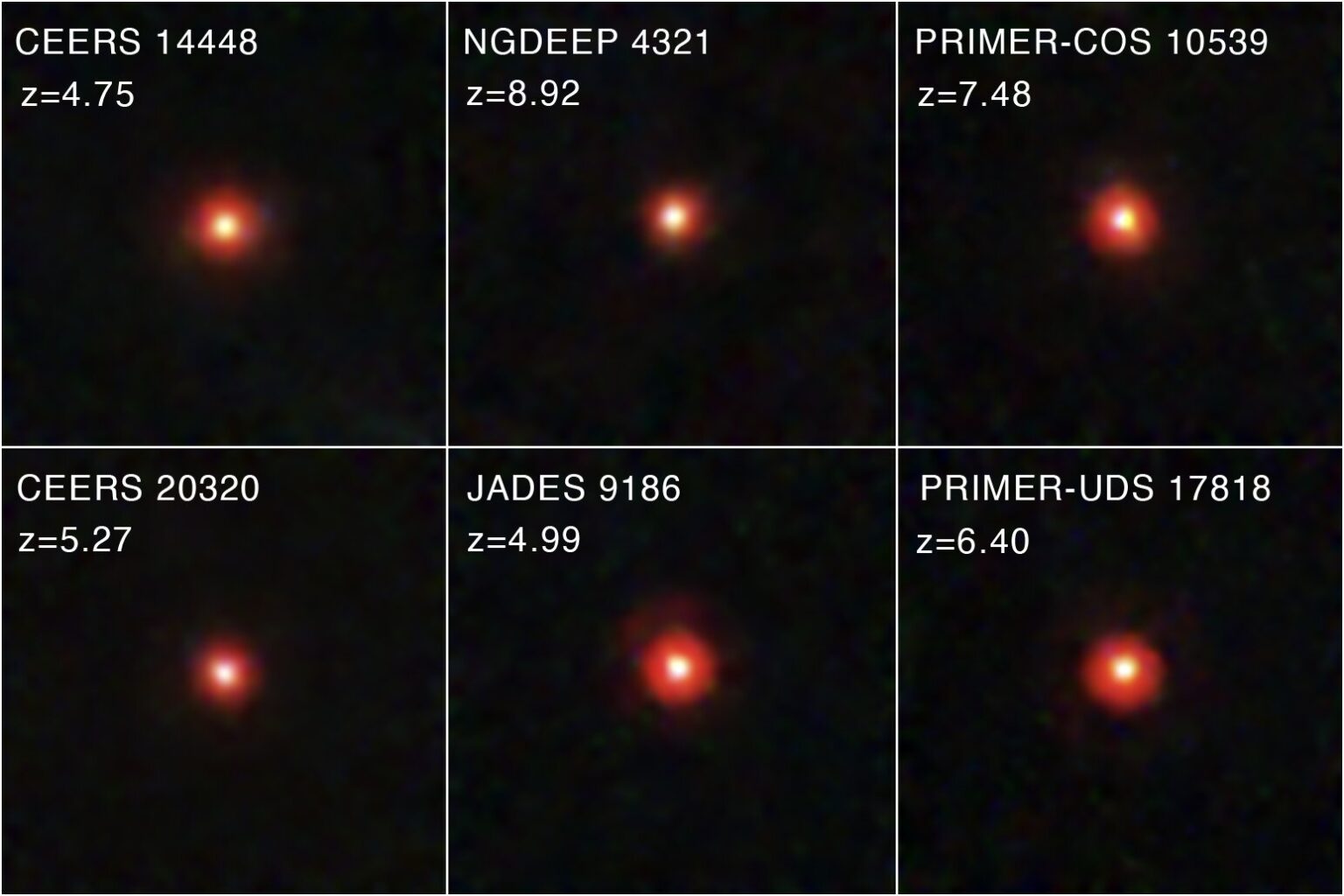 Little red dots. Source: phys.org
Mystery of the ”little red dots”
Shortly after the most advanced space telescope, James Webb, began operating, astronomers were able to observe the early Universe with unprecedented detail. Among other things, they saw little red dots there. And now, an article by scientists from Harvard University claiming to know what they are has been accepted for publication in the journal Nature.
There is no doubt that the “little red dots” observed by James Webb are something extremely unusual that existed in the early Universe. This is not an image of galaxies, because they cannot be seen at such a distance, and the Universe was less than a billion years old at that time, so large star systems simply did not have time to form.
There is a theory that the “little red dots” are quasars, supermassive black holes that actively absorb matter and eject some of it back out in the form of radiation. But they have the same problem as galaxies: they simply don’t have enough time to form.
Direct collapse
This led to the assumption that these red dots were a new class of objects, direct collapse black holes. In fact, these are the same supermassive black holes, but at the first stage of their existence, at a moment in time whose reality remains debatable.
The fact is that scientists see bright quasars in an earlier Universe than they should be. The traditional view of this process assumes that first-generation stars, huge unstable celestial bodies that exploded as supernovae and gave rise to black holes, were formed first, and that the latter merged and became the seeds of the giants currently found at the center of every galaxy.
The problem is that it’s too slow. And scientists have long been saying that a completely different scenario could have taken place: giant gas and dust clouds collapsed under their own weight, but even before a colossal star could form in their place, a black hole was already being born in the center, and the rest of the matter fell onto it very quickly.
This is called direct collapse. It could explain many questions that bother astronomers, but no solid evidence has been found to confirm it yet. Even in the new study, scientists claim that the red dots observed by James Webb could be gas clouds collapsing directly into black holes, based on calculations.
They conducted hydrodynamic-radiation modeling of this event and showed its feasibility. Moreover, from the outside, this process should appear very similar to a little red dot.
According to phys.org