
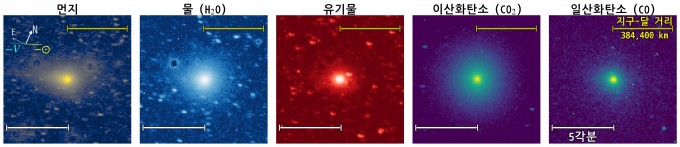
Key substances observed on the interstellar comet by SPHEREx. Courtesy of KASI.
The space telescope ‘SPHEREx,’ jointly developed by Korea and the U.S. National Aeronautics and Space Administration (NASA), has captured the emission of water and organic molecules from an interstellar comet that flew in from outside our solar system.
The Korea Astronomy and Space Science Institute (KASI) and the international SPHEREx collaboration announced on the 9th that they detected organic molecules such as water, carbon dioxide, carbon monoxide, and cyanide by observing the interstellar comet 3I/ATLAS. Organic molecules are the basic building blocks of life. This research was published in ‘Research Notes of the American Astronomical Society’ on the 3rd.
3I/ATLAS is a comet discovered in July last year by NASA’s ATLAS survey telescope. Orbital analysis confirmed it to be an object from another star system, and it is being tracked and observed by several NASA research teams. Objects from outside the solar system provide a rare opportunity to directly examine the composition of other planetary systems.
The research team compared and analyzed the initial observation results from last August with follow-up results from this past December. In August, abundant amounts of carbon dioxide and small amounts of carbon monoxide and water were detected in the ‘coma,’ the atmosphere surrounding the comet’s nucleus. In the December observation, the coma’s components were more diverse, and the ratio of carbon monoxide to carbon dioxide had increased. The comet’s brightness significantly increased about two months after its perihelion, its closest point to the Sun.
As a comet approaches the Sun, its surface ice undergoes sublimation, turning directly from a solid to a gas without passing through a liquid phase. Because it takes time for the Sun’s heat to penetrate the comet’s interior, the most active material emission can occur after the perihelion. 3I/ATLAS is a case that exhibited this characteristic.
Components like water and carbon dioxide are difficult to observe with ground-based telescopes. Detecting them requires capturing specific infrared wavelengths emitted by the molecules. The same components in Earth’s atmosphere absorb this light, making ground-based observation challenging. SPHEREx, being a wide-field space telescope observing from outside the atmosphere, can precisely image the entire comet and obtain information on the emission of various organic materials.
The research team plans to gather additional observational data to compare solar system comets with interstellar ones, continuing their research to uncover the formation processes of both exoplanetary systems and Earth. “An interstellar object entered our solar system just months after the launch of SPHEREx,” said Park Yoon-soo, a senior researcher at KASI. “Science sometimes progresses at the right moment and in the right place.”
Copyright ⓒ DongA Science. All rights reserved.