
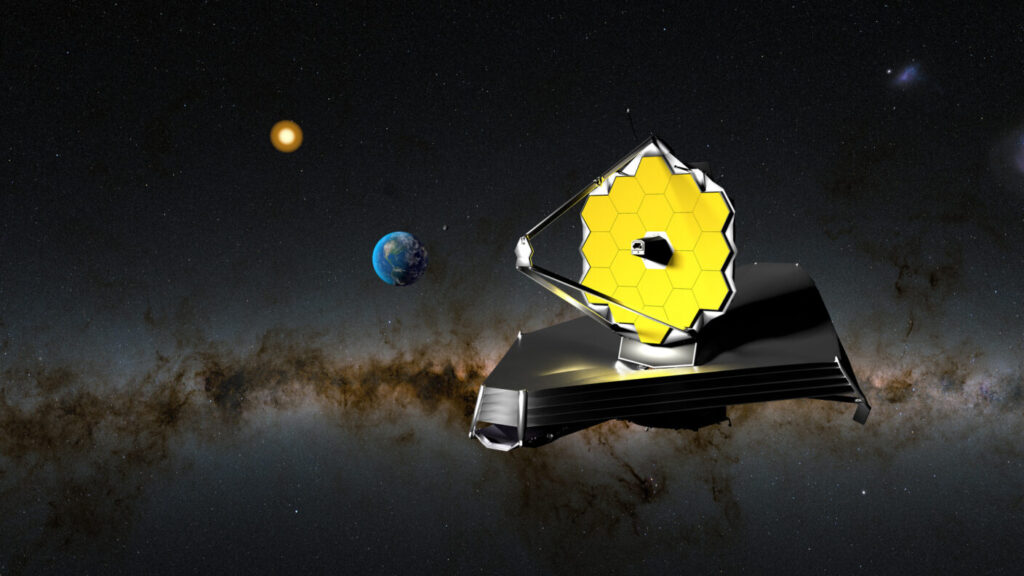
Astronomers using the James Webb Space Telescope (JWST) have spotted galaxy collisions in the early universe, in the latest round of discoveries that reveal distant, very old cosmic structures are far more complicated than previously believed.
The research team behind the observations at Texas A&M University has demonstrated that large-scale galactic interactions were already reshaping the universe just 800 million years after the Big Bang. Dr. Weida Hu, a postdoctoral researcher and the study’s lead author, and Dr. Casey Papovich, professor of physics and astronomy, published their findings in Nature Astronomy.
The newly discovered system, nicknamed “JWST’s Quintet,” contains at least five galaxies that are both tightly packed and in the process of merging. At this earlier time in our comic history, when the collisions occurred, astronomers expected galaxies to be small and isolated. However, “JWST’s Quintet” reveals something very different: a compact region of the cosmos surrounded by a halo of oxygen‑rich gas.
“What makes this remarkable is that a merger involving such a large number of galaxies was not expected so early in the universe’s history, when galaxy mergers were thought to be simpler and usually involve only two to three galaxies,” Hu said.
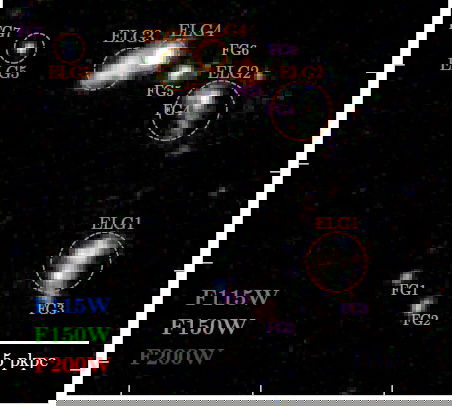 A pseudo-color image of JWST’s Quintet (JQ) at redshift 6.71. The five emission line galaxies in JQ are indicated by large orange circles and labeled (ELG1–ELG5). Credit: Weida Hu, et. al./Texas A&M University/DOI 10.1038/s41550-025-02636-1.
The system was identified in the JWST Advanced Deep Extragalactic Survey data. Despite being tens of thousands of light-years apart, these galaxies host an unusually dense region of space and were forming stars at a rate of roughly 250 solar masses per year—much higher than that of a typical galaxy of their era.
The Texas team also found a halo of glowing oxygen- and hydrogen-rich gas around the galaxies, which they believe was likely expelled during their merger. This shows that gravitational interactions (not just galactic winds) helped shape the environments of their galaxies in the early universe.
“By showing that a complex, merger-driven system exists so early, it tells us our theories of how galaxies assemble—and how quickly they do so—need to be updated to match reality,” Papovich said.

The team says their discovery could help explain why JWST sees many massive galaxies that become inactive within a few billion years. Fast mergers, like JWST’s Quintet, may have consumed or used up their gas early, leading to the evolution of these later huge galaxies.
The recent paper, “Extended enriched gas in a multi-galaxy merger at redshift 6.7,” appeared in the journal Nature Astronomy.
Chrissy Newton is a PR professional and the founder of VOCAB Communications. She currently appears on The Discovery Channel and Max and hosts the Rebelliously Curious podcast, which can be found on YouTube and on all audio podcast streaming platforms. Follow her on X: @ChrissyNewton, Instagram: @BeingChrissyNewton, and chrissynewton.com. To contact Chrissy with a story, please email chrissy @ thedebrief.org.