
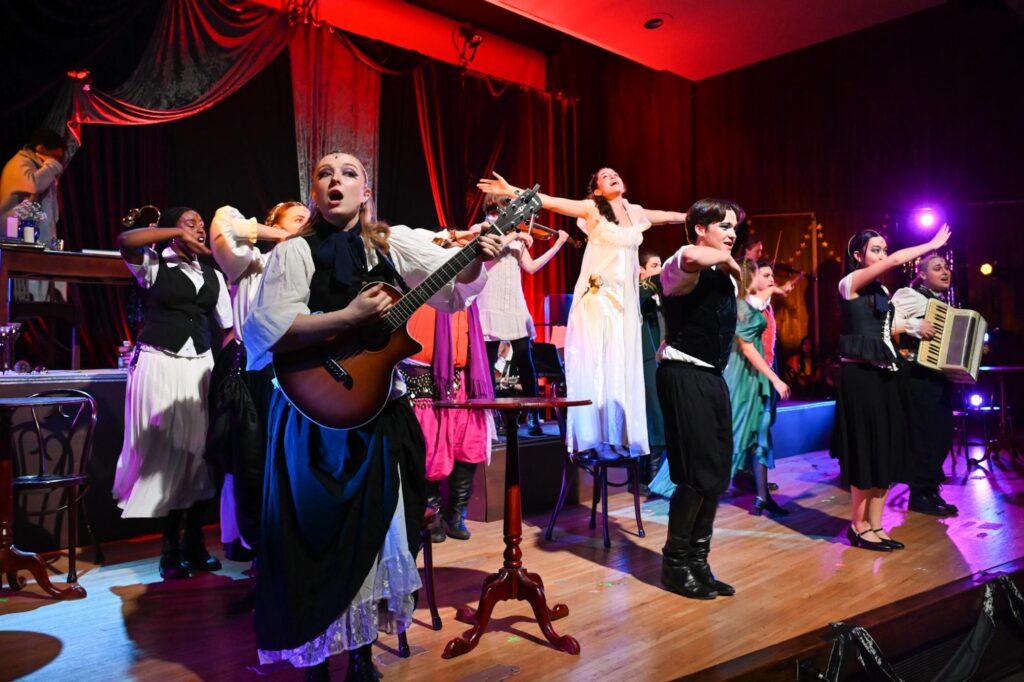
Tolstoy and synth pop don’t usually mix, but in “Natasha, Pierre & The Great Comet of 1812,” seemingly unrelated art forms work in tandem, creating a distinctive piece of musical theater.
The only thing to expect during the Jewish Theater Ensemble’s production of “Natasha, Pierre & The Great Comet” was the unexpected: audience members on stage? Cast members in the audience? Electropop opera? Sure, why not?
Directed by Weinberg junior Taylor McMullen and produced by Weinberg junior Owen Meehan-Egan, “Natasha, Pierre and the Great Comet of 1812” opened with two performances Friday night at Norris University Center’s McCormick Auditorium, followed by two more performances Saturday.
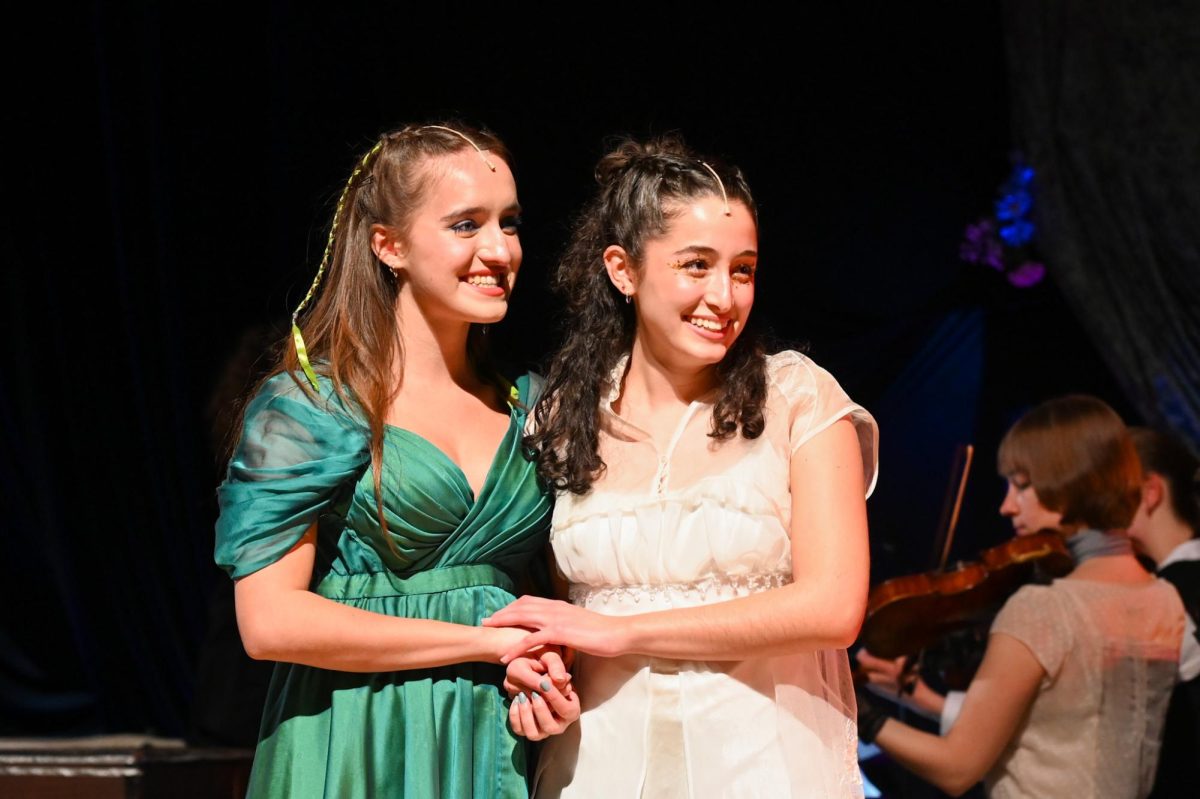
Communication sophomore Sophia Gleeson played Natasha, the titular character, and Communication sophomore Clarisa Gomez Rodriguez played her sister, Sonya.
The musical was originally written by Dave Malloy and is based on an excerpt of Leo Tolstoy’s “War and Peace.”
The musical follows Natasha (Communication sophomore Sophia Gleeson) and Pierre (Bienen sophomore Nigel Swinson), two early 19th century Russian aristocrats whose lives intertwine due to their tumultuous relationships with each other’s family members and friends.
Natasha is engaged to Andrey (Communication senior Roie Dahan), who is away fighting in the Napoleonic Wars, but falls in love with Anatole (Communication sophomore Tyler Guinto-Brody) — who happens to be the brother of Pierre’s promiscuous wife, Hélène (Communication senior Veronica Gonzalez).
The many relationships between characters can be confusing, which the show addresses in the prologue: “This is all in your program / You are at the opera / Gonna have to study up a little bit if you want to keep with the plot / ʼCause it’s a complicated Russian novel / Everyone’s got nine names.” The first few of those lines are also printed above a relationships chart in the program, which cast members handed out to audience members during the first song.
Interactions between the cast and audience didn’t stop there — audience members were brought on stage, encouraged to clap along to the music and spoken to directly throughout the show, all of which broke the fourth wall.
The music was also a unique aspect of the show. The pit orchestra was fully integrated into the production — with the full group situated onstage and Communication junior Jordan Klein, the show’s music director and conductor counting off out loud, it almost appeared to be part of the cast.
During “The Abduction,” when Anatole prepares to take Natasha to Poland, some musicians performed solos on an elevated part of the stage, showcasing individual talents including Bienen sophomore Ethan Kasparian Weisman on the clarinet and Bienen and Communication first-year Henry Tate on the accordion.
Additionally, some cast members further incorporated music into the show by playing instruments. Communication first-year Reeve Green and Communication sophomore Sayuki Layne played the violin, Communication sophomore Eloise Nelson played the accordion and Medill senior Ella Barnes played the guitar.
The abnormal blend of Russian folk music and electropop was especially prominent during numbers like “The Opera,” where the music was accompanied by eerie sound effects and drum tracks that contributed to a futuristic sound.
Other production aspects of the show brought it to life. The props and scenic design transported the audience to 19th century Russia, while the glittery makeup gave the show a modern look. These clashing features are reflective of exactly what the Jewish Theater Ensemble hoped to accomplish with “Natasha, Pierre & The Great Comet of 1812:” a mystical combination of elements that might appear to conflict, but result in an enchanting performance.
Email: [email protected]
Related articles:
— Curtain Call: ‘Hand to God’ is a twisted perspective on morality
— Curtain Call: ‘Eureka Day’ hysterically parodies civic discourse in a Bay Area private school