
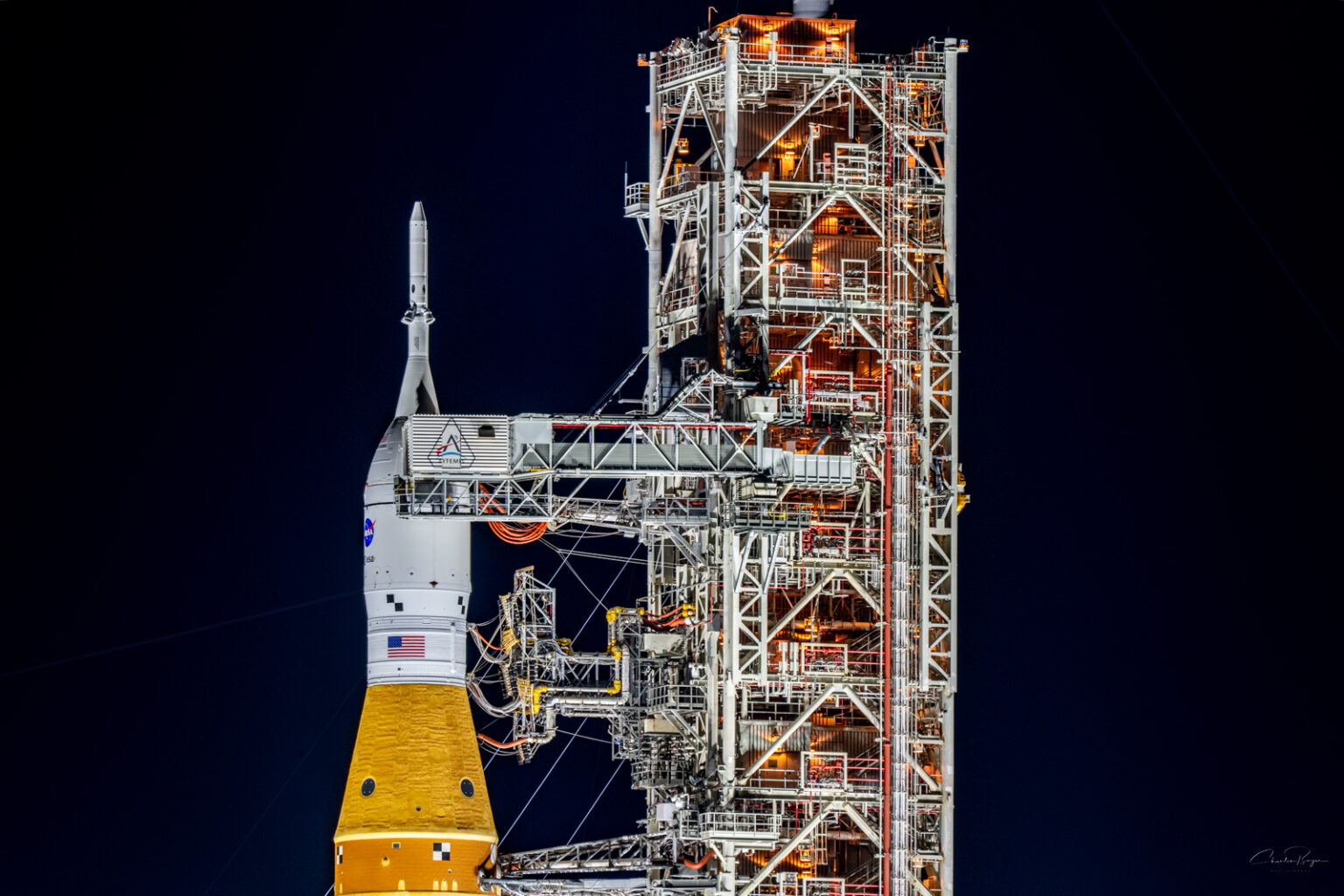
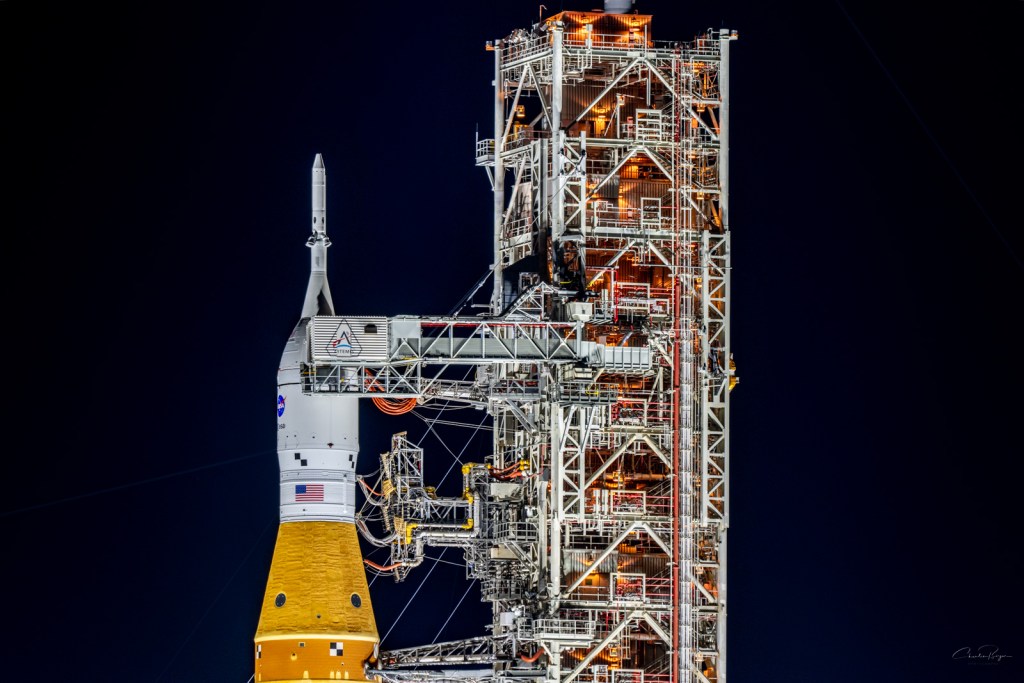
Artemis II
Photo by Charles Boyer
When NASA wrapped up the first Artemis II wet dress rehearsal on February 3 at Kennedy Space Center, they had successfully loading the SLS rocket’s tanks with cryogenic propellant. That was the good news, but the less welcome bad news was that the test revealed higher-than-allowable hydrogen gas leaks at the Tail Service Mast Unit on the launch pad. Obviously, those leaks must be repaired before a launch attempt.
The Work For WDR-2 Started As Soon As WDR-1 Was Completed
Not long after propellant draining was complete after WDR-1, technicians began working to access the TSMU umbilical. They detached both the rocket-side and ground-side interface plates to inspect the area where elevated hydrogen levels were detected, and replaced seals around two fueling lines.
The two tail service masts — each about three stories tall — provide the cryogenic propellant lines and electrical cable connections to the SLS core stage. They tilt back before launch and include “quick disconnects” — mechanisms that instantaneously detach at liftoff to ensure safe retraction.
Reconnecting the interfaces is expected to be complete by Monday, Feb. 9. Engineers are still evaluating the root cause of the leak, and the removed seals are being analyzed. NASA also plans additional testing at Stennis Space Center in Bay St. Louis, Mississippi, to evaluate the dynamics of the interface plates. Engineers are reviewing options to verify the repair before committing to the next full wet dress rehearsal.
Repairs For WDR-2
Here’s a breakdown of the repairs underway and the operational changes NASA is making for WDR-2:

Five Key Changes for the Next Rehearsal
Five Key Changes for the Next Rehearsal
Artemis II Wet Dress Rehearsal | Kennedy Space Center
Type
Change
Details
Hardware Fix
Two seals replaced
Seals replaced around fueling lines at the tail service mast umbilical where hydrogen concentrations exceeded allowable levels. Removed seals are being analyzed and additional plate dynamics testing is planned at Stennis.
Operations
Orion hatch closed before test
The crew module hatch will be sealed prior to the rehearsal. The closeout crew — who on launch day help astronauts into their seats and close both Orion hatches — will not be deployed to the pad.
Operations
Crew access arm stays extended
The arm will not be retracted during the next rehearsal. Engineers successfully demonstrated during the Feb. 3 test that the ground launch sequencer can retract it during the final countdown phase, so that objective is already complete.
Timeline
One extra hour in countdown
NASA has added 30 minutes of extra hold time at each of two planned holds — one before and one after tanking operations — to allow more time for troubleshooting. The total countdown is now one hour longer. This does not affect the crew’s launch-day timeline.
Focus Shift
Rehearsal focused on fueling
With the crew access arm retraction and other pad objectives already demonstrated, the next WDR will concentrate on tanking operations and verifying the hydrogen leak repair.
Source: NASA, “NASA Conducts Repairs, Analysis Ahead of Next Artemis II Fueling Test,” Feb. 8, 2026
NASA continues to eye March as the next potential launch opportunity but will not set a targeted launch date until after completing a successful wet dress rehearsal and reviewing the data. The critical second WDR is set to start as soon as this Friday, February 13th.
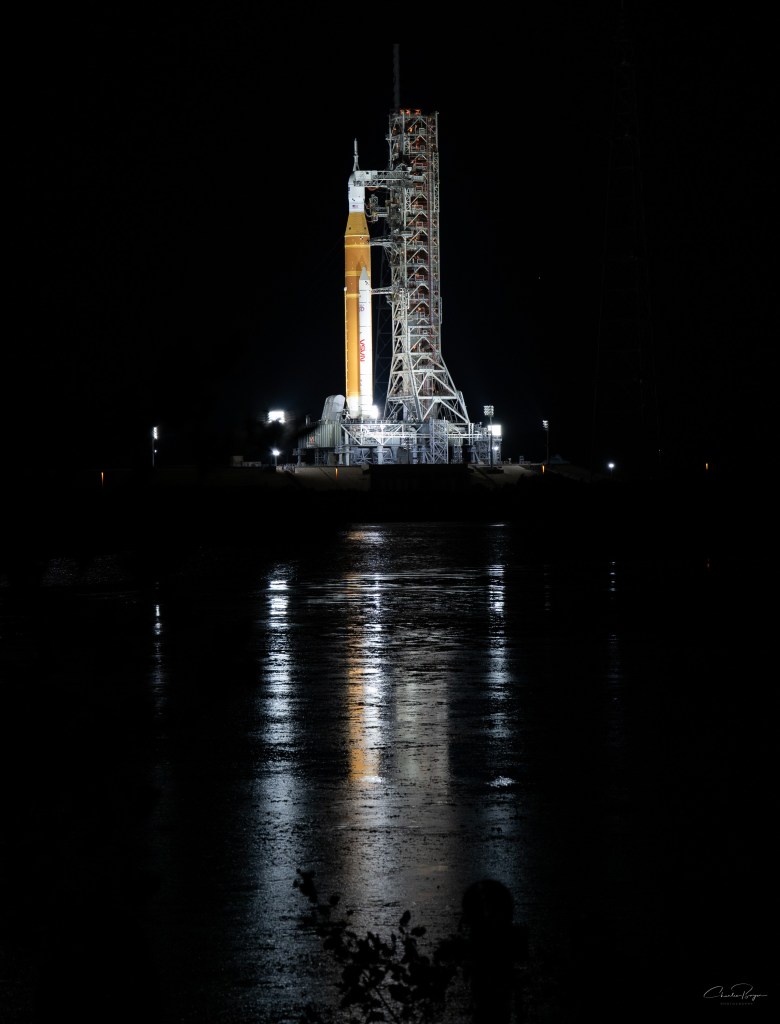
Artemis II at LC-39B
Photo: Charles Boyer