
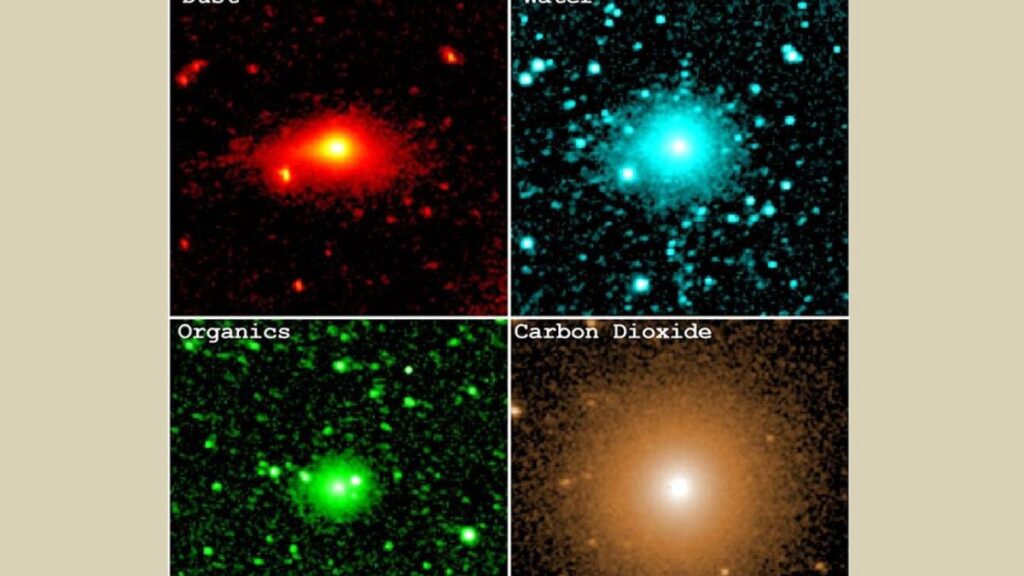
Washington: New infrared observations by NASA’s SPHEREx space telescope have revealed dramatic changes in interstellar comet 3I/ATLAS as it made its farewell pass through the solar system, offering scientists an unprecedented chemical glimpse of material formed around another star.
According to NASA, SPHEREx (Spectro-Photometer for the History of the Universe, Epoch of Reionisation and Ices Explorer) captured images of the comet in December 2025, showing a powerful outburst of gas, dust and complex molecules, a surprising surge that occurred nearly two months after the object’s closest approach to the Sun.
Also read | ISRO issues warning as powerful solar flares threaten radio blackouts
The findings are detailed in a new research note by mission scientists, who report the detection of organic molecules such as methanol, cyanide and methane. While organic molecules are the building blocks of life on Earth, researchers note that they can also form through non-biological processes.
The observations also recorded a sharp increase in the comet’s brightness well after perihelion, a phenomenon linked to delayed sublimation, when ice turns directly into gas, as subsurface ices warm and erupt into space.
“Comet 3I/ATLAS was full-on erupting into space in December 2025, after its close flyby of the Sun, causing it to significantly brighten. Even water ice was quickly sublimating into gas in interplanetary space,” said study lead Carey Lisse of Johns Hopkins Applied Physics Laboratory in Laurel, Maryland. “And since comets consist of about one-third bulk water ice, it was releasing an abundance of new, carbon-rich material that had remained locked in ice deep below the surface. We are now seeing the usual range of early solar system materials, including organic molecules, soot, and rock dust, that are typically emitted by a comet.”
Also read | Genes may play a bigger role in how long you live than previously thought
Scientists explain that peak comet activity does not always coincide with the closest approach to the Sun, as heat can take time to penetrate through outer layers. In the case of 3I/ATLAS, SPHEREx data suggest that deeply buried ices began sublimating only weeks later, triggering the observed outburst.
Earlier SPHEREx observations in August had detected a coma dominated by carbon dioxide, with smaller amounts of carbon monoxide and water. By December, however, the coma had become far more active and chemically diverse, fed by erupting subsurface water ice mixed with other ices, organic compounds and rocky material.
“The comet has spent ages traversing interstellar space, being bombarded by highly energetic cosmic rays, and has likely formed a crust that’s been processed by that radiation,” said Phil Korngut, the mission’s instrument scientist at Caltech in Pasadena, California. “But now that the Sun’s energy has had time to penetrate deep into the comet, the pristine ices below the surface are warming up and erupting, releasing a cocktail of chemicals that haven’t been exposed to space for billions of years.”
The data also suggest that the comet is ejecting relatively large rocky particles rather than fine dust. Scientists observed only a small, pear-shaped dust tail, indicating that the ejected material includes BB-sized chunks too heavy to be pushed far from the nucleus by solar radiation pressure.
The comet observations were made possible by SPHEREx’s near-polar low-Earth orbit and its ability to scan the entire sky in infrared wavelengths. Launched on March 11, 2025, the mission recently completed the first of four planned all-sky infrared maps, observing the universe in 102 infrared colours.
“Our unique space telescope is gathering unprecedented data from across the universe,” said Yoonsoo Bach, deputy study lead from the Korea Astronomy and Space Science Institute. “But in this case, our galaxy delivered a piece of a faraway star system to us only a few months after launch, and SPHEREx was ready to observe it. Science is sometimes like that: You’re in the right place at the right time.”
Comet 3I/ATLAS was discovered on July 1, 2025, by the NASA-funded ATLAS (Asteroid Terrestrial-impact Last Alert System) survey telescope in Rio Hurtado, Chile, and was quickly identified as interstellar due to its high velocity and unusual trajectory. It is only the third known interstellar object ever detected passing through the solar system.
NASA said multiple missions have since tracked the comet to refine its trajectory and analyse its composition, underscoring the agency’s broader efforts to study comets, asteroids and near-Earth objects that travel through the solar system.
Published: 08 Feb 2026, 01:53 pm IST
Subscribe to our NewsletterGet Latest Mathrubhumi Updates in EnglishFollow
Disclaimer: Kindly avoid objectionable, derogatory, unlawful and lewd comments, while responding to reports. Such comments are punishable under cyber laws. Please keep away from personal attacks. The opinions expressed here are the personal opinions of readers and not that of Mathrubhumi.