
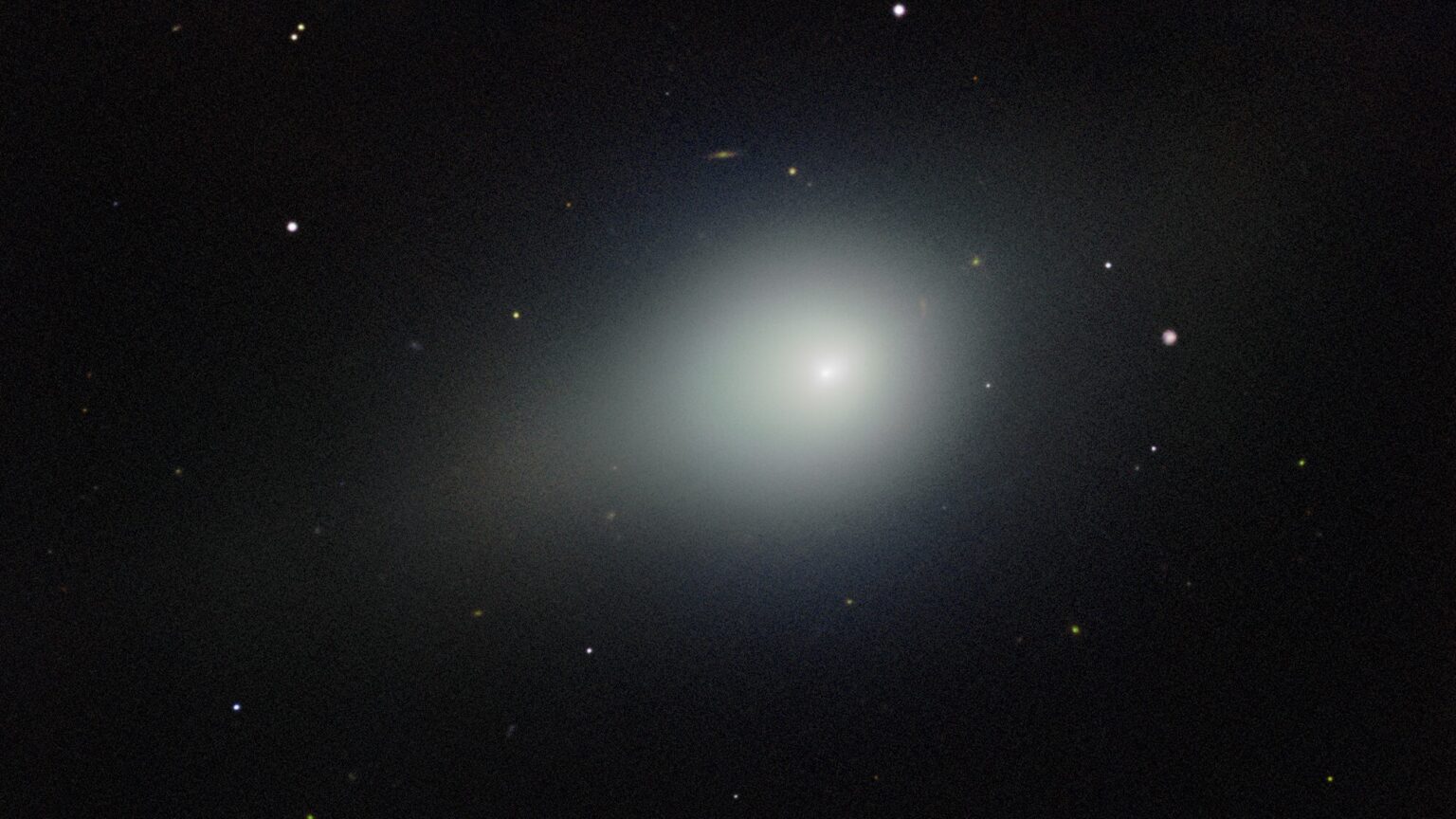
NASA has captured striking new images of interstellar comet 3I/ATLAS as it unexpectedly flared while exiting the solar system, an unusual surge of activity that has intrigued scientists and fuelled fresh online speculation about the object’s origins.
NASA’s SPHEREx space telescope has captured new infrared observations of comet 3I/ATLAS showing a dramatic increase in activity in December 2025, months after the object made its closest approach to the Sun. Instead of gradually fading as expected, the comet released a surge of gas, dust and complex molecules while already on its way out of the inner solar system.
The Comet In Question
The observations revealed a glowing coma surrounding the comet, rich in water vapour, carbon dioxide and organic compounds. Scientists also detected a distinctive, pear-shaped dust tail, formed as rocky material was ejected into space during the outburst.
Researchers say the timing of the flare-up was unexpected. Comets usually become most active near perihelion — the point at which they pass closest to the Sun — when solar heating causes surface ice to sublimate. In the case of 3I/ATLAS, however, the most intense activity occurred well after that point.
‘Rather than quietly dimming as it moved away, the comet became significantly brighter,’ said Carey Lisse, lead author of the study, in a statement from NASA. “Even water ice was rapidly turning into gas far from the Sun.”
Comet 3I/ATLAS was discovered in July 2025 by the ATLAS asteroid survey and is only the third confirmed interstellar object ever observed passing through the solar system. The first, 1I/’Oumuamua, detected in 2017, drew widespread attention due to its unusual shape and motion, while the second, 2I/Borisov, identified in 2019, behaved more like a typical comet.
Alien In Origin?
Although astronomers stress that 3I/ATLAS is a natural object, its sudden brightening has fuelled renewed speculation online. Some social media users have likened the flare-up to a spacecraft “powering up” as it departs, echoing earlier claims that interstellar objects could be artificial in origin. Scientists, however, say there is no evidence to support such theories.
According to researchers, the most likely explanation lies beneath the comet’s surface. Sunlight may have taken time to penetrate a hardened outer crust, eventually reaching deeply buried ice that had remained frozen for billions of years. Once warmed, those ancient materials rapidly escaped into space, producing the delayed outburst seen by SPHEREx.
The telescope is particularly well suited to this kind of analysis. Operating in infrared wavelengths, SPHEREx can identify not only dust but also a wide range of molecules streaming from the comet, including methane, methanol, cyanide and other carbon-rich compounds — substances considered essential in the early stages of planet formation.
Because 3I/ATLAS originated beyond the solar system, its chemical make-up offers a rare opportunity to compare local comets with icy bodies formed around other stars. Early results suggest many familiar ingredients are present, supporting the idea that the basic building blocks of planets may be common throughout the Milky Way.
Last Few Sighting
Scientists also believe the comet’s long exposure to cosmic radiation during its interstellar journey played a role. Over immense timescales, this radiation likely altered the comet’s surface, sealing off more pristine ice beneath. When solar energy finally reached those untouched layers, it triggered the sudden release of material.
The findings were published in February 2026 in Research Notes of the AAS. While comet 3I/ATLAS is now fading as it continues into deep space, scientists say its unexpected farewell has provided valuable insight into the nature of interstellar objects — and a reminder of why such visitors continue to spark both scientific interest and public fascination.