
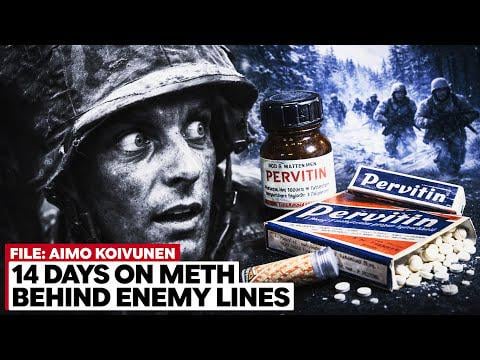
In March 1944, during Finland’s Continuation War, a ski reconnaissance patrol operating in Lapland was cut off and encircled by Soviet forces. One of the men, Aimo Koivunen, became separated from his unit during the retreat and survived alone for over two weeks in Arctic conditions that should have been unsurvivable.
According to Finnish military medical reports and postwar documentation, Koivunen ingested an entire issue of Pervitin (methamphetamine) intended for multiple soldiers over several days. The result was not sustained performance, but a prolonged physiological and psychological breakdown: hallucinations, blackouts, loss of orientation, extreme tachycardia, and near-total depletion of body mass.
Despite this, Koivunen covered an estimated 250+ miles on skis, survived temperatures between –20°C and –30°C, evaded pursuing Soviet units, crossed minefields, and remained alive long enough to be recovered by Finnish patrols. Medical staff later recorded a heart rate exceeding 200 bpm and a body weight reduced to approximately 43 kg (94 lb). He survived what is considered the only documented massive Pervitin overdose in WWII.
I’m curious how others here interpret this:
Was this purely an outlier of luck, or evidence that human limits under extreme stress are far less defined than we assume?
by No_Money_9404