
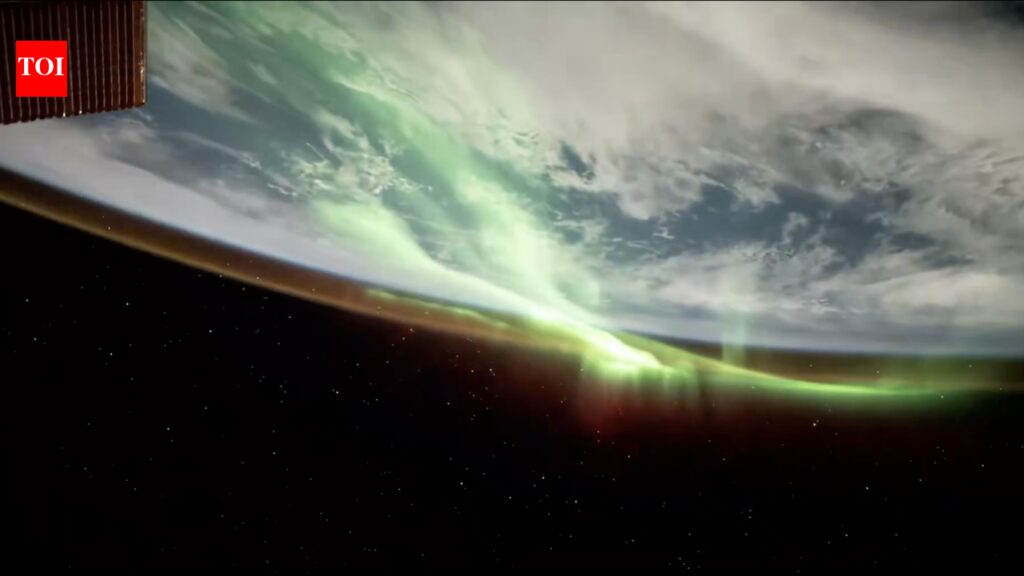
 NASA shares ISS visuals of solar flare lighting up Earth’s atmosphere (Image Source – NASA) A stretch of green light slid along Earth’s curve earlier this month, picked up by cameras aboard the International Space Station. NASA later released the footage. It shows auroras flaring quietly across the upper atmosphere, with a thin orange line sitting below them, marking the edge of the air itself. The timing lines up with a recent solar flare, one of several as the Sun moves into a more active spell. From orbit, the scene feels less dramatic and more exposed. The planet looks small, wrapped in faint layers, responding to forces that arrive without warning. Auroras are familiar sights from the ground, but seen this way, they look less like an event and more like part of a larger, ongoing exchange.
Auroras seen from orbit tracing the edge of Earth: NASA shared visuals
From the station’s altitude, auroras do not hang like curtains. They stretch and thin, drifting sideways across vast distances. The green glow is the strongest, but the orange band beneath it stands out, steady and narrow. That lower glow is always there, created by chemical reactions high above the surface, though it usually goes unnoticed. When auroras brighten, the contrast sharpens. The footage makes the atmosphere look fragile, more layered than deep, like a boundary rather than a shield.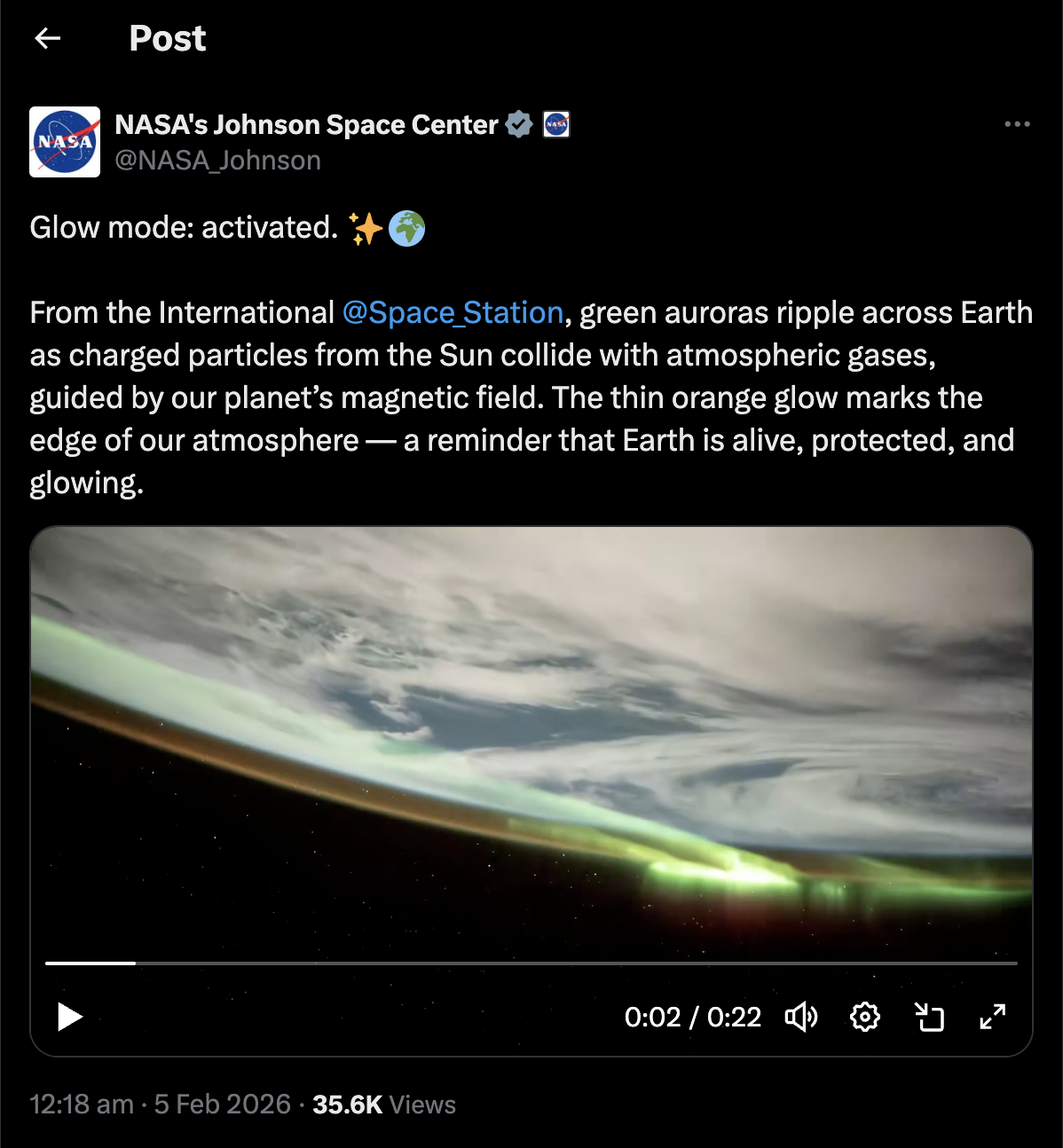
Auroras seen from orbit tracing the edge of Earth: NASA shared visuals (Image Source – X/NASA)
Solar flares send charged particles toward Earth
The Sun releases energy constantly, but some moments are louder than others. Solar flares push streams of charged particles outward, and some of that material ends up here. Earth’s magnetic field bends those particles, guiding them rather than stopping them outright. The recent auroras followed a flare recorded in early February. There is no clean start or finish to this process. Particles arrive, fields shift slightly, light appears, then fades again. The timing fits, even if the path is never perfectly traced.
Atmospheric gases shape aurora colours
The colours are familiar, but their sources are spread out in height. Oxygen tends to glow green at certain altitudes and red much higher up. Nitrogen adds blues and purples closer to the lower edge of the aurora. These layers overlap. From space, they sometimes blur into each other rather than forming neat bands. The colours mix, soften, and thin out. What looks vivid from the ground can appear restrained from orbit, more like a wash than a flare.
Increased solar activity widens aurora visibility
As solar activity rises, auroras drift away from their usual polar limits. In recent weeks, people reported seeing them in parts of the United States and Europe where they are uncommon. Missouri, Colorado, and parts of Germany were among the places mentioned. These sightings tend to come and go without much warning. They depend on timing, cloud cover, and how the magnetic field happens to respond at that moment.
Space weather affects more than the night sky
Auroras are often treated as scenery, but they sit alongside less visible effects. Strong solar activity can interfere with satellites, radio signals, and power systems. This time, the impact stayed mostly overhead. From the station, the lights did not look threatening. They looked routine, almost subdued. Just a reminder that Earth is not still, and never fully sealed off from what is happening beyond it.