
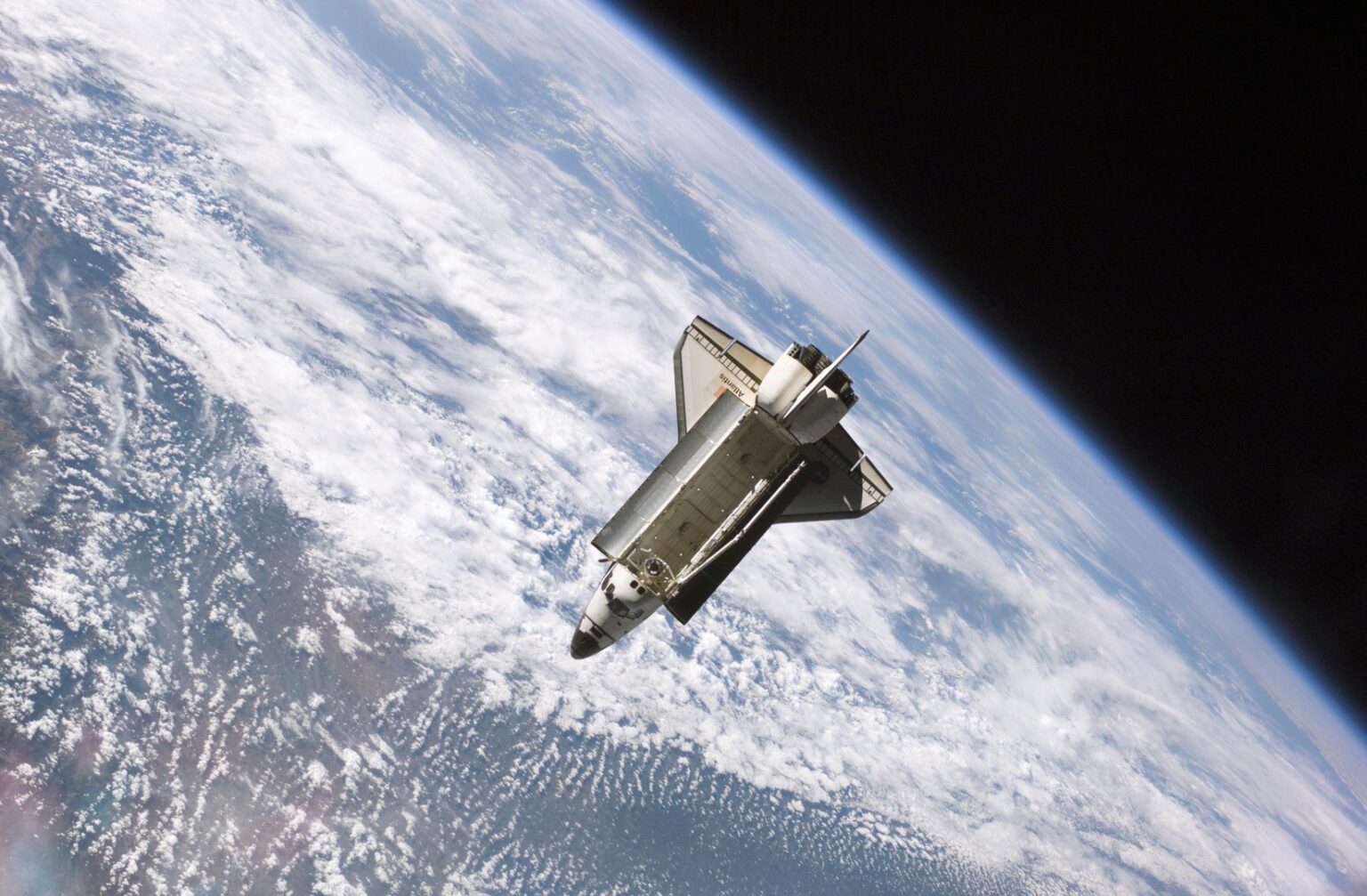
 Image in Creative Commons.
We need to talk about this baby thing. It turns out that while we’re getting much better at building rockets, our biological “hardware” isn’t exactly “space-rated” yet; and it’s becoming a problem.
Space is a toxic cocktail of radiation and weightlessness that is hostile to terrestrial biology. As missions stretch from weeks to years, and as private companies eye Martian settlements, the question of human fertility is becoming a serious concern.
The aim is not to promote conception in space, but to reduce the reproductive risks that space travellers may encounter, especially during long-duration missions,” the authors say.
Exposure in Space
Our bodies are fine-tuned for the environmental conditions on Earth. Even so, natural conception could still occur in space, particularly on commercial flights. In fact, this is one of the authors’ first concerns.
“Incentives to advance space exploration quickly may lead to companies carrying out reproductive research or allowing space-based conception and gestation without sufficient medical, ethical or legal preparation, compromising ethical principles such as informed consent, safety prioritization, and transparency,” reads the study, led by Giles Palmer, an embryologist at the University of Leeds.
Radiation is one of the big problems. Here on Earth, we are coddled by a robust magnetosphere that shields us. When we go beyond it, we get pelted by cosmic rays and solar particles. These can directly break bits of our DNA, particularly in vulnerable areas.
For male astronauts, the testes are often the first to be affected. Even at relatively low doses, we see compromised DNA integrity in sperm, even when the little guys are still swimming just fine. One study even found that spaceflight activated specific transcription factors in mouse testes that altered the “small RNA” expression in their offspring. Essentially, the father’s time in space left an epigenetic fingerprint on the child’s liver before the child was even conceived.
Women astronauts also face serious problems. While men produce new sperm constantly, women are born with their entire lifetime supply of oocytes. Radiation exposure in space can cause a “follicle pool decline” that is staggering. In rodent studies, exposure to heavy oxygen and iron ions resulted in a loss of up to 71% of the follicular pool. For a lengthy mission (say, to Mars), it could be devastating.
IVF in Space
The review proposes that conception in space should probably be some kind of semi-automated IVF. In this field, AI-driven progress can help greatly, adapting IVF to the extreme constraints of long-duration missions and off-world settlements where natural reproduction may be unreliable or high-risk.
×
Thank you! One more thing…
Please check your inbox and confirm your subscription.
Yet IVF brings the additional problem of storage. Liquid nitrogen is the gold standard for freezing eggs and sperm on Earth, but it’s a logistical nightmare in space. It’s heavy, it’s dangerous, and it doesn’t play well with microgravity. Scientists are now looking at “freeze-drying” (lyophilization) as a lightweight, energy-efficient alternative. We’ve already seen healthy mouse pups born from sperm that spent years freeze-dried on the ISS. It’s a strange vision, but it could work.
But let’s say you conceive. What happens next is even more precarious.
The first few days of embryogenesis, when a cluster of cells decides how to become a human, are incredibly sensitive to gravity. Experiments on the International Space Station (ISS) have shown that while mouse embryos can develop, they do so more slowly and with frequent abnormalities. The birth rate for embryos cultured in microgravity is significantly lower than for those at 1g — in one study, it dropped from 21% to a measly 5%.
The Ethics
As the technology catches up, the ethics are falling behind. Traditionally, space was the playground of national agencies like NASA and the ESA, which operate under a “safety-first” ethos and strict government oversight. But the “New Space” era is driven by commercial ambition, market competition, and — let’s be honest — profit. Companies take more risks; so, what happens when that starts including babies in space?
We’re facing a dangerous “Wild West” scenario. Right now, there are no industry-wide standards for reproductive health in space. Private companies are already sending civilian crews into orbit. However, they aren’t required to monitor pregnancy status or provide long-term fertility counselling. There is a terrifying potential for “premature attempts” at in-space reproduction. And we could easily see a PR stunt to attract funding happening.
And what about the rights of that child? A person born on a lunar base or a Martian colony will have lived their entire developmental life in partial gravity. We know that gravitational loading is essential for bone and muscle development. A “space baby” might grow up with a body that is perfectly adapted to the Moon but “ill-suited to ever return to Earth’s gravity”. We would effectively be creating a new subspecies of human, forever exiled from the home planet by the conditions of their birth.
Lastly, there’s the issue of coercion.
In a high-stakes, isolated environment like a Martian settlement, the pressure to “repopulate” could be immense. If a company has invested billions in a colony, will they “subtly or overtly incentivize” reproduction? Will informed consent even be possible when you are millions of miles from the nearest ethics board, working for the company that provides your oxygen?
A Call for Caution
The experts are now calling for a “Collective Industry Ethics Review Board” and a binding international treaty to govern reproduction in the stars. They argue for a “precautionary principle”: we must prohibit conception and childbirth in space until we have validated every stage of the process in Earth-based analogues.
In the end, the challenge of making babies in space isn’t just about biology or robots. It’s about what kind of humanity we want to export to the cosmos; and we’d better start thinking about it.
Journal Reference: Reproductive biomedicine in space: implications for gametogenesis, fertility and ethical considerations in the era of commercial spaceflight, Reproductive BioMedicine Online (2026). DOI: 10.1016/j.rbmo.2025.105431