
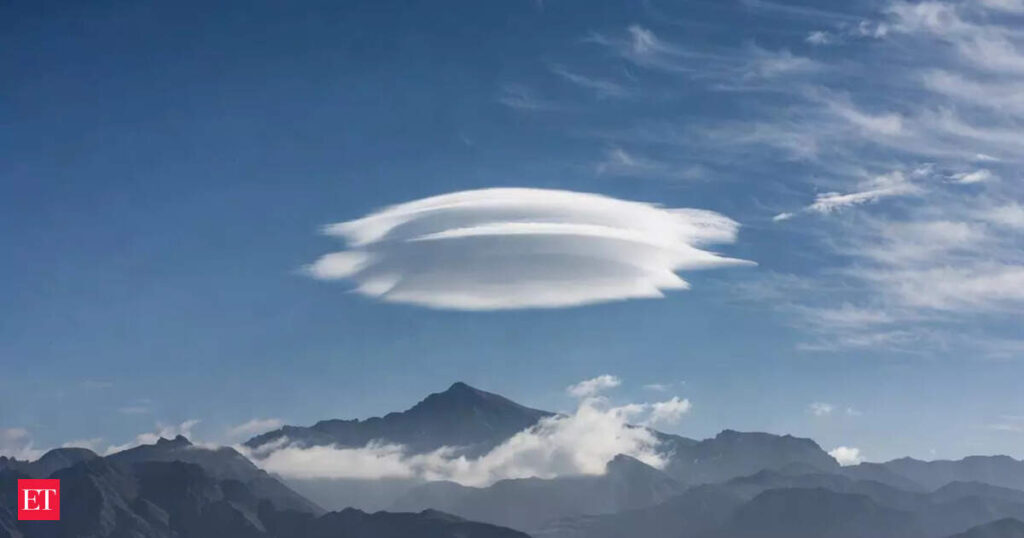
Smooth, lens-shaped clouds that appear to hover motionless in the sky have triggered UFO reports for decades, but atmospheric scientists have a very grounded explanation. These formations are called lenticular clouds, and despite their unusual appearance, they are among the best-understood cloud types in meteorology.
Lenticular clouds are real, stable, and entirely natural. They form under specific atmospheric conditions that shape them into structures so symmetrical and sharply defined that they often look artificial to the human eye.
What Lenticular Clouds Actually AreLenticular clouds belong to the altocumulus family and are formally classified as Altocumulus lenticularis. They are composed of tiny water droplets or ice crystals, depending on altitude and temperature. What makes them stand out is not their composition, but the way airflow organises them.
Unlike most clouds, lenticular clouds do not drift across the sky in obvious ways. They appear stationary even when strong winds are present, which enhances their uncanny hovering appearance.
 Live Events
The Hidden Role of Mountains and AirflowThe key to lenticular cloud formation is mountain waves, a phenomenon created when stable air flows over a mountain range or steep terrain. As wind pushes air upward over the obstacle, the air begins to oscillate on the downwind side, much like water flowing over a rock in a stream.
These oscillations create standing waves in the atmosphere. At the crests of those waves, air cools and condenses into clouds. At the troughs, it warms and evaporates again. The result is a cloud that continually forms in the same place while air passes through it, creating the illusion that the cloud itself is stationary. Meteorologist David Schultz has described lenticular clouds as “clouds made visible by invisible waves in the atmosphere,” emphasising that the cloud marks airflow rather than floating freely within it.Why the Shape Is So Smooth and SymmetricalLenticular clouds form in layers of stable air, meaning the atmosphere resists vertical mixing. This stability prevents turbulence from shredding the cloud’s edges, allowing it to maintain clean, rounded outlines.
As moist air rises smoothly and evenly within a mountain wave, condensation occurs at nearly the same altitude across a wide area. This uniform process produces the classic lens or saucer shape that looks almost engineered. Multiple stacked lenticular clouds can form when several wave crests align vertically, creating a layered structure that appears even more deliberate and otherworldly.
Why They Often Appear Near MountainsLenticular clouds are most commonly seen near major mountain ranges, including the Rockies, Andes, Alps, and Himalayas. However, mountains are not strictly required. Any sharp topographic feature or strong atmospheric disturbance can generate the required wave patterns.
Pilots are particularly familiar with lenticular clouds because they indicate strong winds and nearby turbulence. In aviation meteorology, these clouds are treated as warning signs rather than curiosities.
Why They Stay in Place While Winds Are StrongOne of the most counterintuitive features of lenticular clouds is their apparent stillness during high winds. The cloud remains fixed because new droplets continuously form at the wave crest as older droplets evaporate downstream.
From the ground, this cycle looks like a single stationary object. In reality, the cloud is constantly rebuilding itself, second by second, as air flows through it at high speed. This behaviour is well documented in time-lapse photography, which reveals rapid internal motion hidden beneath a calm exterior.
Why Humans Mistake Them for UFOsLenticular clouds challenge several expectations humans have about clouds. They are symmetrical when most clouds are irregular. They are stationary when most clouds drift. They have sharp edges when most clouds fade gradually.
Psychologists who study perception note that the human brain associates symmetry, stillness, and clean boundaries with artificial objects. When these traits appear in the sky, the brain instinctively searches for a technological explanation. This cognitive bias explains why lenticular clouds have been reported as unidentified flying objects long before modern aviation existed.
What Lenticular Clouds Reveal About the AtmosphereFar from being anomalies, lenticular clouds are valuable scientific indicators. They reveal the presence of strong winds at altitude, stable atmospheric layers, and powerful vertical air motions that are otherwise invisible.
Climate scientists and meteorologists use them to study airflow patterns, turbulence risks, and energy transfer within the atmosphere. In this way, lenticular clouds act as natural tracers, briefly outlining the structure of moving air.
A Familiar Sky, Made Strange by PhysicsLenticular clouds remind us that the atmosphere is full of hidden motion and structure. What appears to be a hovering object is, in fact, a precise balance of temperature, pressure, moisture, and wind, briefly exposed to view.
They are not signs of visitors from elsewhere. They are signs of physics at work, shaping air into forms so precise that they momentarily break our expectations of what clouds are supposed to look like.