
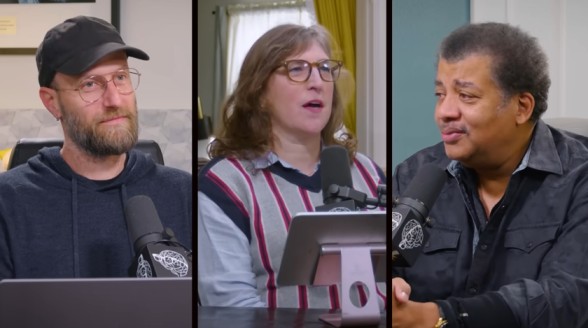
And so it was very helpful. You know, I would, I would later host Cosmos, which gave me a little more facetime to a camera and even script time. How to read a script as though it’s just coming out of you fresh that you take that for granted. But oh, my gosh, to do that, right?
And so they wanted to, for Cosmos, you didn’t ask this, but I’m going there. They wanted to get me a voice coach. And I said, voice coach? I know how to speak. What do you mean voice? You know, welcome to the universe. What do you mean, voice coach? These are people who teach you accents, you know, on the screen. I don’t need a voice coach.
MAYIM BIALIK: What did they want?
NEIL DEGRASSE TYSON: So they brought in the voice coach and it was like one of the most amazing moments I’ve ever had.
MAYIM BIALIK: What did they do? Well, did you used to speak with an Irish accent?
NEIL DEGRASSE TYSON: They made me what I am today. No, no, no. It was, it was how to read a script. And here was the transition moment for me. I walked through a portal, through a proscenium. It was, here is a list of planets in order from the sun. Okay, here it is on script. Okay, give it to me. And so I say, okay, Mercury, Venus, Earth, Mars, Jupiter, Saturn, Uranus, Neptune, and Pluto at the time. Okay. We’re still kind of considering it. All right, now how would you say that if you were not reading it? Okay. Even though it’s still there.
MAYIM BIALIK: Yeah.
NEIL DEGRASSE TYSON: And I, so here’s how I would now do it. I would say Mercury, Venus, Earth, Mars, Jupiter, Saturn, Uranus, Neptune, and Pluto. Now, that’s way more sort of off the top of your head. And that bit completely transformed me in my ability to read scripts against something you would take for granted because you did it professionally.
MAYIM BIALIK: This episode is behind the Actor’s studio with Neil deGrasse Tyson.
NEIL DEGRASSE TYSON: Exactly. How to turn Neil into a slightly better cameo actor than he was.
MAYIM BIALIK: You do have a very melodious voice. Like, you do have a very beautiful voice.
NEIL DEGRASSE TYSON: I don’t hear myself, you know, when I’m out in the world and I wear a hat. And the COVID mask helps greatly tamp down the recognition.
MAYIM BIALIK: There’s no more Covid, or is that what you’re here to tell us?
NEIL DEGRASSE TYSON: No, but I do that, and it tamps down the recognition factor.
MAYIM BIALIK: But your voice is…
NEIL DEGRASSE TYSON: So then I speak, and then people just turn around, and then. So I have to, like, do that and not speak if I want to go totally incognito.
MAYIM BIALIK: You don’t recognize me from my voice. I think if you have any unusual voice, that’s not, you know, kind of the timber of most people.
JONATHAN COHEN: Now do the planets method style. Like, they’re all about to go in different directions, and the universe is ending.
NEIL DEGRASSE TYSON: Oh, wow. Mercury, Venus, Earth, Mars, Jupiter, Saturn. I need my motivation. Thank you.
JONATHAN COHEN: That coach really did work.
The Second Big Bang Theory Appearance
NEIL DEGRASSE TYSON: So the second time…
MAYIM BIALIK: I was just going to say the second…
NEIL DEGRASSE TYSON: Time was in the final season.
MAYIM BIALIK: And, yeah, everyone remembers that.
NEIL DEGRASSE TYSON: Yeah, yeah. That’s when you got your Nobel Prize.
MAYIM BIALIK: Oh, right.
NEIL DEGRASSE TYSON: What do you mean? Oh, just an afterthought.
MAYIM BIALIK: I…
NEIL DEGRASSE TYSON: Okay.
MAYIM BIALIK: I was not on drugs.
NEIL DEGRASSE TYSON: Okay.
MAYIM BIALIK: I just don’t hold…
NEIL DEGRASSE TYSON: I remember whether or not you do. Okay. So I, so that explains why I’ll come up to actors where they had some really impactful line that they gathered in a movie, and I’ll just recite it back to them, and they’ll look at me like, what? What are you going to say? And so I had to come to realize that when you perform, it’s a performance in the moment and you keep moving on.
MAYIM BIALIK: Correct.
NEIL DEGRASSE TYSON: It doesn’t sit with you the way it might sit with the people who you touched with your handiwork.
MAYIM BIALIK: Right.
NEIL DEGRASSE TYSON: So, and that one, it was a fun, a fun storyline where Raj was asked by the local news to comment on a comet that was coming through. There was some astronomical event, and he thought he’d be cute and say, oh, was Neil deGrasse Tyson not available? Right. And the host of the music anchor just ignored that and then continued with the question.
So that freaks him out. Said, maybe I was not the first choice. And then he starts making fun of me professionally and socially. And then you have, who among you were watching this on television saying, Raj, pull up, pull up. Raj, Raj. And so then I catch wind of this. And then they script me in a conversation with him from my office. They rebuilt my office. They took some pictures of my office and remade everything.
And so I’m there and I call him up and he’s in a car and I say, Raj, this is Neil deGrasse Tyson. Oh, oh, oh, what about this Twitter dust up that we’re in? Because it happened over, that’s right, over social media. And I say, I’m going to be at the, what’s the bookstore in Pasadena? There’s a bookstore there? No, I’m going to be at Vroman’s. Come there and tell that to my face. And he says, oh, no, I’m busy, I can’t make it, I’m sorry.
So it was a very tense kind of thing. But the funnest script line, which was invented in the moment, not by me, I can’t take credit for this, was I’m going through a list of people who I’m calling out for their conduct on social media. And then so we hang up. And I said, that was satisfying. Now who else needs a deGrasse Whoopin?
MAYIM BIALIK: That’s right, deGrasse Whoopin.
NEIL DEGRASSE TYSON: A deGrasse Whoopin. And then I call Bill Nye, right? And so I said, Bill, this is Neil. We got to talk. And then quickly hangs up. And that’s my only, that was my only presence.
MAYIM BIALIK: You know, I’ve set a few wellness related goals for myself in 2026, like continuing to move my body with taekwondo and really trying to set myself up for a successful, healthy year. Jonathan’s my accountability buddy. We’re working together to keep ourselves motivated and on target. And luckily Cachava helps us actually feel good while sticking to those wellness goals.
Since adding it to our routine, we have noticed a steady, all day kind of energy. The kind that gets you through a morning workout without crashing halfway through and still leaves you patient, focused and present for the rest of the day. Our workouts feel stronger and more fueled thanks to the protein and electrolytes. And recovery feels smoother so that sore muscles don’t slow us down.
The fiber, probiotics and enzymes keep our digestion on track. And B vitamins and essential minerals support a healthy metabolism and clear headed focus. I’ve noticed fewer afternoon brain fog moments and more mental stamina for my endless to do lists. Immune supporting nutrients like vitamin C, zinc and probiotics make us more resilient.
And I love blending my cachava with frozen fruit, whatever nut milk that I’ve got on hand and a little peanut butter for extra staying power and I feel fueled instead of sluggish or hungry an hour later. Cachava is one of those rare, rare finds that actually does it all. It’s an all in one nutrition shake made with seriously high quality ingredients. No fillers, no artificial flavors, just clean plant based fuel with no GMOs, no soy, no animal products, no gluten and no preservatives but somehow it still tastes amazing.
I love the coconut acai flavor and you will too. Just two scoops gives you 25 grams of plant based protein, 6 grams of fiber plus greens, adaptogens and all the good stuff that your body actually craves. Stick with your wellness goals. Go to kachava.com use code breakdown for 15% off that’s Kachava K A C-H-A V A.com code breakdown.
JONATHAN COHEN: Mind Bialik’s Breakdown is supported by IQ Bar, our exclusive snack, hydration and coffee sponsor.
MAYIM BIALIK: IQ Bar protein bars, IQ Mix hydration mixes, IQ Joe mushroom coffees are the delicious, low sugar, brain and body fuel you need to win your day. The new year means a clean slate. Time to transform frustration into fuel. Power your day with IQ Bar.
The Ultimate Sampler Pack is a great way to try all the IQ Bar products and flavors. You get nine IQ Bars, eight IQ Mix Sticks and four IQ Joe Sticks. All IQ Bar products are clean label certified entirely free of gluten, dairy, soy, GMOs and artificial ingredients. Jonathan’s face lights up when he starts to talk about IQ Bars and today is no exception.
JONATHAN COHEN: I’m actually in a bad way right now because I have run out of IQ Bars and I have failed to stock them appropriately. I keep going to the kitchen looking for a snack and they are not there. I’m telling you, these are my go to.
MAYIM BIALIK: These are Jonathan’s go to. Right now IQ Bar is offering our special podcast listeners 20% off all IQ Bar products including the ultimate sampler pack plus free shipping to get your 20% off. Text breakdown to 64,000. Text breakdown to 64,000, that’s breakdown to 64,000. Message and data rates may apply. See Terms for details.
Representing Geeks on Television
What was it like to see the evolution of a TV show that was essentially about the kind of people who dig Neil deGrasse Tyson?
NEIL DEGRASSE TYSON: I was delighted that my people have representation in the acting world. And I was, you know, how many cop dramas can you show? How many emergency room shows? How many of these is worth one geek show? And I think Chuck and Bill, Bill Prady, they saw that there was low hanging fruit that probably would have been rejected in a dozen of other idea proposals to the gatekeepers of what gets aired and what doesn’t and say, here it is, there’ll be scientists and no one will know what they’re talking about and there’ll be jokes and everyone will laugh. It’s like, right, okay.
And I’m so glad that it wasn’t just a mildly successful show. It was one of the most successful shows ever. And, you know, Gilligan’s Island went three seasons. Shall I remind us of this? The original Star Trek went three seasons. And if you look at some of the episodes in that third season, you were reminded why it only went three seasons and you guys went eight, nine seasons.
MAYIM BIALIK: No, we went 12.
NEIL DEGRASSE TYSON: 12, was it?
MAYIM BIALIK: We would say we were like, we got graduation rings at the end. Like we were like 12th graders.
NEIL DEGRASSE TYSON: 12th graders. So just congratulations. I haven’t seen you since then.
MAYIM BIALIK: Well, I mean, I was just happy to be along for the ride, but, you know, having you on and Stephen Hawking, I mean, we had some incredible people on. William Shatner as well. William Shatner and Kareem Abdul Jabbar. My gosh, that’s right. I mean, we also, we had most of the Star Trek world, which is like a Bill Prady thing.
NEIL DEGRASSE TYSON: One last thing, if I may. Just because as I’m fanboying on the show, that show took turns that for any other show might have been jumping the shark. You know, there is your main character interested in a woman who’s out of his league and there’s a tension there.
MAYIM BIALIK: I don’t have to talk about me like that. I’m right here. Oh, you’re talking about Penny. I get it.
NEIL DEGRASSE TYSON: And so there’s sexual tension there, there’s awkwardness and that propels scripting.
MAYIM BIALIK: Sure.
NEIL DEGRASSE TYSON: You’re going to consummate that and have them get married. You don’t do that in a sitcom. But they did. You guys did it and everybody ended up married. And it was so, that, I think, was heroic to get that to work in a sitcom and not have it pull you back.
MAYIM BIALIK: Yeah. I mean, I remember when I joined, you know, people were very, very protective over the Sheldon character in particular. And a lot of people felt like he shouldn’t have a girlfriend. Like it’s going to draw away. But I think the writers found a really nice way to tie it in.
NEIL DEGRASSE TYSON: I hope the chance of jumping the shark by doing that.
MAYIM BIALIK: Yeah.
NEIL DEGRASSE TYSON: And you told me, you probably won’t remember this, you told me your instructions how to act. Your role was to be a girl Sheldon.
MAYIM BIALIK: Instead of a boy Sheldon Cooper.
NEIL DEGRASSE TYSON: That’s right. Yeah. Then you become, then you’re not interfering with him. You are supporting him in that way. And that worked brilliantly.
MAYIM BIALIK: Now I have to be a female Neil deGrasse Tyson today.
NEIL DEGRASSE TYSON: Well, give me some of your voice.
MAYIM BIALIK: Mars.
NEIL DEGRASSE TYSON: No, no, Mars.
MAYIM BIALIK: I would pronounce it Uranus also because I am a third grade Uranus.
NEIL DEGRASSE TYSON: If you’re third grade, yes.
JONATHAN COHEN: That’s the one question to wrap this segment, which is out of the scientists and colleagues that you have now, who do you want to call and give the business to?
MAYIM BIALIK: Who needs a deGrasse weapon?
NEIL DEGRASSE TYSON: No, I would not. I don’t run around thinking that way. I’ll do it for a scripted sitcom.
JONATHAN COHEN: You don’t have to publicly share it.
NEIL DEGRASSE TYSON: But there’s got to be, no point. I’ll tell you secretly now, but don’t tell anybody.
Bringing the Universe Down to Earth
MAYIM BIALIK: Well, maybe we’ll get to it in all of the questions that we have. So in the time that we have with you, you know, obviously, you do this, you speak, you educate, you…
NEIL DEGRASSE TYSON: I try to bring the universe down to earth.
MAYIM BIALIK: Correct. You try to bring the universe down to Earth. And what we wanted to do is, you know, we’ve talked a lot, especially in the last year or so, about this intersection and spirituality. What are some of the things that are fantastical? What’s the science behind them? So we’re just going to go through some topics and see what strikes your fancy.
NEIL DEGRASSE TYSON: Bring it on.
MAYIM BIALIK: Sound good?
JONATHAN COHEN: Beautiful.
NEIL DEGRASSE TYSON: Bring it on.
MAYIM BIALIK: And there’s obviously, I’m going to preface that.
NEIL DEGRASSE TYSON: Not 10, 15 years ago, I would enter a conversation about spirituality or religion in a kind of a distance, discounted way. And then I had to mature out of that. And what I mean by that is I’m an educator, and people come to me with sincere, honest thoughts, questions, concerns about their lives, how they were raised, what they care about, what they value.
And I realized I owed them a more nuanced, more thoughtful reply than just, is there evidence for it? Just chuck it.
MAYIM BIALIK: Sure.
NEIL DEGRASSE TYSON: So I then spent quite a bit of time reading, is literature the right word? No. Reading tracts, religious tracts all around the world, you know, Hindu, you know, I have a copy of the Torah at home, for example.
MAYIM BIALIK: It’s very popular.
NEIL DEGRASSE TYSON: I have every pamphlet that was left at my door by the Jehovah’s Witnesses. We also do something slightly different, you know, so I have a shelf of that. And so I just, I have Joseph Smith’s account for the Mormons. And so that way when someone comes to me, I have some sensitivity to their wiring.
Science, Religion, and the Big Questions
MAYIM BIALIK: We weren’t going to start here, but since you kind of opened the door to that, I’d love this as a framework because one of the things that I’m interested in is how much different traditions, and I include academic traditions in that, how much our function as humans on this planet is to try and figure out where we came from, why we’re here and where we’re going.
And to me, science is another religion of sorts, right? It’s a set of beliefs, it’s a set of theories, it’s a set of ways to think and approach things. So many of the religious traditions are trying to figure out the answers to these things. Some have some scientific merit. What is your general perspective, right, on trying to frame those three questions? Where did we come from? Why are we here and where are we going?
NEIL DEGRASSE TYSON: Before the methods and tools of science were available to us, the whole world was a mystery. You know, why is there a storm? Oh, Poseidon has risen up. There’s a lightning bolt that struck. You know, even go back to the early 19th century, even when Ben Franklin is learning about lightning and how it operates and what attracts it, and he invents the lightning rod, and now you put that on your building and it protects you from getting destroyed.
But before then, churches would get hit by lightning bolts. And if it was your church and not my church, ah, there it was, you preaching the wrong gospel. There God let you know. And so divinity of all stripes, be it monotheistic or polytheistic, was the account that people conjured to explain that which they had no control over.
Science rises up and one by one, these are put in the record books. No one is blaming Poseidon or, who’s the Roman version of that? Neptune. No one is blamed with the trident. So that has been the trend, and that trend continues to this day.
And so I have been quoted occasionally, accurately with the following statement. If to you, God is where science has yet to tread, because I would say, you know, we have all evidence points to the big bang. Someone would ask, well, what was around before the big bang? I said, I don’t know. Got top people working.
Something had to be there. Was it God? The urge to put God or some divine power in a place where science has yet to tread is huge. And it’s been, we’ve been at, people have been doing that for thousands of years.
MAYIM BIALIK: Literally.
The God of the Gaps and Scientific Humility
NEIL DEGRASSE TYSON: Yeah. Yes. Okay. Newton did it, Ptolemy did it. I’ll give you. Let’s go back to AD 150, Ptolemy. He pioneered the geocentric understanding of the world. Earth in the middle. Everybody’s going around Earth. You had to put planets on epicycles because planets occasionally go to the left and then they slow down, stop, and then they go to the right again. They invented a word for that. They called it retrograde.
All right, so how do you explain all of that? You have these epicycles. So there you are. You know what he said in the margin of his greatest work where he lays all this out? He hand wrote, “I know that we are mortal by nature and ephemeral, but when I trace at my pleasure the windings to and fro of the heavenly bodies, I no longer touch earth with my feet. I stand in the presence of Zeus himself and take my fill of ambrosia.” He’s feeling it.
Okay, now that was obviously not the Judeo Christian God. That was the Greek God. He was a Greek polymath. But that’s him appealing to divine influence on something he doesn’t really yet understand. And even Isaac Newton would do this. So this doesn’t escape the most brilliant minds there ever was. And it continues basically to this day, but it manifests slightly differently today.
Now people go around. So the philosophers call this the God of the gaps. Okay? And so my reply to that was, if to you God is where science has yet to tread, then God is an ever receding pocket of scientific ignorance. And because that’s an if statement, it’s just sort of fundamentally true. Because it’s an if statement. What people have done, especially the atheist community, which is trying hard to fully claim me, but I keep some distance.
MAYIM BIALIK: They’re very like religious fanatics sometimes.
NEIL DEGRASSE TYSON: They’ll try to grab anything I say. What they did was. They left off the first part of that quote. And they have their T-shirts, they have it say, “God is an ever receding pocket of sight. Neil DeGrasse Tyson.” Yes, those words came out of my mouth, but it followed an if statement that matters. I’m not just declaring what God is. No, I’m saying if God to you is this, then this has to follow.
So I don’t see science as equivalent to other attempts to understand the world because it does not appeal to a divinity, to any divine forces, whereas basically every other religion does. So that distinguishes it, I think, from the rest.
Now fast forward to modern times. You know what happens? People go see the pyramids and how did they do it? I don’t know. The aliens must have helped. Okay, so you just watch how often aliens show up in people’s accounts. So I said, maybe we’re entering an era of aliens of the gaps. But that doesn’t have the alliteration. So I invented a new phrase, aliens of our ignorance.
So you have people today who there’s something we. Lights in the sky, moving. I don’t know what it is. Must be aliens. So aliens are supplanting the role that God had played in our ignorance in modern times. But science pushes on.
Theory vs. Hypothesis
And yes, there are theories. The word theory has been misused. I don’t want to blame people because. But let me officially say what a theory is, okay? You can’t run around and say, I have a theory, that whatever. No, you have a hypothesis. Einstein had a theory. You have a hypothesis.
If you have an idea that’s not tested, it’s a hypothesis once it’s tested and verified and reverified. And reverified. And it organizes things that happen in the world in a coherent way, makes predictions that you can verify, that’s a theory. There was a day when we called them laws, but we’re a little more humble going forward.
MAYIM BIALIK: Darwin’s theory of evolution is one that people.
NEIL DEGRASSE TYSON: Yeah, no, no, it’s fine. We still call it that. People want to think, just because and for understandable reasons, that when you use the word theory, well, we’re still just making stuff up and we don’t know. I’m saying quantum theory has never been shown to be experimentally wrong. But we still call it quantum theory. We call it Einstein’s theory of relativity. We don’t call it Einstein’s law of relativity.
It’s just a 20th century recognition that an idea that may be right in every way tested, there might be tests on the edge of it that show where it fails and that there might be a deeper understanding awaiting us. That’s what’s going on now. That’s what happened between Isaac Newton and Einstein. Isaac Newton has the laws of motion, laws of gravity, and it’s working. We went to the moon on Newton’s Laws.
And then we find out, wait a minute, if the gravity is really strong or if you’re moving really fast. Newton’s laws don’t work anymore. We’re getting the wrong answer. What’s going on? Einstein says, I got the answer. It’s relativity. And relativity gets you in those extreme places, and it gets the right answer.
What happens if you put low speeds and low gravity into Einstein’s equations? They become Newton’s equations. So it’s not like we’re Newton’s out, Einstein’s in. Newton is embedded within a deeper understanding. And so that’s where theory carries us into the future.
Science and Mystery
MAYIM BIALIK: I wonder, is there a place where science has gone too far in pushing out some of the mystical, some of the inexplicable? Have we gone too far?
NEIL DEGRASSE TYSON: Am I biased when I say science can never go too far? It is conceived and constructed to give we feeble humans a deeper understanding of the world in which we live so that we’re not running away from mysterious. One of the titles of Carl Sagan’s book was “A Demon Haunted World,” subtitled importantly, “Science as a Candle in the Dark.” Without the science, we’re wandering in the dark, running away from ghosts.
And can I tell you what I did with my kids? Should I admit this? I don’t know when they were really little, okay? So my wife has a PhD in mathematical physics, so we have two kids who are being raised with science literate parents. Okay. Nerds. Okay. And, you know, there’s. Do we live in a time when someone will accuse you of being a nerd? Say nerd, and you don’t. You know what my reply is? Thanks for the compliment.
MAYIM BIALIK: Yep.
NEIL DEGRASSE TYSON: That’s all I say. So I wanted that. I didn’t want them to be afraid of ghosts, okay? Because I’m not yet convinced that ghosts are real or have ever been real. So they were really young. And so I said, I’m going to put you in this closet, this dark closet, and close the door, okay? And then, then I’m going to get a monster to try to break into the closet. So of course it’s me. And they know.
MAYIM BIALIK: Parenting by Neil DeGrasse Tyson.
NEIL DEGRASSE TYSON: So I close the closet and I go. And they start laughing and laughing and laughing. And so they’ve never been afraid of turning a corner of the dark or of a haunted house. It takes some of the fun out of haunted houses because you’re just not buying it.
MAYIM BIALIK: You know, I’m scared of everything because my parents got into the closet with me and were like, what if a.
NEIL DEGRASSE TYSON: Monster comes and the monster was still there. So let me get, let me give the other half of that. Yes, there are mysteries today that people enjoy or it gives them a sense of, what do we say? A sense of not knowing everything. And that’s kind of important to some people. They don’t want science to know everything.
What they don’t know is at any given moment, there is no end of science mysteries that are still there, not still there. It’s the next round of science mysteries. It’s not. Are the ghosts in the closet? No. Is it, what is dark matter? What is dark energy? How did we go from organic molecules to self replicating life? Earth seemed to have no trouble doing that. We still don’t know how to do that in the lab. We have top people working on it.
What was around before the Big Bang? Is there a multiverse? Will we ever make a wormhole? These are mysteries, and they’re less grand mysteries that still exist in all the sciences. So my issue here is, yeah, I’m getting rid of some of the magisterial mysteries that you grew up with, but I’m replacing them with others because science has tread there and has come up with answers where we’re moved on to the next question.
JONATHAN COHEN: We are all fascinated with the edges that science is exploring and are along for that ride.
NEIL DEGRASSE TYSON: And the edges are always there. And here’s my favorite comment on that. As the area of our knowledge grows, so too does the perimeter of our ignorance.
MAYIM BIALIK: Say it again.
NEIL DEGRASSE TYSON: As the area of our knowledge grows, so too does the perimeter of our ignorance, because that’s the boundary between what we know and don’t know. So for me, science is like a forever thing.
Challenging Scientific Dogma
JONATHAN COHEN: I love this. And if I give voice to some of the people who have said, wait a second, science is sometimes so dogmatic and so assured of what they know that they have missed the mark. For example, when medical doctors said the mind and body are totally separate and the mind never impacts the body. And now we’re showing more and more that those two things are far from the truth and actually have led medicine quite astray. Then they’re trying to plead to the scientists to sort of stay open and curious and, you know, challenge continually what we know and push those edges.
MAYIM BIALIK: For example, you know, people like Gabor Maté, right, have introduced this notion that we used to think we know why autoimmunity happens. We know why cancer happens, right? We know why diabetes happens.
JONATHAN COHEN: And we know some, we know a good chunk of the story.
MAYIM BIALIK: But the interplay between let’s say stress the environment. Right. And our physiology reveals that there is a much more elaborate combination of things that make up what, as scientists, we try and understand. But there are many elements that are harder to put our finger on. Correct.
NEIL DEGRASSE TYSON: So a couple of things first, and I’ve said this on social media just to put it out there, physics and astrophysics and understanding the universe is way easier than understanding the human mind, body and soul. Okay, so let me just make that clear. The human mind and its interplay with itself and your body. Oh, my gosh.
It’s part of the reason why neuroscience as a field is so young relative to physics and astronomy. They say astronomy is the second oldest profession. So we’ve had the benefit of millennia of brilliant thinkers contributing to physics, astronomy, engineering. You know, the pyramids were built, you know, 5,000 years ago.
So our advances in human. Part of what resisted that was the sanctity of the human body. You don’t just cut open the body just to explore, especially not the human mind. And correct me if I’m wrong, because this is your business. A lot of what we learned about the functioning of the brain came from brain injuries to people. And what was left over after this part of the brain got damaged. So this is not the brain in a petri dish. This is waiting around for a brain injury to see what you’ll learn on the next emergency room visit. So I just want to make that point clear.
Second, there is no end of examples you can give, such as the one just presented, where there’s a prevailing truth, let’s call it, that would later be shown to be false. I will say without hesitation that if you go back to that time and look at the research going on, I guarantee you whatever was the thing that was ultimately shown to be wrong was not experimentally verified. It was. I think this is true. It’s probably true. I did a few things on my own. What do you think? Yeah, it makes sense. Let’s declare it. And so it’s the experimental verification that makes it true. And it’s very hard to experiment on the human body for the reasons I say.
MAYIM BIALIK: And the human mind.
NEIL DEGRASSE TYSON: So that’s why all. And especially the human mind, that’s why your best examples of this are going to come from the field of medicine. Where doctors are in denial that let me operate on this cadaver, let me deliver your baby. And did you wash your hands? No. Why do I have to wash my hands? The doctor’s hands. There’s no research supporting that.
And so it’s kind of a caricature of science to say, oh, and by the way, there’s. Well, Earth was flat, and then it’s not flat. So excuse me, Earth being flat, that knowledge and expectation predated the existence of telescopes. And it predated the tradition of science to test your idea. It was. It kind of looks flat. It’s probably flat. Oh, it looks like. And plus, the Bible doesn’t deny this. We’re in the center of the universe. Everything goes around us.
Our vocabulary still preserves a geocentric universe. I don’t say to you, Mayim, I don’t ask you, what time tomorrow does Earth rotate such that our sight line to the sun appears over the horizon? No, we say, what time does the sunrise. That’s a geocentric vocabulary word. So it’s what the world looks like. What science tells us is the world isn’t always what it looks like, and it isn’t always what it seems.
And so that’s my reply to you, but just to give a shout out to the medical community. You know what our life expectancy was in cavemen? Half of everyone born wasn’t suffering from menopause. That’s another way to say it. Everyone was fertile their whole life.
MAYIM BIALIK: We did our best work before 20.
NEIL DEGRASSE TYSON: So half of everyone born was dead by the age of 30. Half. Caveman says 10,000, 20,000 years ago. Fast forward to 1850, 1840. Half of in the world was dead before they turned 35. And everyone in that time was eating organic and the water ran pure.
MAYIM BIALIK: That’s not fair.
NEIL DEGRASSE TYSON: It’s true. That is true. Does not have to be fair. They all ate organic. And so what happens in the late 1800s?
MAYIM BIALIK: Didn’t know to wash their hands before a doctor put his hands inside their body.
NEIL DEGRASSE TYSON: At the second half of the 19th century, germ theory matures. We have Pasteur who develops this. We bring the microscope to our physiological needs, and between 1840 and today, we have doubled your life expectancy.
So with all of your comments. Well, the mind actually is affecting the body. And the doctors were clueless. They had their head up their ass. Whatever else was happening. That increase in life expectancy is not because of how people are eating. It’s because of medicine. It is because of science.
And my path into this description came from a New Yorker comic by the artist Gregory. I don’t know if it says first or last name, but it says Gregory signs it. There’s two. There are two cavemen sitting across from the fire, and one says to another, you know, they say this, they say, our water runs pure, our game is free game. And everyone is eating healthy, eating organic. But no one lives past 30.
And so science matters here. And it is so fundamentally infused in our lives, it is so easy to take it for granted. That’s my reply.
Oh, one other thing. Yeah, I know it’s kind of related. You didn’t say it, but I’m going to bring it up. There are people who say science will never understand love. For example, that’s if not love, then something else. Put it, put in your favorite thing there. Someone to. Then I go, I say to such a person, is that because you don’t want science to ever understand love?
And I realize they want science to have boundaries. And as a scientist, I don’t see that as a real thing. And I can imagine an experiment where science then fully understands love. I can make one up. For example, we find out that you look at a painting and you feel great affection for it. Not sexual love, but really you love the painting.
MAYIM BIALIK: It’s none of your business what I feel when I look at a painting.
NEIL DEGRASSE TYSON: In English, we don’t distinguish between just loving something because you like it a lot and sensual, romantic love, but. So you look at a painting and then you look at the same painting and you feel the same way. And we do some brain scans in the same part of the brain is being activated in both of you.
And we do this experiment. 100 people. Or if it’s not the same pain, it’s just something that they have affection for. We found the love center of the brain. So now let’s go into your brain. And there’s something that you don’t care. You don’t have any feelings about. And I tickle it while you’re looking at it. And then you talk about it and say, I love this. I never realized it before.
And you do this automatically after I tickle the brain. Once we know the brain center and how we can control it, that’s science understanding love. Now we move on to the next question. That’s an example. Whether that’ll ever happen, I don’t know. But I think it’s a completely plausible.
MAYIM BIALIK: And I think also, I mean, love. It’s a good example. I think that there are absolutely certain components that we can understand. The sort of symphony that creates attraction and connection. Right. Is a combination of a variety of systems. Right.
NEIL DEGRASSE TYSON: Then it’s more than one part of the brain, perhaps. Thank you.
MAYIM BIALIK: We appreciate it. It’s very generous of you as an astrophysicist.
NEIL DEGRASSE TYSON: No, no, I simplified the case. Like, consider a spherical cow.
MAYIM BIALIK: Correct.
NEIL DEGRASSE TYSON: I simplified it to a plausible experiment.
MAYIM BIALIK: Correct.
NEIL DEGRASSE TYSON: Perhaps not yet conducted. Correct. That would answer for me what science would have to say about love.
MAYIM BIALIK: Correct.
NEIL DEGRASSE TYSON: By the way, I’m just delighted to be in your company.
MAYIM BIALIK: Well, we are delighted to have you here.
NEIL DEGRASSE TYSON: Oh, really? We’re here. We’re having a great time. Thank you for having me.
MAYIM BIALIK: Thank you.
NEIL DEGRASSE TYSON: I’m delighted to be in your company too, but a little less so than.
JONATHAN COHEN: I get that all the time.
NEIL DEGRASSE TYSON: O.
Simulation Theory
MAYIM BIALIK: Let’s talk about simulation theory. Oh, sure, I knew of the phrase, but it was not until we had Rizwan Verk on to talk about simulation theory that I really understood what we’re talking about. Meaning I had heard people say, like, we’re living in a simulation. And I was kind of like, I don’t want to talk to you. But once I read the book, I understood the structure of what this conversation is. So I know you’re asked a lot of things that don’t matter and I don’t know where simulation theory falls.
NEIL DEGRASSE TYSON: No, as an educator, I care about what makes people curious. Simulation theories at the top 10 in the list.
MAYIM BIALIK: Okay, great.
NEIL DEGRASSE TYSON: So, God, alien simulation theory, in that order.
MAYIM BIALIK: Those are literally our bedtime stories.
JONATHAN COHEN: Black holes and the multiverse.
NEIL DEGRASSE TYSON: They come later than God. Aliens and simulation theory.
MAYIM BIALIK: Let’s dive into simulation theory.
NEIL DEGRASSE TYSON: Bring it on.
MAYIM BIALIK: I’m curious when you first kind of became aware of this notion of simulation theory. And I’m curious what your take on it is. Does it seem to fit what doesn’t fit? What works for you about it?
NEIL DEGRASSE TYSON: It’s hard to argue against it. So we don’t like it. Nobody likes realizing you’re in a simulation. But when I go through the arguments, it’s hard to argue my. I can give you my best argument against it.
MAYIM BIALIK: Well, I want your best support for it.
NEIL DEGRASSE TYSON: Oh, sure, sure, sure. No, so.
MAYIM BIALIK: And then I want.
NEIL DEGRASSE TYSON: Oh yeah, yeah. It’s. I’m not claiming that I’m in a camp that is cheering on. I’m just as someone who thinks about this, I share with you those thoughts. We have ever growing computing power available to us and we create worlds on our computer for our own amusement.
And let’s take something simply like Mario. Look at some primitive version of the Mario game and there’s Mario walking around and he picks up coins, I think, and he jumps. And you can ask the question, does Mario have free will?
MAYIM BIALIK: Sure.
NEIL DEGRASSE TYSON: Is Mario self aware?
MAYIM BIALIK: Right.
NEIL DEGRASSE TYSON: When you look at the code that makes Mario, it’s pretty clear that Mario doesn’t. Marriage is following lines of instructions. All right, well, that’s limited by our computing power. We can put more and more nuance into that character as computing power continues to grow. And imagine a future of quantum computing where it’s thousands, millions, even billions of times more computing. Call it phenomena computing.
MAYIM BIALIK: Sophistications.
NEIL DEGRASSE TYSON: Yeah, sophistications that can be put into the simulation.
MAYIM BIALIK: And like, can you insert free will into that?
NEIL DEGRASSE TYSON: So you can put so many options. Yeah, that the question about whether your choice is free will doesn’t even matter anymore, because the number of options you had available to you essentially mimic having free will.
MAYIM BIALIK: This is the matrix.
NEIL DEGRASSE TYSON: Okay. Except in the matrix, you’re living in your own mind and your body still exists.
MAYIM BIALIK: So does he knock something over? Right. Because.
NEIL DEGRASSE TYSON: Oh, you mean at the beginning when he’s with the. With the Oracle. Yeah. How would he have known if that. If it was the case? So that. That depends on whether your timeline is already understood.
MAYIM BIALIK: Sure.
NEIL DEGRASSE TYSON: And you just access your timeline. Can you go back in time before it? Right. All right, so now imagine a future where we create a world where Mario believes Mario has free will. Because the options available to Mario at any node. Do I go through the door, up, down, Do I just stay here? Do I bake a cake? Do I order pizza? You know, do I take an Uber?
It’s large enough to be indistinguishable from it’s approaching infinity. And the limit as N goes to infinity. Your choices mimic free will. Now let’s make 8 billion people and create a world. I’m old enough to remember the video game SimCity. I’m a city kid. So you are mayor of the city, and they can vote you out of office if you don’t make them happy in their opinion polls.
And you got to move money. There’s only limited. Do you raise taxes? That way you can improve the schools, but the people won’t vote for you if you raise taxes. This is an entire dynamic, and you get into it and you say, oh, my gosh, I am mayor and I am doing this.
MAYIM BIALIK: I do matter.
NEIL DEGRASSE TYSON: And one feature that I thought was a little contrived, but later on I said, no, it was real. Every now and then, Godzilla walks through your city, and I said, this is stupid. And then I said, no, this is real.
MAYIM BIALIK: It’s Donald Trump.
NEIL DEGRASSE TYSON: And so ask me, why is that real, Neil?
MAYIM BIALIK: Why is it real?
NEIL DEGRASSE TYSON: Because there was September 11th. No, it’s not literally Godzilla, but it’s something nobody ordered.
JONATHAN COHEN: It’s a black swan event.
NEIL DEGRASSE TYSON: Okay? It’s something happens that wreaks havoc on your city, and now you have to solve what just happened. And so I take that that was now 20 years ago when I was playing this game. Today, imagine there are 8 billion people in a world that they think is a real world. And they’re all just have. And then they evolve because they programmed in evolution. Not only biological evolution, but cultural evolution and scientific.
And they invent computers. They invent computers in that world and they get bored and they want to create a game, and so they advance to quantum computing and they.
MAYIM BIALIK: Now you have a fractal.
NEIL DEGRASSE TYSON: So there it goes. And it’s then simulations all the way down. And now close your eyes. Throw a dart. Which universe are you in? The first one that programmed the next one, which is real, or the countless others, and you’re going to land in the countless others.
So I don’t have a good argument against that. I have an argument that softens it, but I don’t have a good argument that will remove that from the table. Can I give you my softening argument?
MAYIM BIALIK: Sure.
NEIL DEGRASSE TYSON: Okay. We do not yet have the computing power to create that world.
MAYIM BIALIK: Sure.
NEIL DEGRASSE TYSON: So we can’t be any of the ones that have already created another world that takes out the entire middle of this cascade. Meaning we are either the first real universe that hasn’t gotten there yet, or we’re the last universe.
MAYIM BIALIK: Right.
NEIL DEGRASSE TYSON: That’s simulated, that has yet to evolve to that state.
JONATHAN COHEN: If you have to pick one, which are you?
NEIL DEGRASSE TYSON: Well, now, that’s 50-50. I want to be real, you know, like Pinocchio. I want to be.
MAYIM BIALIK: There absolutely are people who, and I’m not just talking about sort of like, let’s talk about aliens. I’m not talking about those people who I have a lot of respect for as well. But when we speak to, you know, people who study exoplanets, when we speak to people who study signatures and things like these things?
NEIL DEGRASSE TYSON: Life signatures? Yeah, correct.
MAYIM BIALIK: You know, is there a world literally in which…
NEIL DEGRASSE TYSON: Say it right. In a world.
MAYIM BIALIK: In a world. Is there a world where there is a set of beings that have a tremendous amount more sophistication than we have already?
Are We Smart Enough to Understand the Universe?
NEIL DEGRASSE TYSON: I have no reason to doubt that. In fact, I lose sleep. People say, what questions do you? No, no, I lose sleep. Not on what the next question might be. I lose sleep wondering, are we physiologically, neurologically smart enough to ever actually figure out the universe?
And my best example there is, okay, genetically, our closest genetic relative, the chimpanzee.
MAYIM BIALIK: Yes.
NEIL DEGRASSE TYSON: We’re within one, one and a half percent, identical DNA to a chimpanzee. Now, if you are very human centric, you’ll say, well, what a difference that 1% makes. That 1%. We have philosophy and music and art and the James Webb telescope, and all a chimp can do is stack boxes and reach a banana. Okay. Or they can also choose a stick to extract termites. Okay.
MAYIM BIALIK: They can also survive in the wild and raise babies and do many amazing, important things.
NEIL DEGRASSE TYSON: Okay. But that would be survival, as any animal would have the ability to survive. We’re…
MAYIM BIALIK: They’re very sophisticated.
NEIL DEGRASSE TYSON: We’re taking another level here and talking about intellect.
MAYIM BIALIK: Sorry, I’m partial to primates here. Okay.
NEIL DEGRASSE TYSON: Being one ourselves. Yeah.
MAYIM BIALIK: Okay. I don’t even like you saying intellect. I think it’s…
NEIL DEGRASSE TYSON: No, no, no, no, no. That’s important, right? I have to say intellect because, yes, it’s fun. You asked me a question about beings that would make us… Okay, sure. So I have to go there.
MAYIM BIALIK: Yeah, yeah.
NEIL DEGRASSE TYSON: So what a difference that 1% makes. Look what we have. And look at the chimps. All right. By the way, every animal knows how to survive in the wild. So that is, I’m not going to use that to distinguish.
MAYIM BIALIK: No, but primates are sophisticated besides homo sapiens.
NEIL DEGRASSE TYSON: Okay, but that’s…
MAYIM BIALIK: I’m defending chimpanzees who are going to be like, didn’t give us enough respect. You’re right. We don’t need to talk about it.
NEIL DEGRASSE TYSON: Not even the point.
MAYIM BIALIK: Chimpanzees are awesome.
NEIL DEGRASSE TYSON: I’m not going to, that’s not where I’m even going to land.
MAYIM BIALIK: Yeah, yeah, yeah.
NEIL DEGRASSE TYSON: What I’m saying is if our toddlers can do what that chimp can do, basically not the survival part, but just the task part. All right? And by the way, you can have a conversation with a chimp and say, oh, Bozo, whatever the chimp’s name is, I’m going into town. There are bananas on sale. If they’re ripe, I’ll bring some back. Okay. I assume you want some. What is the chimp here? Blah, blah, blah, blah, blah, bananas, blah, blah, blah. Okay.
I gave it the simplest human sentence that has a place, a time, a destination, and it’s not going to work with a chimp. And no matter how hard you try, I’m asserting this. I don’t think it’s a controversial claim. No matter how hard you try, you will never teach long division to a chimpanzee. Okay?
MAYIM BIALIK: They won’t write the Bible if you just give them a bunch of typewriters.
NEIL DEGRASSE TYSON: There’s enough chimps in it. Yeah, yeah. Okay. Eventually, yes. So let’s ask the question. Imagine a life form, be it on another planet, and who has one and a half percent DNA in that vector beyond us that we have, beyond the chimp, what would we look like to them?
They’re humanologists. So the people who study, they would exhume Stephen Hawking, roll him forward and say this human was slightly smarter than the rest because he can do astrophysics calculations in his head like little alien Timmy from preschool. Timmy. Oh, Mommy. Daddy, I just composed a sonnet and I derived the principles of calculus. Isn’t that cute? Let’s put it with a magnet on the refrigerator door.
So I lose sleep over this prospect where the most brilliant chimp does what our toddlers can do. The most brilliant human would do what us. And that’s only one and a half percent. Make them 5%, 10%. If they were 10%, Earth could be a literal aquarium terrarium that they constructed for their own amusement, and we would be their simulation in their snot. Those kids basement.
JONATHAN COHEN: It goes to the zoo hypothesis.
MAYIM BIALIK: Well, the zoo hypothesis also presumes that whatever is more sophisticated than us. Right? As a lot of astrophysicists that we speak to about these things say, if there are aliens, they’ve been around for a lot. No, but I’m saying I thought I was special.
NEIL DEGRASSE TYSON: Oh, okay. I’ll get over it.
MAYIM BIALIK: Okay, we can get you a plaque.
NEIL DEGRASSE TYSON: You’re my favorite neuroscience. No, you’re my second favorite. I know several neuroscientists.
MAYIM BIALIK: Oh, I’m sure we’re a dime a dozen. No, but what many people say that we have spoken to about this, when, again, trying to speak from sort of a clinical perspective, is that if there are beings that have evolved, they’ve done so a long, long time ago in that they are likely basically AI, or they’re utilizing AI, or they are essentially… I mean, I’m picturing like a room of computers because I was raised in the 80s, right. I’m picturing that’s the level of activity we’re up against.
JONATHAN COHEN: It’s been described that they would have used technology to augment failing body parts or figured out ways to make material body parts longer. Exactly.
NEIL DEGRASSE TYSON: We would, we’re toddlers to them. So our most brilliant… So consider this. If the chimp can’t understand our simplest sentence, it means our most brilliant sentence might not be understandable to this next species because it is too trivial for them to consider having any value to them at all.
And we are so into ourselves that such thinking is anathema to our egos. So I’m all in on smart aliens being out there somewhere, but there’s still the laws of physics that matter. Sure, you can’t get around the universal, quote, “laws of physics.”
The Multiverse and Multiple Realities
MAYIM BIALIK: The next place I’d like you to take us, I want to talk about, I don’t just want to talk about the multiverse in the Marvel sense, which I personally love to talk about it in the Marvel sense. But I want you to walk us through kind of from a quantum perspective. What does it mean to imagine that this reality, right, for lack of a better word, this reality is not the only reality?
NEIL DEGRASSE TYSON: Is it harder to think that way than what must have confronted people in the age of Copernicus, who says, Earth is just a planet, among others? We are not the object of the creation. We orbit this other thing, just like Mars, Venus, Jupiter, Saturn. And how devastating might that have been to you back then to say there’s another reality?
In fact, in the year 1600, we’re now 45 years, 50 years after Copernicus wrote, there’s a monk. He’s monk, so he’s religious. His name is Giordano Bruno, who had read Copernicus, and he said, wait a minute. If Earth is just a planet orbiting the sun, maybe the sun is just a star, just like these stars in the night sky. If that’s the case, then these stars in the night sky would also have planets. If they have planets, they might also have life.
For that he was burned at the stake, upside down, naked, with a block hammered into his mouth, so that even in the afterlife he could not utter such heresies. Oh, now, you know, one of his last words reportedly…
MAYIM BIALIK: I don’t like this story, Mr. Tyson.
NEIL DEGRASSE TYSON: And one of his last words were, “Your God is too small.” If your God is the God of Earth and life on Earth and there’s life elsewhere out there, and he’s just proposing this, your God is too small. That’s badass. When they’re about to, you know, prosecute you and burn you at the stake.
So to say, if to have any trepidation at all about there being other universes, that’s just in a long tradition, the understandings of astrophysics, taking you to the next level of the next level to demote your ego.
Near Death Experiences and Time
MAYIM BIALIK: Great. So I’m going to use an example, please. We speak to a lot of very fascinating individuals who have had clinically cataloged near death experiences. And there are many, many features of these that I would love to ask you about. But in the time that we have, I want to focus in particular on this notion of there being many versions, right, of our lives and the ability to sort of slice through time, right.
That there’s some sort of quantum grid, right. And that we have the ability to, you know, time travel, right, in our experiences. Can you speak a little bit to what that aspect of this adds to a conversation about the multiverse? Is time something that is progressing and that we are experiencing? Are there multiple timelines happening at the same time or is it some sort of loop where you can, as we’ve had people describe as if you can slice through time like it’s a seven layer cake?
NEIL DEGRASSE TYSON: Yeah. So a couple of things. And you started with near death experiences. I just want to make one point about that. There’s some experiments you can do that have never been fulfilled in their expectations. There are people who say they rise up out of their body and they see themselves down there and they’ll either rejoin it or whatever.
MAYIM BIALIK: Well, it’s a very common dissociative experience.
NEIL DEGRASSE TYSON: That’s the word. Thank you. So what you do is you have a truss over your deathbed and you get someone to just write a simple phrase on the top facing upwards like “roses are red.” Something simple that doesn’t require much. The person has an out of body experience, looks down and they say what’s written up on that thing? And if they can tell you what’s there, then you’ve got some good evidence. I mean, these are the kinds of things we should be doing experiments on rather than just taking people’s testimonies about their personal experience.
MAYIM BIALIK: Sure.
NEIL DEGRASSE TYSON: So that’s the role of science in bringing eyewitness testimony to task.
MAYIM BIALIK: Sure. Knowing you don’t always know when someone’s going to have an NDE. That’s the thing.
NEIL DEGRASSE TYSON: Knowing the susceptibility of the human mind to interfere with objective reality in your recounting. So that’s one aspect of this. Yes, the… There’s one story. I’m going to retell this back. I grew up in New York City. There was some guy who had committed some crime and he was running away. He’d shot people. He was running away from the police and the police shot him. Okay. And he fell to the ground.
They rushed him to the hospital and apparently his brother was killed in committing crimes. Okay. So they’re trying to bring him back to life and then he’s in this near death. And he does come back to life and he recovers and he remembers what happened while he was in this near death experience. He saw his brother and his brother said, no, it’s not your time yet. And his brother pushed him back to earth. He saw his brother up in heaven, pushed him back to earth, and then he recovered.
Okay, first of all, why would he think either he or his brother were headed to heaven? That’s my first comment. Okay. They were both criminals. Okay?
MAYIM BIALIK: You don’t know the rules of heaven, Neil deGrasse Tyson.
NEIL DEGRASSE TYSON: I’m just…
MAYIM BIALIK: You don’t know God.
NEIL DEGRASSE TYSON: You’re right. I’m just putting it out there. Okay? That’s my…
MAYIM BIALIK: This is your problem with this story?
NEIL DEGRASSE TYSON: No.
MAYIM BIALIK: Is that they use the word heaven?
NEIL DEGRASSE TYSON: No. No. Okay, so then, plus, there was like bright lights there and everything he’s describing, the operating room table with doctors trying to resuscitate him, pushing down on his chest with bright lights above him. But his brain puts that into heaven and we hear his account. And especially if you’re religious, you want that to be real because there’s so much invested in the reality of that, yet the brain is a fungible place.
So when I just heard that whole explanation, these are doctors pumping on his chest and he’s seeing operating room lights, and that’s what his heaven is. Okay? So with the near death experiences, I want more science experiments to be done than just compiling people’s accounts.
MAYIM BIALIK: The thing that I do think is interesting, and I want you to bring it back to the multiverse also. Next is when you have, you know, thousands of accounts. And I’m not saying this is proof of God, I’m not saying it’s proof of heaven, nothing like that. But when you have thousands of accounts of people independently who are all using very similar imagery, very similar experiences, similar notions.
Of course I have physiological explanations for why you would feel a narrowing. Right. When you’re near death. Right. And you’re having a cardiac event. Right. But there’s something interesting to me about what is in common with these stories and a lot of mystical traditions and a lot of the early physicists who developed quantum theory. Right. Who identified that there is something still outside of the realm of what we are describing that has a certain quality to it. And you know, Bohr, all these men, they had a phenomenal understanding of what we would describe as a mystical quantum dimension.
NEIL DEGRASSE TYSON: Okay, so let me see what I can pick up the pieces of what all that just you put on the table.
MAYIM BIALIK: That’s what my therapist says every week.
NEIL DEGRASSE TYSON: I mean, disentangle the spaghetti.
MAYIM BIALIK: Then you’re going to zip me up and send me back into the world.
The Quantum Realm and the Multiverse
NEIL DEGRASSE TYSON: So when we speak of a quantum realm, it is our realm. We just don’t have immediate access to it because our senses don’t take us there, but our particle accelerators do. And before that, our microscopes and then our particle accelerators and other methods and tools of probing the reality in which we live. And it’s not just the small, but also the large. There’s the scale of the universe. That’s no different in terms of a scientific frontier entering a realm that’s outside of your own than seeing what’s in the small, the small and the large.
So that’s not the same thing as a multiverse. The multiverse is a whole other universe, not different realms within our universe. We experience this other realmness when we visit other cultures where they think and do things as we’ve never done them before. That’s what makes fish out of water stories so compelling in movies that somebody. Their world is different from the world they’re immersed in.
And, you know, I think of a fish who’s only ever known water, and then they’re fished out. And then there’s a hook in their lip and they’re looking around and there’s like. They feel sunlight, like, what the hell is that? Who’s this creature holding me? And then the hook gets undone because they don’t weigh enough to be kept. They get tossed back in the water. And now they have to describe that experience to other fish. You got to believe me. I was taken out of this dimension and I was put in a whole other dimension. And it wasn’t even wet. I didn’t even know what not being wet means. And I felt this fire in the sky, and I don’t even know what fire is. And it’s an alien abduction story being communicated.
MAYIM BIALIK: It’s also a psychedelic or transcendental story you’re telling.
NEIL DEGRASSE TYSON: Sure, except where does that fit in except psychedelic stories? Your brain makes it all up. It’s not. I had an argument with Joe Rogan. Joe Rogan so badly wanted me to take drugs.
MAYIM BIALIK: You shouldn’t feel so special. He wants everybody to take drugs.
NEIL DEGRASSE TYSON: I said to him, the human brain barely works as it is.
MAYIM BIALIK: True.
The Limits of the Human Brain
NEIL DEGRASSE TYSON: Why is it that we have these books called Optical Illusions, Simple Line Drawings? Is it in the page? Is it out of. Is it longer? I don’t know. Simple Drawings are stumping your human mind. Our brain barely works. You now want to stir in chemicals of any kind and assert that you now have a closer awareness of objective reality. I am yet to be convinced of that.
You’ll have an awareness of other things your brain is capable of. But as a scientist that cares about what is objectively true. And objectively true means you can do the experiment. You can do the experiment and we all get the same answer. That’s what objective truth is to me. Your trip that you took in your mind is no less real to you than anything else you’ve experienced. But science is what allows us to disentangle what you experience and think is true from what actually happens and is true.
MAYIM BIALIK: So take away the drugs. Take away the drugs. Yogis, mystics, for thousands of years have placed themselves in a state where we actually know the science behind what’s happening. And there’s phenomenal studies on meditation. Right? What is happening in, in, in. Who’s it? The, the Tibetan monks, You can, you can image them, right? What’s happening when you are able to lower your brain waves right to a theta state and you are accessing theta state? Well, yeah, it’s like, you know, you’re getting to the theta state.
NEIL DEGRASSE TYSON: Have the Greek Alphabet going there. I like my alpha beta state, but I’m not getting the theta.
MAYIM BIALIK: No, but the notion is when you place your nervous system in such a way. Right, correct. Your parasympathetic nerves, right. You are getting your vagus nerve on that. We know this is all like the vagus nerve is touching every organ system and lowering heart rate. It’s doing all these amazing things.
NEIL DEGRASSE TYSON: Love me, the vagus nervous.
MAYIM BIALIK: When you get into this state, there are for thousands of years accounts and even now people who describe with all due respect to Joe Rogan, pretty much the same kind of trippy next level access to a higher consciousness, right. They’re in touch with something bigger than themselves. Many people do experience a notion of love as this universal language which, yes, many people call God. But even in the absence of drugs, this is the chemistry of our brain. This is endogenous. Right? So what is that mystical experience? And what can it tell us about? I mean many people would say there’s a universal consciousness.
NEIL DEGRASSE TYSON: I’ve experienced meditation tell us nothing about the objective reality in which that human being is embedded because it’s all happening inside their head. And now is that a narrow minded statement? Like perhaps, but I have yet to see evidence. So for example, if, if entering that trance, the yogi says the next law of quantum physics is. And they write it down, and then we experiment. Oh, my gosh. Then I would be going into those trances. I would say, show me. Let’s do that. But that has not happened.
MAYIM BIALIK: No. What happens is other things about God and connection and person. Right.
NEIL DEGRASSE TYSON: They enter spiritual realm.
MAYIM BIALIK: Well, and for people who have trauma or people who are experiencing PTSD, it’s very. Apparently it’s helpful.
Understanding the Multiverse
NEIL DEGRASSE TYSON: I’m not denying people their spiritual experiences ever. I will not. I’m not that guy. But the multiverse are actual other universes. And there are different varieties of multiverse. When the general relativity and quantum physics marry, it’s really a shotgun marriage because they don’t know how to behave in the sandbox. Because quantum physics is the science of the small and relativity is the science of the large. And at the Big Bang, the large was small. So does quantum phenomenon affect the entire universe when it would otherwise just be affecting particles? That’s, that’s the fun, interesting frontier that is being explored there.
So the two kinds of multiverse. Well, there’s more, but two basic kinds. One of them is we’re in an expanding universe. We’re in this bubble, this, this, this, this horizon in this space time. There could be likely are other bubbles also expanding within the space time. Okay. But space time is expanding faster than these bubbles will overlap, we think if they overlap, who knows what that would look like. But the pockets of universes expanding within a one contingent space time, all of those universes would have the same laws of physics.
Whereas another kind of. As I’ve come to understand this because I’m not the researcher on the frontier here, I give you the names of three or four trustworthy sources here. So another kind is quantum physics. In that state pumps out an entire new universe. One this way, one that way. And quantum physics has quantum variations in physical properties. And so this one, the charge on the electron, is slightly different in this one, antimatter behaves a little differently. And maybe this universe, there are more planets than this, or maybe there’s no matter in that universe and there’s a more.
So these variations would make it hard to imagine other life that we would have any kind of real relationship with. It’s this other kind of multiverse where people think about, in that universe, I have a goatee and I’m evil, or I married my childhood sweetheart rather than this deadbeat that I didn’t know.
MAYIM BIALIK: We don’t need to get personal.
NEIL DEGRASSE TYSON: So those are actual other realities. And I don’t want to confuse that with whatever might be going on in your head.
MAYIM BIALIK: Correct.
JONATHAN COHEN: Just a button on this. Because some people use the simulation theory to describe an internal filtering that is impacting our external reality, whereby in those meditative states, you’re dropping your filters, you’re dropping some of the early childhood programming and you know how much is objective reality that we are all experiencing and how much is subjective based on the fact that you and I will look at something and no matter how similar we think it is, it will never be similar.
NEIL DEGRASSE TYSON: My understanding of this, and Mayim can confirm or deny it, is that at all times it’s a mixture of the two. No matter what you’ve done with the state of your brain, it is a combination of your senses bringing reality to your mind, your mind receiving it, interpreting it, and giving you an understanding of that reality. And that understanding will not necessarily match the understanding provided by others. And that’s why we needed science in the first place.
JONATHAN COHEN: 100%. And what’s interesting is that when people are meditating like that, the similarity of that experience seems to be universal in some way. That is intriguing.
NEIL DEGRASSE TYSON: You mean Earth wide, not universal. You’re talking to an astrophysicist. Okay. Like Miss Universe was Miss Earth all along. Let’s be clear about that.
JONATHAN COHEN: Fair enough.
NEIL DEGRASSE TYSON: Yeah. So. So I. If meditative states are reproducible to some common experience, that signals to us the common origin of the human mind among us all. I mean, that has interesting biophysiological conclusions you might be able to draw, gaining access to these deeper evolutionary states that we evolved past. But maybe they’re still there, lurking, either for our benefit or for.
MAYIM BIALIK: I mean, I like to think of it more as a parallel evolution. Right.
NEIL DEGRASSE TYSON: Okay.
MAYIM BIALIK: Meaning I don’t think of it as having sort of a beginning, middle end, but.
NEIL DEGRASSE TYSON: Okay, yeah. Oh, no. Oh, let me get back to the time element.
MAYIM BIALIK: Oh, yes.
Time and Storytelling
NEIL DEGRASSE TYSON: Love me some time.
MAYIM BIALIK: Yeah.
NEIL DEGRASSE TYSON: Okay. One of my favorite books. I’m not a big reader of novels. I read mostly non fiction, so maybe there are plenty of other books that would enchant me the way this one did. I just have never read them.
MAYIM BIALIK: Let’s see, what is he going to say?
NEIL DEGRASSE TYSON: No, no, it’s Slaughterhouse Five. Oh, by. Okay, yes, it was. It’s partly. Partly autobiographical. At his time serving in the second World War in Dresden after it had been bombed by the Allied forces. So that’s a backdrop. But my takeaway was he was abducted by aliens. I loved it. And he was put in a zoo in a closed room. But. And that sounds like. I don’t want that. But the aliens gave him access to the timeline of his life. So at any point he could just rejoin his life and live that moment.
MAYIM BIALIK: Shout out to Kurt Vonnegut.
NEIL DEGRASSE TYSON: Yes, yes. Particularly that early people weren’t thinking storytelling in that way. And it was a brilliant mechanism for storytelling rather than jumping back and forth just as a. I thought you were.
MAYIM BIALIK: Going to say the Time Traveler’s Wife, which is also excellent.
NEIL DEGRASSE TYSON: Oh. So, yeah, he could have just did it as a storytelling motif. You know, you go forward and backwards and then you confuse the reader and it’s passed off as brilliant writing. He just made it a literal timeline that you have access to.
Our problem is that we are prisoners of the present, forever transitioning between our inaccessible past and our unknowable future. If we had access to our timeline, that’d be a fun game changer. The real question would be, if you go back in time, can you do an offshoot and change what would have happened in that future? Or do you have to live it exactly the way it happened and then you could just get bored with your life?
MAYIM BIALIK: This is just a fun bonus question. Have you heard of the Akashic Records?
NEIL DEGRASSE TYSON: I might have. It’s ringing a bell, but give me more.
MAYIM BIALIK: I don’t know that I subscribe to it, but there is a notion, and it’s in many mystical traditions by various names. Indian traditions, there’s several traditions for a very, very long time. Hundreds, if not thousands of years.
NEIL DEGRASSE TYSON: India means subcontinent India.
MAYIM BIALIK: South Asia.
NEIL DEGRASSE TYSON: South Asia, yeah.
MAYIM BIALIK: I would never.
NEIL DEGRASSE TYSON: Excuse me.
MAYIM BIALIK: Sorry.
NEIL DEGRASSE TYSON: Excuse me.
MAYIM BIALIK: The notion. And many in communities that you may not intersect with, but many in holistic, alternative, spiritual, mystical yogic circles believe that there is an accessible record of everyone that can be tapped into. It is everything that you have ever done.
NEIL DEGRASSE TYSON: So it’s a communal consciousness.
MAYIM BIALIK: It is literally a collective consciousness. And there’s an elaborate meditation that you go into to access it. And there are people who do readings for other people. You give them your information and they pull out things. I mean, you have more experience with this because you’ve heard more about this than I have.
But it’s just interesting that these are places where I wish we had more information. Right, about what are we actually accessing? And many people don’t need the proof. And they just say, I believe that it exists. And so it does. Those people are not scientists, and God bless them.
The Four Forces of Nature
NEIL DEGRASSE TYSON: Let me pose a challenge for you. There are four forces of nature. Okay?
MAYIM BIALIK: I’m one of them, Neil.
NEIL DEGRASSE TYSON: That would make you be the fifth force of nature. Okay, so almost every part of our life experience unfolds from the electromagnetic force. It’s what holds our molecules together, our thoughts, our interaction with light. Yes, of course, there’s gravity. It holds us on Earth. And there’s the strong nuclear force that keeps our atoms as they are. But we don’t experience atoms so much as we experience molecules. And molecules come together from the electromagnetic force, the charge on the electron. All right?
MAYIM BIALIK: It’s what holds us all together.
NEIL DEGRASSE TYSON: Correct.
MAYIM BIALIK: Literally correct.
NEIL DEGRASSE TYSON: When LIGO, the Laser Interferometer Gravitational Wave Observatory, measured this gravitational wave created by the collision of two black holes in a galaxy long ago.
MAYIM BIALIK: Far away.
NEIL DEGRASSE TYSON: Far, far away. This washed over the experiment, specifically, exquisitely designed to detect a ripple in the fabric of space and time. It had to be so sensitive it could detect a change in the position equal to a hundredth the diameter of an atomic nucleus.
MAYIM BIALIK: It’s not even a number.
NEIL DEGRASSE TYSON: Okay, okay. If you have powers of telepathy, of mind reading of whatever that’s going to show up in that experiment. Because we are monitoring the behavior of all matter, energy that is interacting with other matter and energy. So if we don’t see that, I’m giving very low confidence that you’re actually doing anything interesting.
MAYIM BIALIK: That’s very interesting.
NEIL DEGRASSE TYSON: Let me tell you how sensitive it is. If someone is walking a half a mile down the street, it’ll send a vibration into the Earth that they could detect. So everybody’s on shutdown when they’re doing the experiment. And there’s some things they can’t avoid, like the gurgling of the Earth or the cloud. So they model that and then they subtract it out from the data.
So that’s how precise science is. And earlier on you said science is cocky. They think they understand it. What we do understand, we’re justifiably cocky. But on the frontier where we don’t understand, we better be humble. Otherwise, you’re just an ahole. Okay? And I will tell you, we don’t know. Humbly say we don’t know. Dark matter, dark energy. I can list it for you.
MAYIM BIALIK: Sit down. Be humble.
The Big Five Questions
JONATHAN COHEN: Tell us some of the things that you don’t know that are on the frontier that are baffling.
NEIL DEGRASSE TYSON: Oh, it’s not just what I don’t know, it’s what is not known.
JONATHAN COHEN: Yes.
NEIL DEGRASSE TYSON: If it’s just me, then I’ll just research it and. All right. No, for me, the top, the four biggest questions are, what is dark matter? We can measure it. We don’t know what’s causing it. What is dark energy? We can measure it, we don’t. So it’s real. We didn’t just make this up. It’s a measurement. Dark energy, we don’t know what that is.
Combine those together, it is 95% of what is driving the universe. Everything we know, love about chemistry, biology, physics, engineering, it’s in 4 or 5% of what is happening in the universe. I want to know how we got from organic molecules, which nature makes freely and easily, to self replicating life.
MAYIM BIALIK: It’s the best. It’s the best question.
NEIL DEGRASSE TYSON: I love it.
MAYIM BIALIK: It’s the best.
NEIL DEGRASSE TYSON: I want to know what’s around before the Big Bang. I know, I want to know. I want to know, are humans smart enough to figure out the universe or are we clever enough to just step on the rung in the ladder put there by people that came before us and we slowly ascend the wall? No one person had that brilliance. I can’t invent calculus. I’m not smart enough. But Isaac Newton did. I’m stepping on his shoulders, using the calculus to make another advance.
Maybe we can increment our ways to something that the alien toddler could have just done trivially. So maybe that is how we would figure out the universe. I don’t know. But that’s for me. That’s a big question for me. Those are my big five biggest questions.
Before the Big Bang
MAYIM BIALIK: So I want to ask something about what was before the Big Bang. Because the answer to this, and I am a person who comes from a religious and spiritual tradition where we talk a lot about this and our kabbalistic text delves into things that even the Old Testament does not. And many of them relate to physics and many of them relate to.
NEIL DEGRASSE TYSON: Are you a kabbalist? Is that.
MAYIM BIALIK: I’m not a kabbalist, but I value our text. Yes.
NEIL DEGRASSE TYSON: Wasn’t. Who else? Madonna was a kabbalist, wasn’t she?
MAYIM BIALIK: Madonna studied at a facility that teaches Kabbalah. But in the, in our tradition, it’s not something our.
NEIL DEGRASSE TYSON: Is Jewish tradition, correct?
MAYIM BIALIK: In the Jewish tradition, it’s not something that is studied lightly. It’s an intellectual and kind of specific religious pursuit. But one of the things that is talked about is that what was, plus.
NEIL DEGRASSE TYSON: Being named Madonna kind of disqualifies her.
MAYIM BIALIK: No, it’s fine. We have rules. One of the things that many of us talk about in terms of what came before is what came before is something that we don’t get to quantify and we don’t get to know it. And we don’t get to calculate it. And it doesn’t mean that it didn’t exist and doesn’t mean that we don’t believe in it. But it’s something that is beyond the realms of the understanding we have. That is a scientific approach.
NEIL DEGRASSE TYSON: Yeah, sure.
MAYIM BIALIK: Are you comfortable with that kind of uncertainty in general, as a scientist? Yeah.
NEIL DEGRASSE TYSON: In fact, there’s a poem by the German poet Rainer Maria Rilke wrote a book called “Letters to a Young.”
MAYIM BIALIK: “Letters to a Young.”
NEIL DEGRASSE TYSON: Give me some love there. All right. “Letters to a Young Poet.” And there’s a short poem, and I’m embarrassed that it’s short enough. I should have just memorized it. But I was never that guy, though, who memorized poems. But there’s a line that says, “Be at peace with all that stirs within your heart.”
MAYIM BIALIK: That’s right.
NEIL DEGRASSE TYSON: “Learn to love the questions themselves.” So a scientist on the frontier has to be in that state. Otherwise you will force answers before their time, before you have sufficient data, and you will derail the pure curiosity that is what got you to be a scientist in the first place.
So I’m completely comfortable saying I don’t know what was around before the big bang. And like I said, we have top people working on it. And it’s when you say it’s got to be something, it was God. Okay, but I’m still in the unknown part.
MAYIM BIALIK: That’s not your business. Meaning you’re not in the business of that.
NEIL DEGRASSE TYSON: I’m in the business of figuring out the unknown. And as a result, the unknown does not bring me discomfort. It brings me excitement. I love that it is the unknown that has me jump out of bed each day and say, what’s the next unknown that needs my attention?
Humanity as Pets
JONATHAN COHEN: You mentioned that what does keep you up at night is that potentially there’s a civilization that could be, if they are out there, 1%, 5%.
NEIL DEGRASSE TYSON: Oh, no, no, not specifically. That’s surely the case. What keeps me up at night is, are we smart enough to figure out the universe? Because that affects my profession. Are we just, you know, bounding along, touching the toenail of an elephant with no hope of ever seeing the elephant? And here we are coming up with hypotheses of what the larger truth is, and that’s what keeps me up at night.
Not if there’s smarter aliens. I’m good with that. And if they find us and they want to make us their pet, I’m okay with that, too. No, because the thing about it, how do you treat your pet better than you’re treating the homeless person who you just stepped over to get to your office.
MAYIM BIALIK: It feels kind of judgy, but.
NEIL DEGRASSE TYSON: Am I wrong?
MAYIM BIALIK: I bought a homeless man a meal the other day, but.
NEIL DEGRASSE TYSON: Yes, but you’d invite him into your home and feed him and shower him the way you would take a stray pet. So we treat our pets better than we treat stranger humans who are strangers.
JONATHAN COHEN: The title for this episode is hopefully humanity will become the pets of aliens.
NEIL DEGRASSE TYSON: That’s the best we might be able to hope for. Otherwise it won’t bode well for us.
The End of the Universe
JONATHAN COHEN: Is the universe going to end and should we be concerned that it is slowly imploding?
MAYIM BIALIK: I mean, if it does end, we won’t know about it.
NEIL DEGRASSE TYSON: Well, all of our data, all of our data tell us that we’re on a one way expansion trip and just deal with it. It’s not going to recycle. It was philosophically unsettling. Because if it was a recycling universe that gets rid of the origin question. It’s just always been cycling.
MAYIM BIALIK: It was, is, and always will be.
NEIL DEGRASSE TYSON: Exactly.
MAYIM BIALIK: But Earth, we’re not doing so great with our planet. But she’ll be fine. We won’t.
NEIL DEGRASSE TYSON: Oh, right, right.
MAYIM BIALIK: We’ll kill ourselves off people.
NEIL DEGRASSE TYSON: I hadn’t heard Earth genderized in quite, quite some time, so I had to get through that sentence. Sorry. Yes, she will do just fine. Yeah, Mother Earth. If we’re going to go there. Mother Earth. When people say save Earth, no Earth is going to be here before, during and after anything we do to it. It saved life on Earth and not even save humans save life on Earth.
Our survival depends on the survival of the biosphere in which we’re embedded, which we’re already destroying. Correct?
MAYIM BIALIK: Yeah, that was uplifting.
NEIL DEGRASSE TYSON: Okay, okay. You want me to leave you uplifting note?
JONATHAN COHEN: Let’s get a little hope for the end. What do you want people to take away and implement into their daily lives about all the topics that we talked about, but particularly our place in the universe and having excitement about the unknown?
The Unraveling of Civilization Without Science
NEIL DEGRASSE TYSON: Yes, I’m biased here, but I’m not ashamed of this bias that of anything humans have ever invented. Science may be uniquely capable, uniquely capable of giving us access to our understanding of our place in the universe and secure pathways into our future to assure our health, our wealth and our security.
The extent to which people either are in denial of science or reject it, that will be the unraveling of an informed civilization. And we might as well just turn around and march straight back into the caves because that’s where we’re going to end up without it.
MAYIM BIALIK: Neil deGrasse Tyson. Such an honor to have you here and such a pleasure to talk about all these things and we hope we get more time with you in the future.
JONATHAN COHEN: Your God is too small.
MAYIM BIALIK: My universe is too small. But at least it’s expanding.
JONATHAN COHEN: That was probably one of my favorite stories. Also terrifying.
MAYIM BIALIK: There’s also things that he says that it’s like, it sounds like they’re poems that he’s got. Like, does he rehearse them in front of a mirror?
JONATHAN COHEN: I would like to see inside of his brain how many folds he has, please. They said that Einstein had a lot of folds.
MAYIM BIALIK: You think he’s got a lot of folds?
JONATHAN COHEN: Where is he keeping all that information? Does he not have any song lyrics in there?
MAYIM BIALIK: I don’t think he doesn’t have one song lyric.
JONATHAN COHEN: I don’t know that that’s true.
MAYIM BIALIK: Did anyone notice the pattern on his shirt? It looks like he’s a rock and roller, but I don’t think he’s got any song lyrics in there.
JONATHAN COHEN: You should have seen him walk in. He walked in with his hat and his skulls on his shirt.
MAYIM BIALIK: Yep. He had. He didn’t know that he had skulls on his shirt when he purchased it. So it’s like a little bit of a deep cut. If you’re watching this episode, can you pick up the fact that those are skulls?
JONATHAN COHEN: He’s such a fan of the Big Bang Theory. It’s unbelievable.
MAYIM BIALIK: Well, I think what he said is very true that, you know, that was so special to have a show about this aspect of, you know, culture and our society. You know, I had never seen it when I auditioned for it. And so I remember when I kind of learned about it, I said, oh, these are the kind of people that I go to grad school with. These are all the people that I hang out with on the daily. When you’re in grad school, I feel.
The Mind-Body Connection and Scientific Limitations
JONATHAN COHEN: Like my point about the mind body connection was slightly miss set up. Meaning I wasn’t attacking science. I was just trying to acknowledge that there are places. While the scientific method is our best way at understanding things, there are certain aspects that we cannot study and or that have fallen short.
And when we’ve questioned people, they’re so quick to dismiss any type of questioning in defense of what has been said to be true. And what he said, which I appreciated, is that many of the things that have been said to be true were not tested, but then they’re still defended as this is what the science says. And there’s no reason to disbelieve that.
MAYIM BIALIK: I mean, I think there’s a couple things. Like, truth be told, if I knew you wanted to bring that angle up, I would have presented a more cohesive. We could have talked about Neil Theise, like, I would have. I just, I couldn’t. I couldn’t pick it out of the air.
The Gabor Maté one, I think is significant because, you know, no one would have thought there’s a profile for people who get cancer. Right. Like, it was sacrilege to think something like that. Right. Or to talk about immune properties and how they relate to environmental stressors. You know, he’s not in the realm of talking about intergenerational trauma. Right. It’s not what I would go to.
JONATHAN COHEN: Him for or medicine per se. He’s not correct. He any acknowledges the complexity of trying to study both psychology and physiology.
Intelligence Beyond Human Measurement
MAYIM BIALIK: There’s a couple issues I have with the fact that we are, let’s say, 1% different from chimps. And what would someone 1% more, you know, than us look like? Because that’s assuming that it’s on some sort of, like, linear and like exponential. Like, the scale doesn’t have to be the same. But anyway, I didn’t want to get into that with him, but I understand the point.
And I actually, I thought he’d be like, there’s no aliens. That’s not a thing. And I was pleasantly surprised that what he said was the simulation is kind of stacked like that in fractals. And, you know, Valerie mentioned there’s literally a couple Black Mirror episodes specifically about that.
But also this notion that, yeah, there’s got to be something a lot more intelligent than us to be observing us. And that’s why he doesn’t entertain this notion of, like, they’re visiting us and like laser lights and like abductions. That’s a different conversation.
JONATHAN COHEN: The other thing that I had an issue with was somewhat of an oversimplification of the caveman’s lifespan, because I thought of that too.
MAYIM BIALIK: Because we’re not going to live forever. There’s a ceiling effect to how long we’re going to live.
JONATHAN COHEN: Yes. And or not the idea that it was clean water and everything was organic. I didn’t like that we didn’t have enough access to food. So farming, of course, increased the proliferation of food and increased the fact that we could have access to food regularly.
MAYIM BIALIK: No one knew about nutrition also.
JONATHAN COHEN: We didn’t have shelter. So, like, I think there’s, you know, when we say that science has extended our lifespan. No one is arguing that whatsoever. Of course, medical interventions, the fact that we have sanitation, the fact that we.
MAYIM BIALIK: Have indoor plumbing, wash your hands before you stick them in a body.
JONATHAN COHEN: The fact that we have shelters now that we’re not living in caves.
MAYIM BIALIK: Like, caves can be very protected.
JONATHAN COHEN: There are so many advancements in modern civilization that of course have. So I feel like it’s a mixed metaphor. It’s like, oh, it’s not that, oh, we should eat organic.
MAYIM BIALIK: I agree. I also, and I really don’t know why I’m defending chimpanzees this way.
JONATHAN COHEN: You’re getting really.
MAYIM BIALIK: I got really fired up because the notion that if you put a chimpanzee in a human laboratory and you’re like, do you understand what I’m saying? And the chimpanzee will not. That doesn’t mean they’re not in. It doesn’t mean they don’t have intelligence or capacity. It’s not a measurable intellectual capability.
But chimpanzees are incredibly sophisticated also. They live in very, very elaborate social groups with very, you know, intricate rules that they use tools, they pass down information. I mean, like, it’s a very, very highly evolved, beautiful. Yes, that’s true. They don’t speak.
JONATHAN COHEN: Besides, the people who are on the TV show Naked and Afraid, who get sent out into the wilderness to try and survive.
MAYIM BIALIK: Yes.
JONATHAN COHEN: You know, he says, oh, we can all survive. No, we can’t. If I sent 99% of city dwellers out into the wilderness and said they’d.
MAYIM BIALIK: Be dead in an hour, good luck.
JONATHAN COHEN: You’re not faring so well. That’s been bred out of us. We’ve lost that.
MAYIM BIALIK: Well, but you know that he’s talking about ingenuity. And look, I also don’t think that spoken language is the only measure of intelligence. We know that there are a lot of different kinds of intelligence. We know that. I mean, even Stephen Hawking, the example that he used. Right. Used a computer to communicate, you know, coupled with eye movements and all these, you know.
So I don’t think he was speaking with such, you know, he wasn’t painting with such a broad brush. But just again, I don’t know why I’m defending the chimpanzees, but I am.
The Mystery of Dark Matter and Dark Energy
JONATHAN COHEN: I’m always struck by the dark matter, dark energy conversation.
MAYIM BIALIK: I wish we had more time to get to it with him.
JONATHAN COHEN: Like, the biggest problem in science is that 95% of what makes up our universe is unknown. Is no one else troubled by that?
MAYIM BIALIK: I think it’s a lot more troubling than people let on. I mean, even the fact that when you look at something, you think you’re seeing the thing. I’m going to use this glass. I think when I look at this, like I see a glass. And if you were to ask me to describe this glass, I’d be like, oh, well, it looks like this. And here’s the diameter and oh, there’s this beveling and here’s the color, right? There’s the fluid that’s in it that I can perceive and all these things.
That’s actually. If you pull. If you either pull back or zoom in. And that’s not what this is, right? This is the representation that’s been presented upside down on the back of my eye, on the retina.
JONATHAN COHEN: I don’t even know what you see there. I could be seeing something totally different.
MAYIM BIALIK: We would probably describe this glass similarly.
JONATHAN COHEN: But other words could be used to be different, but you could actually be seeing something fairly.
MAYIM BIALIK: That’s a different point about the limits of human language. But I’m even talking about individual perception. This is an object, right, that is made up of molecules and it’s absorbing everything from the color spectrum except what I’m seeing, right? So if you were to be an alien from another planet, if you were to be an outside observer, that’s. This is actually not what things look like.
This is what our brains compute from the data that we can perceive that is processed by the brain that we have. That’s what we see. That’s why when people talk about that, this is just a projection, right? It’s projected onto a screen. The world is wearing a mask, right? That’s what all this is.
JONATHAN COHEN: You don’t actually exist.
MAYIM BIALIK: None of us exist.
JONATHAN COHEN: You are a figment of my imagination. Sitting in the chair across from me.
MAYIM BIALIK: Does my hair look better than I perceive it?
JONATHAN COHEN: Put here by an alien toddler in his terrarium in the simulation that I was created in.
MAYIM BIALIK: And we’ll tap into the Akashic records to have access to it all seems about right.
JONATHAN COHEN: If you want more of this type of fun, follow us on Substack. Mayim Bialik’s Breakdown on Substack where we release content exploring these topics in depth and answer listeners and community members questions. So come on over and check it out.
MAYIM BIALIK: Out from our breakdown to the one we hope you never have. We’ll see you next time.
Related Posts