
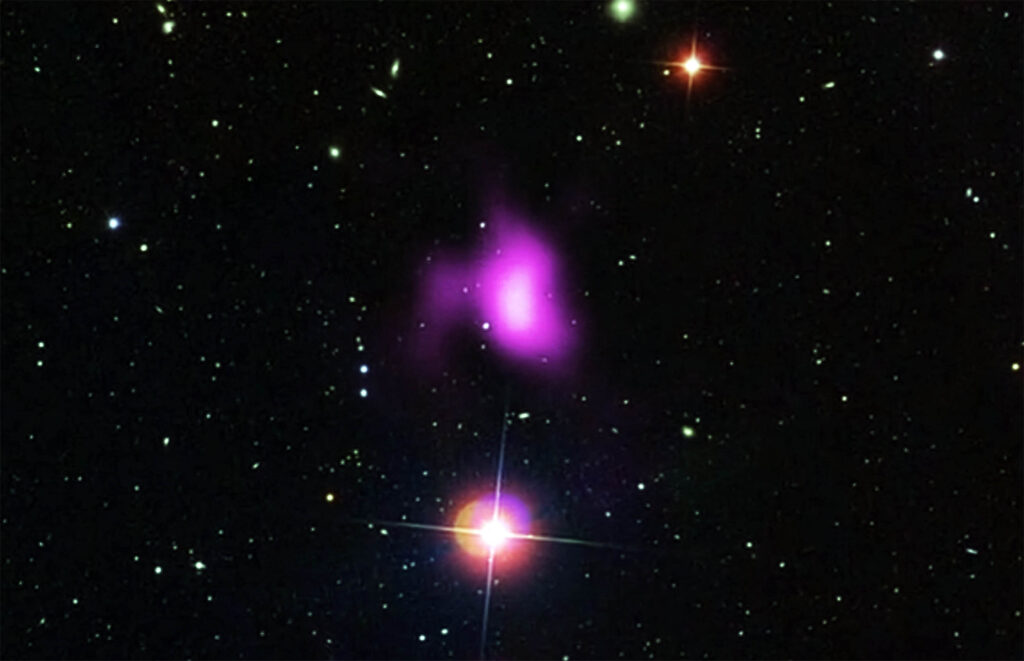
Cloud-9 sits in a universe that rarely stops shining. Telescopes are built to chase that light and record every spark they can find. Yet some of the most important clues about how the universe works come from places that barely register at all.
This object does not glow or glitter. It has no stars and almost no visible light. From a distance, it looks like nothing more than a quiet patch of gas. That absence is exactly what makes it useful.

Cloud-9 offers a rare chance to study what happens when a galaxy never gets the chance to begin.
Cloud-9 holds onto gas without ever forming stars and challenges the idea that light is required to tell a meaningful cosmic story.
The discovery suggests that some of the universe’s earliest building blocks still exist, unchanged, and largely unnoticed.
A galaxy that never showed up
Most galaxies follow a familiar script. Gas gathers, gravity pulls it tighter, stars ignite, and light fills the void. Cloud-9 broke that script early on and never recovered.
What makes Cloud-9 different is not what it has, but what it lacks. Despite holding a large amount of hydrogen gas and sitting inside a massive dark matter halo, it never formed stars.
That makes it a rare survivor from the early universe, a leftover from a time when galaxies were just starting to take shape, now under detailed study.
“This is a tale of a failed galaxy,” said the study’s principal investigator, Alejandro Benitez-Llambay of the Milano-Bicocca University.
“In science, we usually learn more from the failures than from the successes. In this case, seeing no stars is what proves the theory right. It tells us that we have found in the local universe a primordial building block of a galaxy that hasn’t formed.”
A window into dark matter
Cloud-9 belongs to a predicted class of objects called Reionization-Limited H I Clouds (RELHICs). The H I part refers to neutral hydrogen gas. The rest of the name points to its origin. This cloud formed in the early universe and then stalled out.
“This cloud is a window into the dark universe,” said team member Andrew Fox of the Association of Universities for Research in Astronomy/Space Telescope Science Institute.
“We know from theory that most of the mass in the universe is expected to be dark matter, but it’s difficult to detect this dark material because it doesn’t emit light. Cloud-9 gives us a rare look at a dark-matter-dominated cloud.”
Why astronomers were unsure
For years, astronomers debated whether objects like this truly existed. Some thought these faint clouds were just dwarf galaxies hiding their stars too well for Earth-based telescopes to spot.
“Before we used Hubble, you could argue that this is a faint dwarf galaxy that we could not see with ground-based telescopes. They just didn’t go deep enough in sensitivity to uncover stars,” said study lead author Gagandeep Anand of the Space Telescope Science Institute (STScI).
“But with Hubble’s Advanced Camera for Surveys, we’re able to nail down that there’s nothing there.”
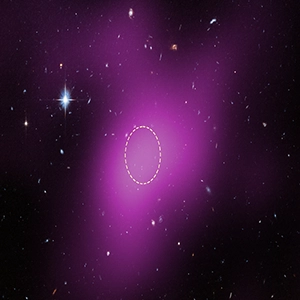 This image shows the location of Cloud-9 dark matter gas cloud, which is 14 million light-years from Earth. The diffuse magenta is radio data from the ground-based Very Large Array (VLA) showing the presence of the cloud. The dashed circle marks the peak of radio emission, which is where researchers focused their search for stars. Credit: Hubble/NASA. Click image to watch a video from NASA.What Cloud-9 is made of
Cloud-9 is small by cosmic standards. Its core spans about 4,900 light-years.
Inside that region sits neutral hydrogen gas with a mass roughly one million times that of the Sun. That gas alone cannot explain how the cloud holds itself together.
The answer lies in dark matter. Based on how the gas behaves and how pressure balances gravity, researchers estimate the surrounding dark matter weighs in at about five billion solar masses. That invisible mass provides the structure, while the gas simply tags along.
This balance explains why Cloud-9 survived at all. If it were heavier, gravity would have crushed the gas until stars formed.
If it were lighter, the gas would have been stripped away or ionized long ago. Instead, it landed in a narrow middle range that allowed it to linger as a quiet relic.
“Among our galactic neighbors, there might be a few abandoned houses out there,” said STScI’s Rachael Beaton.
Discovery of a curious gas cloud
The cloud was first spotted three years ago during a radio survey using the Five-hundred-meter Aperture Spherical Telescope in China.
Radio telescopes can detect hydrogen gas by the signals it emits, even when no stars are present. Follow-up observations with the Green Bank Telescope and the Very Large Array confirmed the gas.
What they could not confirm was the absence of stars. That took Hubble. Only with Hubble’s sharp vision could astronomers rule out even the faintest stellar population.
That final step turned a curious gas cloud into the first confirmed example of a starless, dark matter-dominated relic from early galaxy formation.
Cloud-9 sits near the spiral galaxy Messier 94 and appears physically linked to it. Radio data shows slight distortions in the gas, hinting at interaction between the two.
The cloud was simply named in order, the ninth gas cloud found on the outskirts of that galaxy.
When galaxies remain dark
Cloud-9 shows that studying stars alone leaves out much of the story. Gas and dark matter shape the universe in quieter ways, often hidden behind brighter objects nearby.
These failed galaxies are hard to find, easy to miss, and vulnerable to forces that can strip away their gas.
That rarity makes this discovery important. It suggests more such objects may exist, waiting to be detected by future surveys that look beyond light.
The lack of stars in Cloud-9 gives scientists a clean way to study dark matter clouds without the usual distractions.
Each new find like this adds another piece to the puzzle of how galaxies form, how some never do, and how much of the universe operates in silence.
The study is published in the Astrophysical Journal Letters.
—–
Like what you read? Subscribe to our newsletter for engaging articles, exclusive content, and the latest updates.
Check us out on EarthSnap, a free app brought to you by Eric Ralls and Earth.com.
—–