
The room buzzed with energy as students leaned in to ask their burning questions. They were participants in the moderated dialogue, “Innovating for Tomorrow: A Conversation with The Shaw Laureates 2025,” where the selected secondary students looked beyond textbooks to see the real-world grit behind science.
In this intimate setting, the students received wisdom first-hand from world-renowned scientists: Professor John Richard Bond and Professor George Efstathiou, co-recipients of the Shaw Prize in Astronomy; Professor Wolfgang Baumeister, recipient of the Shaw Prize in Life Science & Medicine; and Professor Kenji Fukaya, recipient of the Shaw Prize in Mathematical Sciences. The scientists offered students a glimpse into the dedication and imagination that drive discovery.
Organised by SCMP Learn and presented by the Shaw Prize Foundation, the event was held in October 2025 at the iconic Shaw Studios.
Talking with Professors John Richard Bond and George Efstathiou opened a gateway to the deep cosmos. For Carissa Ung, the laureates’ differing views proved that success in astronomy lies not in final answers but in the depth of the questions that remain.
Students’ reflections
Beyond Answers: Embracing the Unknown in Astronomy and Life
By Carissa Ung (Heep Yunn School)
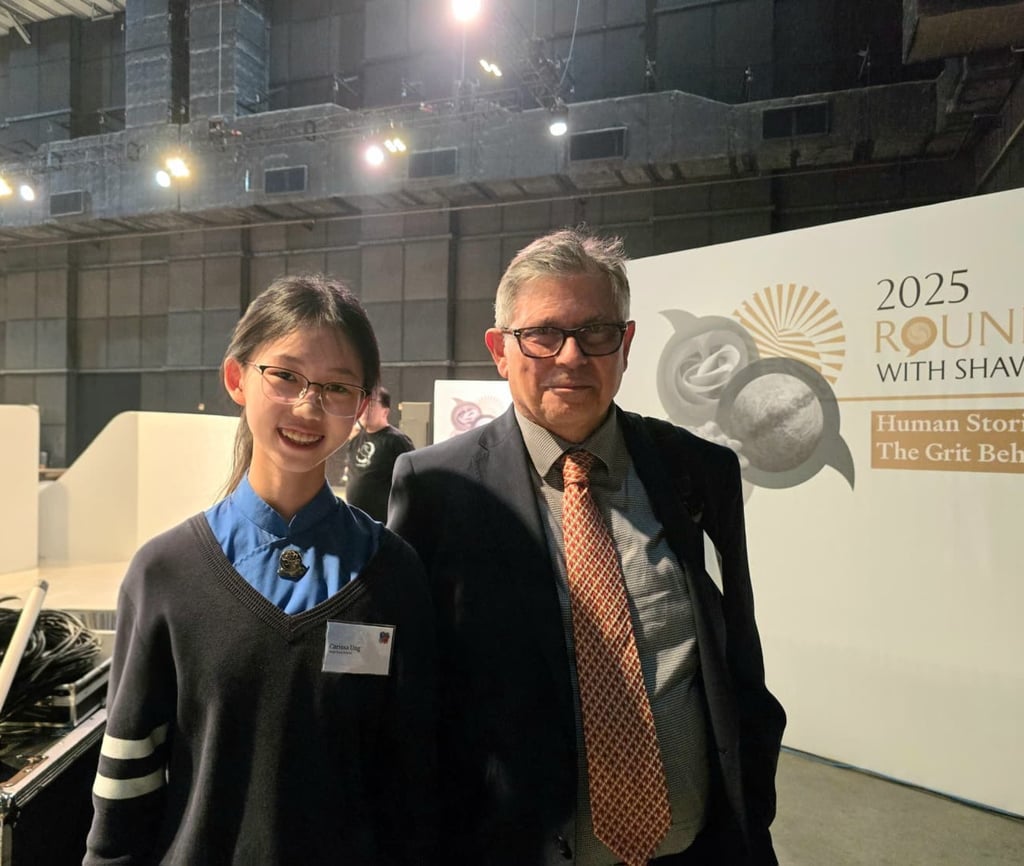 Carissa Ung from Heep Yunn School. Photo: Handout
At its heart, astronomy seeks to explain the universe, yet this very pursuit reveals a deeper commitment to the unknown. This principle was crystallised during my engagement with the 2025 Shaw Laureates, Professor Richard Bond and Professor George Efstathiou. It dismantled my perception of scientific progress as a linear accumulation of discoveries.
While I anticipated the theoretical discourse on the cosmic microwave background, what struck me during the dialogue was the contrast between the two professors’ views on their discoveries. While Professor Bond’s perspective aligned with empirical triumph, Professor Efstathiou revealed something startling: his initial reaction was one of consternation. He felt that their research on the cosmic microwave background had rendered the universe, in a way, excessively simple.
This has completely reframed scientific achievement for me. I had always assumed simplicity was the ultimate goal and the hallmark of a universal truth. But in that moment, I saw that a true scientist isn’t driven by the comfort of solutions, but by the thrill of the hunt, viewing every answer as a first step towards the next problem. This mindset extends far beyond astronomy – we’re often taught to seek finality and to be unsettled by loose ends, but what if we see them as potential?
Thus, this dialogue has reoriented my aspirations and encouraged me to move beyond a single achievement in life. For me, the purest form of intellectual courage is unquestionably the capacity to find motivation not in solutions, but in the elegant depth of the questions that remain.