
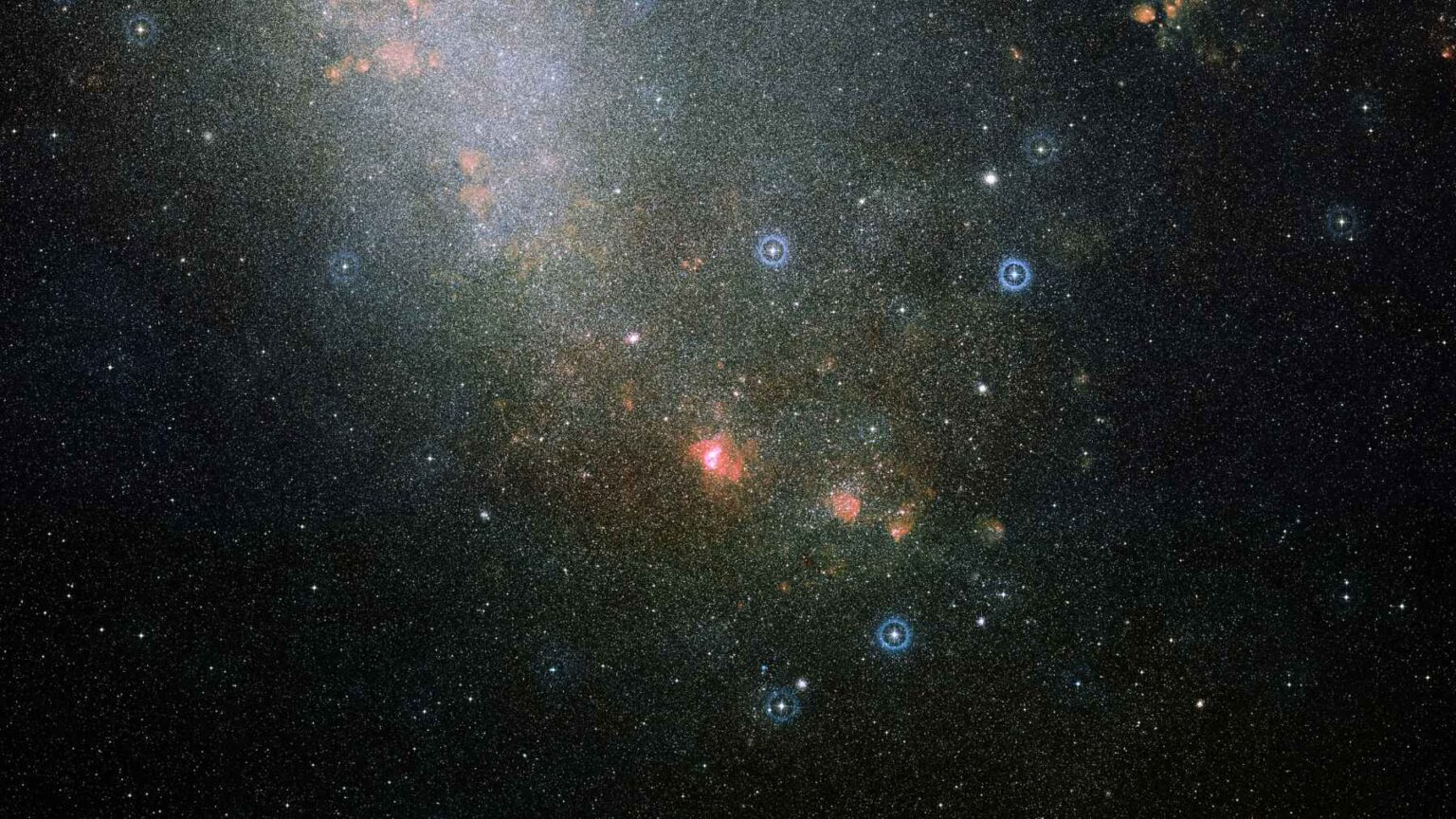
When we picture where stars are born, many of us imagine long, dark threads of gas slowly collapsing under gravity.
New observations from the ALMA telescope show that in a nearby galaxy that mimics the early universe, some stellar nurseries look surprisingly soft and “fluffy” instead. That twist could change how we think about the birthplaces of stars like our Sun over cosmic time.
A team led by astronomer Kazuki Tokuda at Kyushu University, working with colleagues from Osaka Metropolitan University, used ALMA to zoom in on seventeen dense molecular clouds in the Small Magellanic Cloud, a dwarf galaxy about 200,000 light years away that contains only about one-fifth of the heavy elements found in the Milky Way.
In those star-forming regions, roughly 60 percent of the clouds still formed thin, filament-like structures, while about 40 percent had already spread into puffier shapes. The mix hints that as the universe evolved, the very geometry of star forming clouds may have shifted.
A nearby galaxy as a time machine
The Small Magellanic Cloud sits just outside our own galaxy and is one of the Milky Way’s closest neighbors in space. It lies around 200,000 light years from Earth and holds several hundred million stars.
Because its gas contains only about one-fifth as many heavy elements as the Milky Way, it offers a close-up look at conditions similar to those in the universe about ten billion years ago.
Heavy elements in astronomy simply mean any element heavier than helium, such as carbon, oxygen, and iron. These atoms help gas clouds cool by radiating away energy, a bit like metal fins helping a home radiator shed heat. With fewer of them, gas tends to stay warm for longer after it has been compressed or shocked.
Scientists cannot go back in time to watch the first generations of stars switch on, so they search for nearby places where the conditions resemble those ancient days.
For Tokuda and his colleagues, the Small Magellanic Cloud plays the role of a natural time machine. To study it in detail, they used the Atacama Large Millimeter and Submillimeter Array (ALMA) in Chile, an international radio observatory run by partners in Europe, North America, and East Asia together with Chile.
Filamentary clouds and fluffy clouds side by side
In our own galaxy, the gas and dust that form new stars usually gather into long, narrow strands known as filaments. Each filament is roughly a third of a light year wide yet can stretch across several light years and hold enough material to build hundreds of stars.
Parts of these strands break into denser clumps, sometimes called stellar eggs or molecular cloud cores, which eventually collapse into individual stars and planetary systems.
The new study zeroed in on regions of the Small Magellanic Cloud that already host growing giant baby stars more than twenty times the mass of the Sun. Using ALMA’s sharp vision, the team analyzed seventeen such molecular clouds and sorted them by shape.
About 60 percent showed a clear filament pattern, while the remaining 40 percent looked more rounded and diffuse, the “fluffy” clouds that give the research its memorable label.
In the ALMA data, the filamentary clouds were hotter than the fluffy ones. The team links that extra heat to shock waves created when clouds collide, which briefly raise the temperature of the gas. As the gas cools and settles, the sharp spine of the filament seems to soften and spread out, leaving behind a more uniform, cotton-like cloud.
How fewer heavy elements reshape stellar nurseries
In a galaxy rich in heavy elements like the Milky Way, hot gas can radiate away its energy relatively quickly, so shocked clouds cool down to very low temperatures in a short time.
In the Small Magellanic Cloud, with far fewer heavy atoms, cooling takes longer and the hot phase of a cloud can persist. According to the new work, that delay affects how turbulence stirs the gas and how long a filamentary pattern survives.
When the gas is still warm, random motions inside the cloud are relatively gentle, so a narrow filament can stay intact. As the cloud cools, incoming gas carries more punch and generates stronger turbulence, which can blur and eventually erase the filament into a fluffier, more spread out shape.
The researchers suggest that the two classes of clouds they see are snapshots at different stages in this transformation.
An earlier 2023 study of the Large Magellanic Cloud using ALMA had already mapped dense molecular filaments around high-mass baby stars, showing that these structures are common in metal-poor galaxies.
The new Small Magellanic Cloud results add the missing piece by revealing how those filaments can fade into fluffy clouds when heavy elements are even scarcer. In simple terms, the same kind of cloud may behave differently depending on when and where in the universe it lives.
Clues to how suns and planets form
Why should someone worried about their next electric bill care whether a cloud in a distant galaxy is filamentary or fluffy. The answer is that the shape of a cloud influences how many stars it can make and what kinds of planetary systems those stars might host.
If a molecular cloud manages to hold on to a filament shape, it is more likely to break into many low-mass stars with surrounding planets, somewhat like our own Sun and its neighborhood.
Tokuda argues that the surrounding environment, especially how many heavy elements are present, is “crucial for maintaining a filamentary structure” and may strongly influence whether planetary systems can form at all.
The work hints that in the early universe, when heavy elements were scarce, solar-type systems like the one that powers your smartphone and lights your living room may have been harder to build.
The study was published in The Astrophysical Journal.