
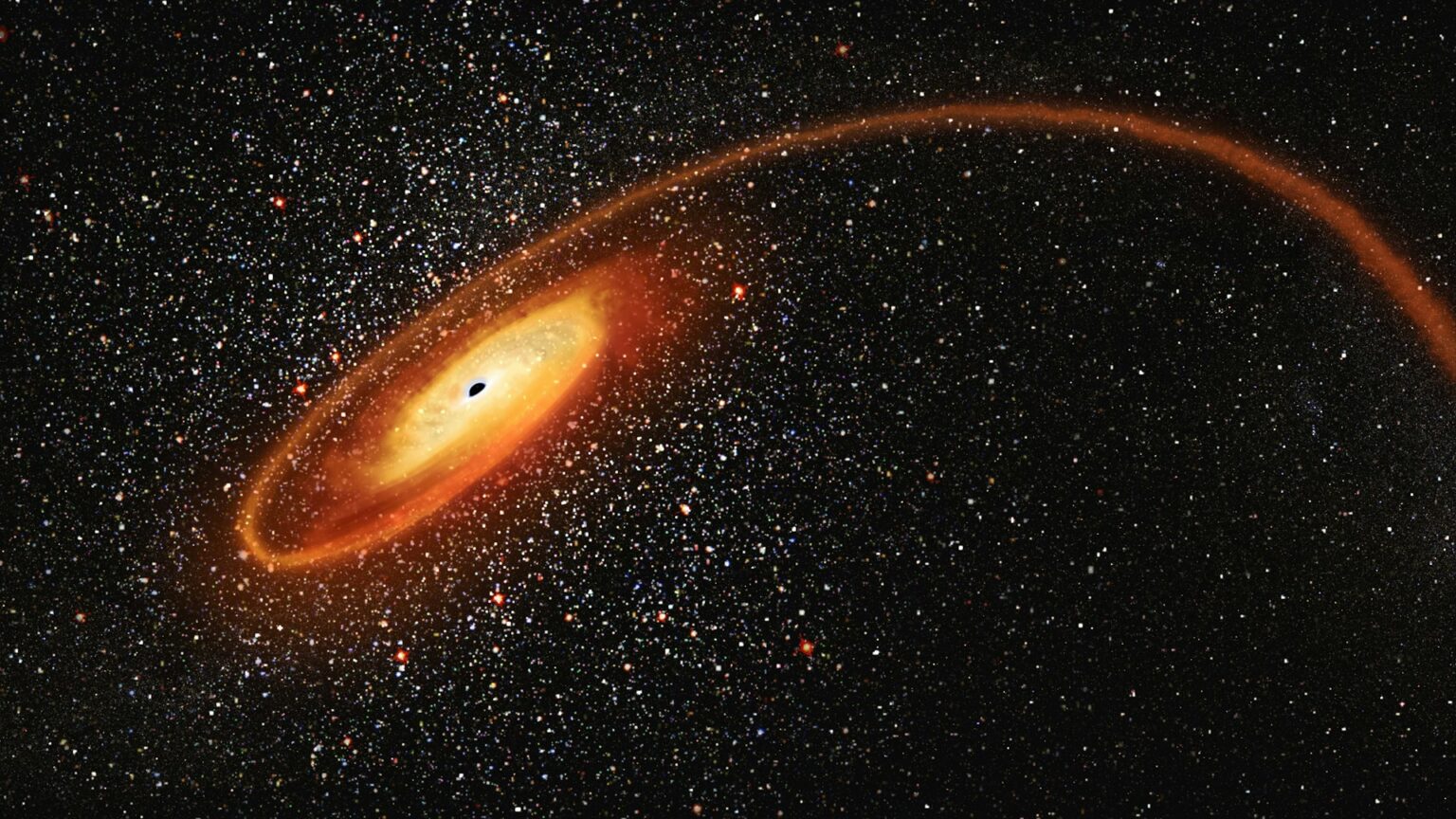
Physicists are investigating whether an extraordinarily energetic particle detected on Earth may be evidence of a rare kind of black hole explosion. This is a finding that could help explain some of the universe’s deepest and most puzzling mysteries.
In 2023, an experiment detected a neutrino with an energy so extreme that it appeared to defy known physics. The mysterious particle carried roughly 100,000 times more energy than anything ever produced by the Large Hadron Collider, and far beyond what astrophysical sources such as supernovae or active galaxies are thought capable of generating. Now, researchers at the University of Massachusetts Amherst have explained in a paper that the event may be the signature of an exploding primordial black hole.
A Different Kind of Black Hole
Unlike the stellar black holes formed when massive stars collapse, primordial black holes are theoretical objects thought to have formed shortly after the Big Bang, from extreme density fluctuations in the early universe. These black holes could be far smaller and lighter than those astronomers have observed so far.
In the 1970s, Stephen Hawking proposed that black holes are not completely black. Instead, they can slowly lose mass by emitting radiation. This is now known as Hawking radiation in scientific circles. For small black holes, this process could accelerate dramatically over time.
“The lighter a black hole is, the hotter it should be and the more particles it will emit,” said Andrea Thamm, an assistant professor of physics at UMass Amherst and co-author of the new study. As these black holes shrink, she explained, they could enter a runaway process that ends in a violent burst of radiation.
The ‘Impossible’ Neutrino
The UMass Amherst team recently published a paper in Physical Review Letters proposing that a specific type of primordial black hole known as a quasi-extremal primordial black hole could produce the kind of neutrino seen in 2023. The detection was originally made by the KM3NeT experiment, which observes high-energy neutrinos using detectors deep under the Mediterranean Sea.
The finding raised immediate questions. A similar observatory, IceCube in Antarctica, did not detect the same event and has never recorded neutrinos anywhere near that energy. If exploding primordial black holes were common, scientists would expect far more detections.
Dark Charge
To resolve this puzzle, the researchers propose that some primordial black holes may carry what they describe as a “dark charge.” This hypothetical charge mirrors electromagnetism but operates through unknown particles, including a heavy “dark electron.”
“We think that primordial black holes with a dark charge are the missing link,” said Joaquim Iguaz Juan, a postdoctoral researcher and co-author of the study. According to the team, these charged black holes would behave differently from simpler models, producing rare but extraordinarily energetic bursts rather than frequent weaker signals.
Implications For Dark Matter
Beyond explaining the neutrino, the researchers suggest their model could also shed light on dark matter (pardon the pun). Dark matter is the invisible substance thought to make up most of the universe’s mass.
“If our hypothesized dark charge is true,” Iguaz Juan said, “then we believe there could be a significant population of primordial black holes… and account for all the missing dark matter in the universe.”
For now, the idea remains theoretical, but the team believes future observations could test it. Baker called the 2023 neutrino detection “a new window on the universe,” adding that scientists may be approaching the first experimental evidence of Hawking radiation. This could possibly mean new physics beyond the Standard Model.
The explosion of a tiny and ancient black hole could turn out to be one of the most important cosmic events ever observed.