

For about half a century, astronomers have been largely convinced that our galaxy harbours a monstrous black hole at its heart.
That theory is now being challenged by a provocative rival idea: that the centre of the Milky Way instead contains a gargantuan knot of dark matter, a mysterious and invisible core with a gravitational pull powerful enough to shape the entire galaxy.
The idea of a central black hole emerged in the late 1960s and early 1970s, when radio astronomers first detected an intense, compact source of radiation in the direction of the constellation Sagittarius.
• Supermassive black holes make galaxies live fast and die young
By the 1990s, observations of stars whipping around an apparently empty patch of the cosmos had cemented the suspicion. The only plausible culprit, it seemed, was a supermassive black hole: a place several million times the mass of our sun, compressed into a region smaller than our solar system.
The evidence was so compelling that the presence of this object, known as Sagittarius A* — pronounced “Sagittarius A-star” — was widely accepted. And yet, in science, even the most imposing ideas occasionally reveal hairline cracks.
A study published in the Monthly Notices of the Royal Astronomical Society suggests that the gravitational tyrant at the centre of the Milky Way could instead be an immense concentration of dark matter, an elusive substance that has never been directly observed but is thought to make up most of the universe’s mass.
The study looks at the so-called S-stars, a cluster of stars orbiting extremely close to the galactic centre. They move at extraordinary speeds, executing tight loops around something invisible. For decades, their orbits have been regarded as evidence of a supermassive black hole, whose gravity would be strong enough to drive such frenzied motion.
The new research, however, argues that dark matter could provide a more elegant explanation.

Scientists now believe dark matter may lie at the core of the Milky Way
GETTY IMAGES
It suggests that if dark matter is composed of subatomic particles known as fermions, they could form an unusual structure: a super-dense central core wrapped in a much larger, diffuse halo.
The compact core could mimic the pull of a black hole closely enough to shepherd the nearby S-stars. Meanwhile, the broader halo could explain a subtle slowing of the rotation of the Milky Way further out from the centre, a pattern known as a Keplerian decline.
The idea may also fit, the authors add, with the most direct glimpse of the centre of the Milky Way achieved so far. An earlier study looked at what would be expected if energetic, glowing gas and dust were to swirl around a dark matter core. It concluded that the light would produce a shadow that would look remarkably similar to a famous image captured by the Event Horizon Telescope of the object at the centre of our galaxy.
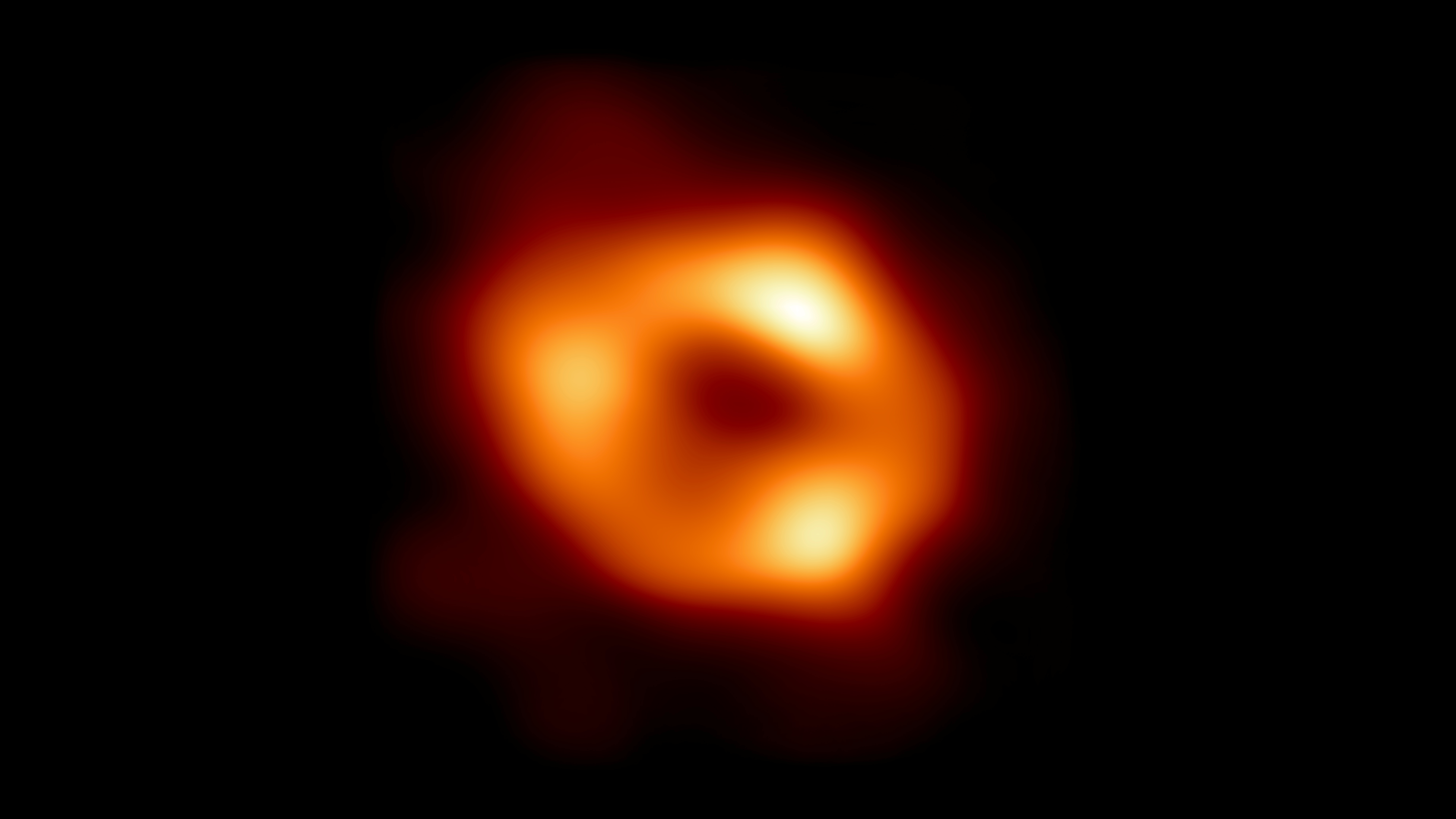
The first image of Sagittarius A*
EHT COLLABORATION/NATIONAL SCIENCE FOUNDATION/REUTERS
“This is a pivotal point,” said Valentina Crespi of the Institute of Astrophysics La Plata, the lead author of the latest study.
“Our model not only explains the orbits of stars and the galaxy’s rotation but is also consistent with the famous ‘black hole shadow’ image. The dense dark matter core can mimic the shadow because it bends light so strongly, creating a central darkness surrounded by a bright ring.”