
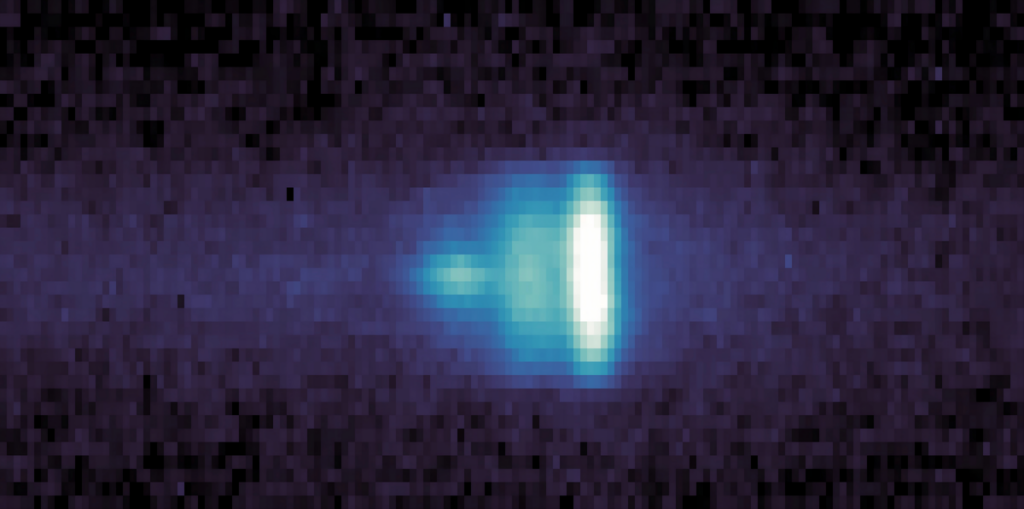
Astronomers have identified 3I/ATLAS as the largest interstellar comet on record, with scientists saying its solid centre measures as big as 2.6 kilometres in diameter according to new detailed Hubble Space Telescope observations. That’s around the size of Retiro Park in Madrid, or as big as the walk from Big Ben in London to Tower Bridge (along the South Bank). And that’s just it’s width!
This, the third confirmed interstellar visitor to our solar system, goes much bigger than any previous massive objects like ‘Oumuamua and 2I/Borisov in size and offers fresh new knowledge into distant planetary systems.
Discovery of the third interstellar object
The comet 3I/ATLAS, also designated C/2025 N1 (ATLAS), was first spotted on July 1 by the NASA-funded ATLAS survey telescope in Chile. Its hyperbolic trajectory and high speed confirmed its interstellar origin, making it the third such object detected after 1I/’Oumuamua (2017) and 2I/Borisov (2019). Early observations make it look like a regular comet, including a covering of gas and dust, rather than an inert asteroid-like body.
Most Read on Euro Weekly News
Hubble telescope measures massive nucleus size
The international team of astronomers used NASA’s Hubble Space Telescope to capture sharper images of 3I/ATLAS and estimate its nucleus size. By separating the bright nucleus from the surrounding coma, the glowing cloud of gas and dust, the researchers determined a diameter of about 2.6 km for the solid core. Independent methods, including analysis of non-gravitational forces from outgassing gases affecting the comet’s path, supported this measurement.
So, 3I/ATLAS is a lot larger than any other predecessors, a potentially more dangerous: ‘Oumuamua’s nucleus was estimated under 1 km, and 2I/Borisov’s around 1 km. Hubble’s precision placed tighter constraints on the size, though the nucleus remains partially obscured by the glowing coma around it, even in these high-resolution views.
Greater mass and unique chemical composition unravelled
Spectroscopic data reveals a composition rich in water ice, carbon dioxide, and methane, much different from typical comets but with unusual release patterns. A comet’s gas ejection and reddish coma suggest organic compounds influenced by long exposure to cosmic radiation. These traits raise questions about its formation environment, potentially in a distant star system billions of years ago.
Continuing NASA observations with TESS and other missions
NASA’s Transiting Exoplanet Survey Satellite (TESS) also tracked 3I/ATLAS from January 15 to January 22 (likely 2026 or during its passage), capturing brightness variations and activity. Multiple NASA assets, including the James Webb Space Telescope and others, continue monitoring the comet as it exits the solar system on its unbound path.
Implications for origins and future interstellar discoveries
Such an exceptional size, mass, and composition of 3I/ATLAS have challenged models of interstellar object formation. It has moved astronomers to start investigating whether such massive comets are common in other systems or represent a rare traveller to our solar system.
Future results are hoped to clarify whether this is some previously undiscovered natural comet or if it is something visiting our corner of space, directed by its own guidance system.
As 3I/ATLAS heads back into interstellar space, it leaves behind valuable clues about the building blocks of planets beyond our solar system.