
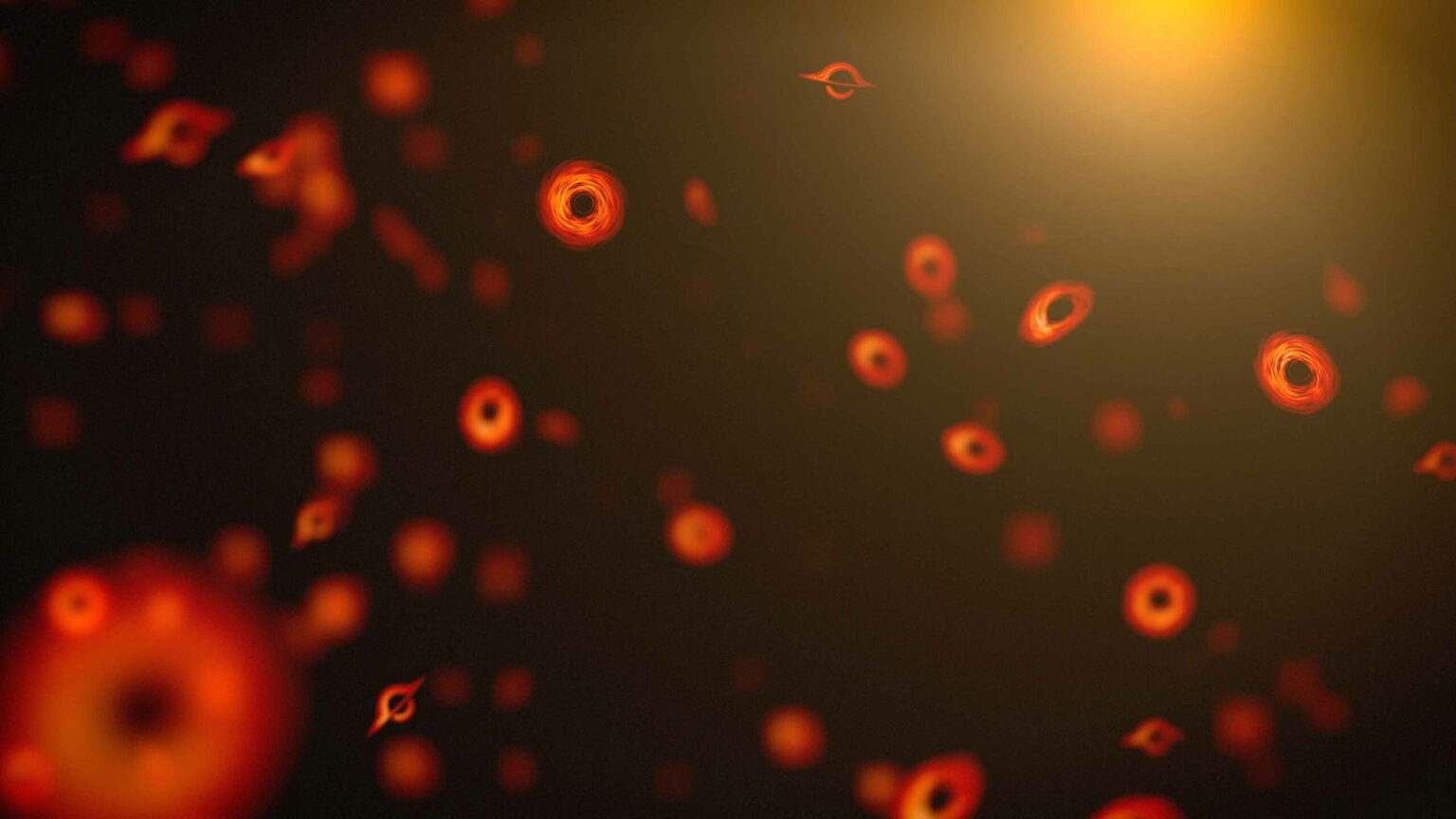
A rare black hole explosion may account for an “impossible” neutrino detection, say UMass Amherst scientists, potentially offering new clues about the fundamental nature of the universe.
Exceeding the energy of the most powerful particle ever produced by the Large Hadron Collider by 100,000 times, a 2023 observation of a neutrino striking Earth has puzzled scientists ever since. Now, a recent paper published in Physical Review Letters suggests that this extraordinarily energetic neutrino may align with a hypothesis about the deaths of quasi-extremal primordial black holes.
Primordial Black Holes
Typical black holes are believed to form from the deaths of stars, with the final supernova leaving behind a region of spacetime with extreme gravity. However, in 1970, Stephen Hawking proposed that primordial black holes (PBHs) may also exist. These black holes would have formed under the universe’s earliest conditions rather than from stellar collapse, resulting in objects with the same inescapable density but far less mass. According to Hawking’s calculations, they would emit a specific type of particle, dubbed “Hawking radiation,” upon reaching a certain temperature.
“The lighter a black hole is, the hotter it should be and the more particles it will emit,” said co-author Andrea Thamm, assistant professor of physics at UMass Amherst. “As PBHs evaporate, they become ever lighter, and so hotter, emitting even more radiation in a runaway process until explosion. It’s that Hawking radiation that our telescopes can detect.”
Observing Rare Particles
Directly observing such an explosion would be a tremendous boon to physics and astronomy. It would provide a complete catalog of all subatomic particles that exist, including known types like electrons, quarks, and Higgs bosons, and potentially particles that have remained entirely theoretical, such as candidates for dark matter. In previous work, the same UMass Amherst team wrote that capturing such an event may be a reasonable goal, estimating that they should occur about once every decade and be detectable with modern observational equipment.
It was the KM3NeT Collaboration that recorded the 2023 neutrino event, which the UMass Amherst team recognized as consistent with the type of black hole explosion they were investigating.
A challenge for the team’s theory was that the IceCube experiment, specifically designed to detect high-energy cosmic neutrinos, did not detect the 2023 event or anything remotely as powerful. This created a major discrepancy between the team’s expectations for event frequency and what has been observed by real-world instruments.
The Missing Link in Black Holes
“We think that PBHs with a ‘dark charge’—what we call quasi-extremal PBHs—are the missing link,” said co-author Joaquim Iguaz Juan, a postdoctoral researcher in physics at UMass Amherst. “The dark charge is essentially a copy of the usual electric force as we know it, but which includes a very heavy, hypothesized version of the electron, which the team calls a ‘dark electron’.”
The team notes that their model of quasi-extremal primordial black holes is more complex than other PBH models. Its ability to explain the otherwise unexplained 2023 neutrino observation suggests that this added complexity may better reflect reality.
“A PBH with a dark charge has unique properties and behaves in ways that are different from other, simpler PBH models,” Thamm says. “We have shown that this can provide an explanation of all of the seemingly inconsistent experimental data.”
“If our hypothesized dark charge is true,” adds Iguaz Juan, also one of the study’s co-authors, “then we believe there could be a significant population of PBHs, which would be consistent with other astrophysical observations, and account for all the missing dark matter in the universe.”
As research continues, the team remains optimistic about the potential to explain dark matter and possibly discover new particles beyond the Standard Model.
The paper, “Explaining the PeV Neutrino Fluxes at KM3NeT and IceCube with Quasiextremal Primordial Black Holes” was accepted to Physical Review Letters on December 18, 2025.
Ryan Whalen covers science and technology for The Debrief. He holds an MA in History and a Master of Library and Information Science with a certificate in Data Science. He can be contacted at ryan@thedebrief.org, and follow him on Twitter @mdntwvlf.