
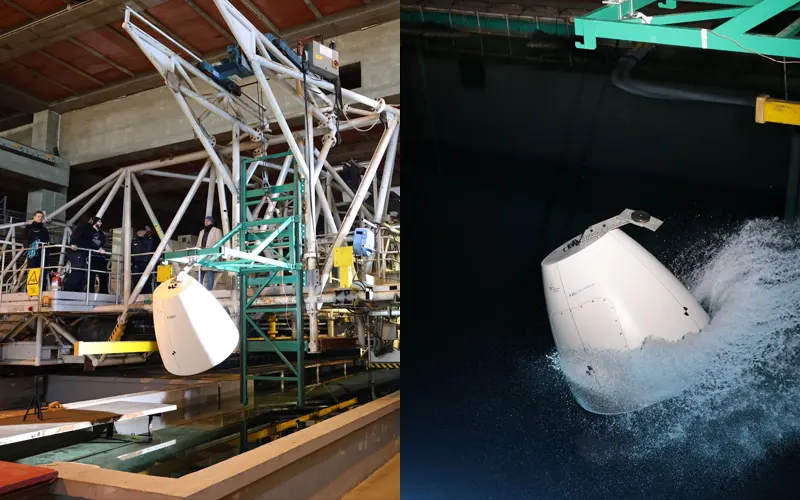
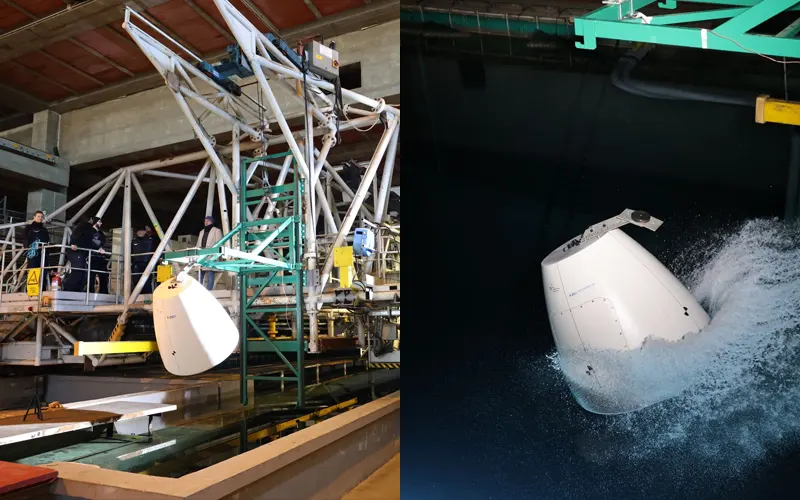
European space logistics startup The Exploration Company has successfully completed a controlled splashdown test of a subscale prototype of its Nyx spacecraft.
Founded in 2021, The Exploration Company is developing a reusable space capsule called Nyx that will initially be used to ferry cargo to and from low Earth orbit destinations. Planned variants of the vehicle will be capable of delivering cargo to lunar orbit and the surface of the Moon. The company is also exploring a crewed variant, saying in June 2025 that it could be operational as early as 2035, a projected timeline that it admitted would be contingent on a “political decision.”
At present, however, the company is focused on completing an initial test flight to the International Space Station in 2028 under the European Space Agency’s LEO Cargo Return Services programme. A key milestone on the path to that inaugural mission is validating Nyx’s performance during a splashdown.
On 5 February, The Exploration Company announced that it had successfully completed a splashdown test campaign at the National Research Council’s Institute of Marine Engineering (CNR-INM) in Rome.
A 1:4-scale mockup of Nyx, with a mass of around 135 kilograms, was built for the test campaign by Poli Model, a small Turin-based model builder. For reference, the full-scale capsule will be 4 metres wide and stand at 7 metres tall. The subscale model’s exterior was fitted with pressure sensors, accelerometers, and a gyroscope.
The tests were conducted in the CNR-INM facility’s Umberto Pugliese towing tank, a 470-metre-long pool measuring 13.5 metres across and 6.5 metres deep. Between 13 and 28 January, a total of 20 drops were conducted at varying heights and speeds in calm water, which the company explained maximised repeatability.
According to the company’s 5 February update, data collected during the drop tests are already being used to refine hydrodynamic coefficients and structural margins to support successful capsule recovery.
Keep European Spaceflight Independent
Your donation will help European Spaceflight to continue digging into the stories others miss. Every euro keeps our reporting alive.