
A new comet approaching the sun has caught the attention of astronomers, primarily because of its lineage. It appears to belong to a group of comets that in some cases have briefly become outstandingly bright objects.
About sixty-six comet groups have been tentatively identified, of which there are fifteen that can be regarded as well-established and have been designated by letters from A to Q (“I” and “J” designations were not used). The members of the “M” group have a special name. In his 1997 book “Comet of the Century” (Springer-Verlag New York Inc.) popular astronomy author Fred Schaaf writes that “The very mention of this name sends chills of awe down the spines of comet observers.” They are the Kreutz sungrazers.
You may like
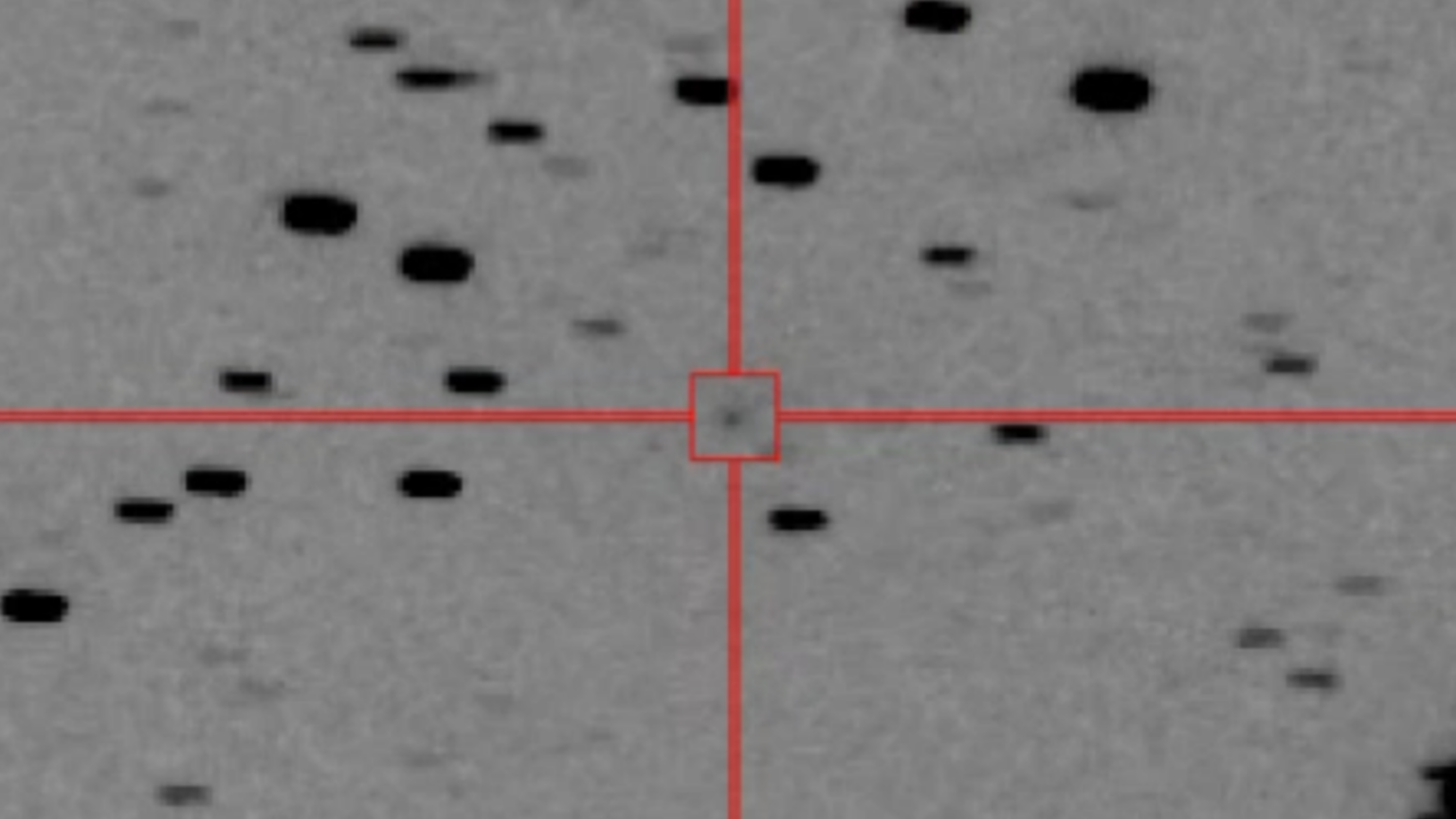
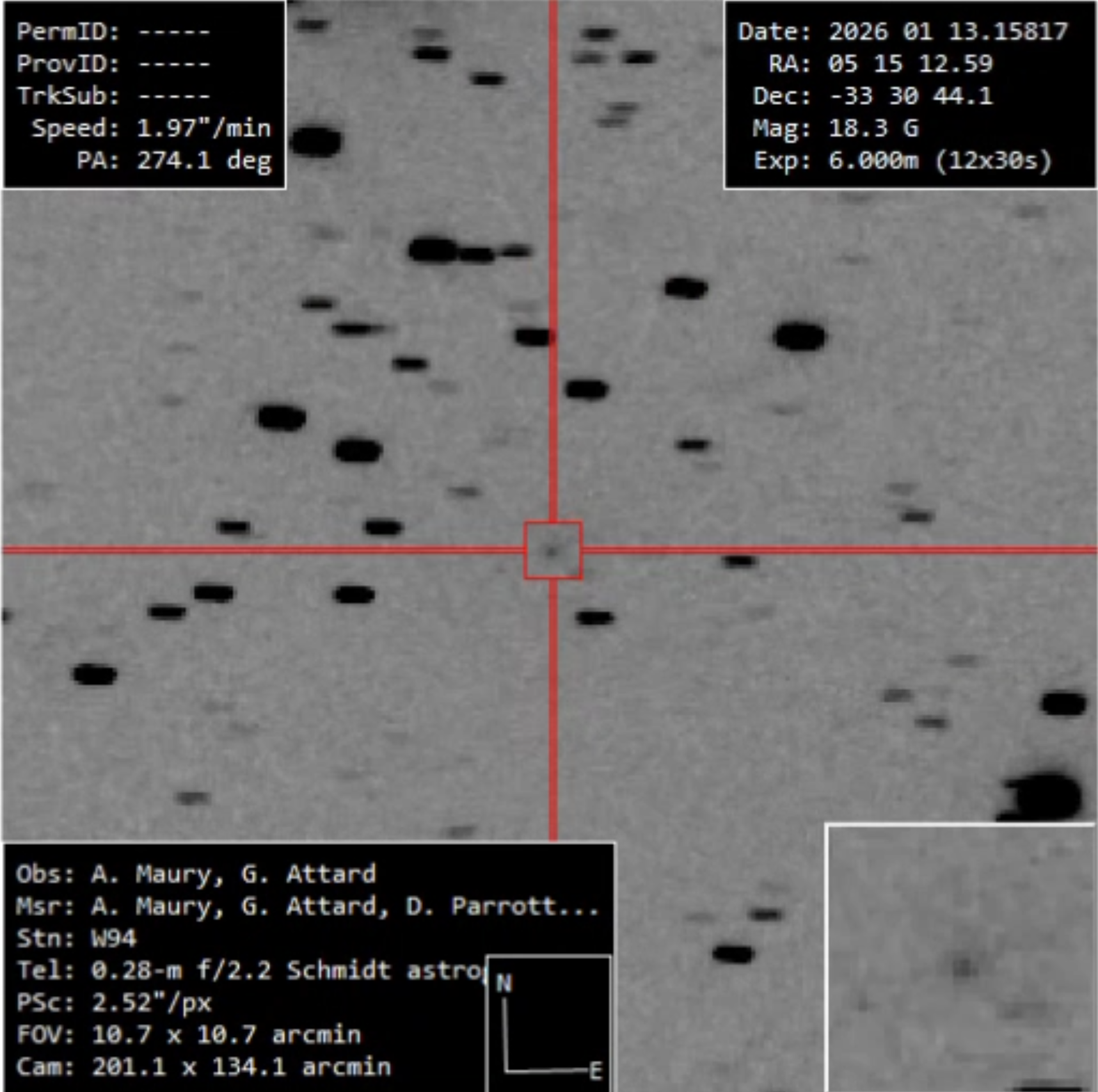
The new object was found using an 11-inch (0.28 meter) f/2.2 Schmidt telescope with a CCD camera. When first sighted, it was located at 191 million miles (308 million km) from the sun; shining in the constellation of Colomba the Dove at a magnitude of +17.8, meaning it was exceedingly faint.
Once enough observations were collected, including a pre-discovery image that was taken in December 2025, an orbit was determined that showed that Comet MAPS was a member of the Kreutz comet family. This discovery was unprecedented in this aspect: no inbound Kreutz comet has ever been discovered so far from the sun, with such a long lead time — 11.5 weeks — before reaching its closest point to the sun (perihelion). The previous record was held by the brilliant comet C/1965 S1 (Ikeya–Seki) at only 33 days before perihelion. This does not necessarily mean that Comet MAPS is also going to be brilliant, but before we start making any considerations, let’s take a closer look at other Kreutz family members.
Comet fragments
Apparently, all the members of this group of comets were pieces of a single giant comet, which had fragmented in the distant past. The source of the group may have been the Great Comet of 371 BC, described by the Greek historians Ephorus, Aristotle and Seneca. It apparently came very close to the sun and might have even split into two pieces.
In February 1106, a very bright comet appeared, described in many Chinese, Japanese, Korean and European chronicles. It may have been related to the comet of 371 BC and is believed to have ultimately fractured into numerous fragments. It now appears quite probable that these fragments have themselves broken up repeatedly as they’ve orbited the sun, resulting in orbital periods ranging from about 500 to 900 years or more.
The German astronomer Heinrich Carl Friedrich Kreutz (1854 –1907) studied many comets that came within a hairbreadth of the surface of the sun, and noted that several had very similar orbits, which apparently were produced, he surmised, when a very large sun-grazing comet fragmented many hundreds of years previously. In honor of his extensive work, the members of this group are referred to as Kreutz sungrazers.
Two of these sungrazers, (in 1843 and 1882) not only developed very long tails but also achieved the rare distinction of having been bright enough to be seen in broad daylight with the unaided eye. Many years later, Dr. Brian G. Marsden (1937-2010), a highly regarded specialist in celestial mechanics and astrometry, considered that almost all the comets belonging to the Kreutz group separated from one of two comets that appeared around 1100 AD. One of these might very well have been the comet of 1106.
How many?
We know today that there are literally thousands of Kreutz sungrazers. Beginning in 1979, orbiting space observatories such as SOLWIND and the Solar Maximum Mission satellite began to detect sungrazing comets using instruments called coronagraphs. A coronagraph is designed to look at the solar atmosphere by blocking out the bright disk of the sun. Tiny sungrazing comets, which normally would be too faint and too near to the glare of the sun, can be picked up using a coronagraph.
You may like
In fact, sungrazers continue to be routinely being discovered using the Large Angle Spectrometric Coronagraph (LASCO) on the Solar and Heliospheric Observatory (SOHO) satellite. Over 5,000 SOHO comet discoveries have been made by amateurs using SOHO images on the internet, and SOHO comet hunters come from all over the world. Over 3,500 SOHO comets have been identified as Kreutz sungrazers. Most are probably just a few meters across; none have survived their sweep around the sun.
But that also doesn’t necessarily mean that we will never see another large, bright comet moving in the same orbit. Indeed, Kreutz comets are like trains of all sizes moving along the same railroad track while passing our station (Earth) in space. And like impatient commuters we can only watch and wonder what awaits us up the track!
Comets belonging to the Kreutz group include the Great Comets of 1668, 1843, 1882 and Ikeya-Seki in 1965. All were very bright objects, sporting long tails. They all had relatively large nuclei, probably measuring several miles or more in diameter.
But just when will another large and spectacular member of the Kreutz group, like Ikeya-Seki, appear? No one can say for sure. The last Kreutz Sungrazer to become bright was Comet Lovejoy in December 2011, and yet, that comet disintegrated shortly after perihelion.
So now we are looking at Comet MAPS. The big question now is: Will it sizzle and become bright and spectacular, or will it fizzle and remain faint and possibly even disintegrate when it sweeps around the sun?
Another look at comet C/2026 A1 (MAPS) (Image credit: Denis Huber/Wikimedia Commons/CC BY-SA 4.0)How bright? Opinions differ
Comet MAPS is expected to arrive at perihelion early on April 4, passing a mere 99,600 miles (160,200 km) above the solar surface (photosphere). To survive such an exceedingly close approach, the comet needs to travel along what equates to a hairpin turn around the sun at speeds measuring over 2 million miles (3 million km) per hour! Even at such extreme velocities, the comet will be subjected to temperatures of thousands of degrees Fahrenheit, and might end up being completely vaporized or torn apart by massive tidal forces if it’s not very large, perhaps leaving only a tail in its wake. One of the best examples of this was the Great Southern Comet of 1887, which is known in some astronomical annals as the “headless wonder.”
Astronomer Daniel Green at the Central Bureau for Astronomical Telegrams, believes Comet MAPS will suffer a similar fate, noting on Circular 5658: “The faint absolute magnitude of C/2026 A1 (MAPS) does not bode well for the comet’s survival past perihelion.” But Czech astronomer and veteran comet observer Jakub Černý disagrees. In a recent post on Facebook’s ICQ Comet Observations Group Forum page, he notes that Kreutz comets are an “extremely special case from many points of view, and it is difficult to apply many general rules to these objects. The most probable scenario is that this is a mid-size Kreutz comet, possibly larger than Comet Lovejoy, and that it may survive perihelion passage or even the entire return, resulting in a bright naked-eye comet, potentially with or without a distinct head (‘headless wonder’ appearance).”
So, when will we know?
It appears that we will need several more weeks to determine whether Comet MAPS is developing into a potentially bright object or will remain small and dim. By early March, we should have a much better idea as to how it will perform. If it does develop into an eye-catching naked-eye comet, it would grace our evening sky during the second week of April, low in the west shortly after sunset.
Of course, if that happens, Space.com will provide all the details on how, where and when you might see it for yourself. Keep your fingers crossed and stay tuned!
Joe Rao serves as an instructor and guest lecturer at New York’s Hayden Planetarium. He writes about astronomy for Natural History magazine, Sky and Telescope, The Old Farmer’s Almanac and other publications.