

A major international effort has produced detailed images and chemical data on interstellar comet 3I/ATLAS, revealing its nucleus size and unusual gas composition as it leaves our solar system.
Observations from the Hubble Space Telescope and the James Webb Space Telescope have shown a nucleus around 2.6 kilometres wide while revealing the comet’s gas coma contains methane alongside carbon dioxide and water. These findings mark the first direct detection of methane in an object known to originate outside our solar system and offer rare insight into the chemistry of a distant star system.
3I/ATLAS was first spotted on 1 July 2025 by the Asteroid Terrestrial-impact Last Alert System (ATLAS) in Chile and is only the third recognised interstellar object to ever grace our solar system. It joins the elite and enigmatic club previously occupied only by the cigar-shaped ‘Oumuamua and the more traditional Comet Borisov. But while its predecessors often felt like ghostly whispers caught in passing, 3I/ATLAS has been a loud, vibrant guest, allowing a global consortium of observatories to scrutinise its every move.
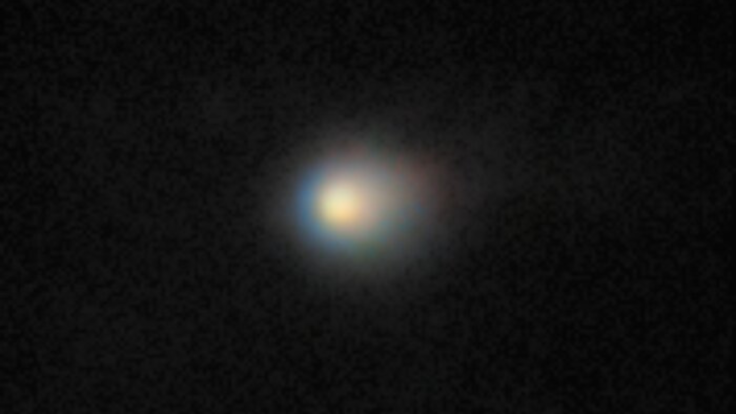
New image of 3I/ATLAS reveals ‘chemical scream.’
Gemini North telescope/NSF
The Unfolding Narrative of 3I/ATLAS
What makes this visitor so striking is its refusal to behave like a local. While most comets we encounter are born in the Kuiper Belt or the distant Oort Cloud, the icy outskirts of our own system, 3I/ATLAS arrived on a ‘hyperbolic’ trajectory.
In layman’s terms, it is moving far too fast for our Sun to ever hold captive. It is merely a tourist, hurtling through at speeds that reached roughly 68.3 km/s at its closest point to the Sun in October 2025 (perihelion).
By early February 2026, fresh data from the James Webb Space Telescope and the Hubble Space Telescope have revealed something even more fascinating: the direct detection of methane. This is the first time an interstellar object has been observed, and it provides a chemical fingerprint of a planetary system billions of miles away.
The robust methane outgassing was noted in late 2025 and January 2026, providing a ‘puzzling’ and unique data profile that sets it apart from native solar system comets. It suggests that the ‘recipe’ for world-building in other parts of the galaxy might not be as different from our own as we once theorised, yet the comet’s volatile behaviour hints at a home system far more chaotic.
The sheer scale of this observation effort cannot be ignored. From the arid silence of Chile’s Atacama Desert to the high peaks of Hawaii’s Mauna Kea, telescopes have been stitched together into a single, massive eye.
Observatories from the Atacama Desert to space-based platforms have worked in concert to characterise 3I/ATLAS. Instruments on NASA missions such as MAVEN, TESS, and even the Mars Reconnaissance Orbiter have captured views of the comet’s coma and tail at various points in its trajectory.
NASA’s SPHEREx mission has also tracked changes in the comet’s coma, noting large amounts of carbon dioxide and water ice as the comet released gas and dust during its approach to the Sun.
Using adaptive optics to cancel out the shimmering ‘noise’ of Earth’s atmosphere, researchers have resolved the comet’s nucleus with more precise post-perihelion measurements from Hubble, suggesting an effective diameter of approximately 2.6 kilometres (0.4 km).
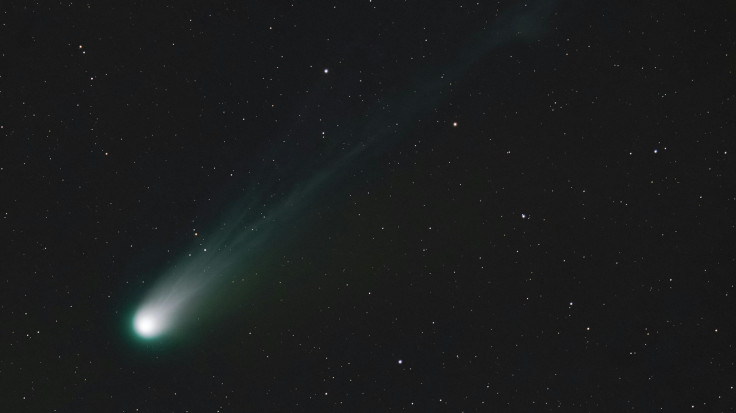
3I/ATLAS
Scott Lord/Pexels/IBTimes UK
Deep-Space Lessons from 3I/ATLAS
There is a certain irony in the fact that we are learning more about a foreign star system from this single piece of ‘space junk’ than from decades of peering through telescopes at distant planets. Scientists have noted that 3I/ATLAS appears to be less dense and more porous than our local comets, almost as if it were a loosely packed snowball of interstellar soot and organic compounds.
They say 3I/ATLAS provides a unique chance to study material formed in another star system. Interstellar objects carry chemical fingerprints that reflect the environments in which they were born.
Spectroscopic analysis also revealed an unusual abundance of carbon dioxide (CO₂) relative to water, along with the surprising presence of nickel vapour detected earlier in its journey.
The comet is now on its outbound path toward the outer solar system. Observatories will continue to monitor its fading activity.
What this reveals is a galactic history that predates us. Some estimates suggest 3I/ATLAS could be three billion years older than our own 4.6-billion-year-old solar system (with some researchers speculating an age of up to seven billion years). It is a literal time capsule, a piece of a world that might have crumbled or thrived long before the Earth was even a molten ball of rock.
As the comet begins its long exit toward the constellation Cancer and back into the void, it leaves us with more than just terabytes of data. It is scheduled to venture past Jupiter in March 2026 on its final outward path.