
Is it possible to save Earth from a deadly asteroid by blowing it up, as in Hollywood blockbusters? Earlier calculations showed that such a scenario would lead to the formation of debris that would only exacerbate the impending catastrophe. But a revolutionary new simulation conducted by an international team of scientists provides an unexpected answer: yes, a nuclear explosion could be a viable plan, and even better than we thought. The scientists described this optimistic future in a publication in Nature Communications.
 A nuclear strike near the asteroid proved to be a more successful solution than a kinetic collision with it. Illustration generated by Grok AI
The key discovery is that space bodies are much more resistant to extreme impact loads than laboratory tests have shown. This is good news for planetary defense. If a nuclear strike is directed at an asteroid, it will most likely remain intact rather than disintegrate into a deadly shower of thousands of fragments that will still fall on the planet.
How to test a meteorite without destroying it
Researchers from Oxford University and Outer Solar System (OuSoCo) have solved a fundamental problem: the inability to observe the reaction of asteroid material in real time under impact. They used a particle accelerator at CERN to irradiate a sample of the Campo del Cielo iron meteorite with high-energy protons.
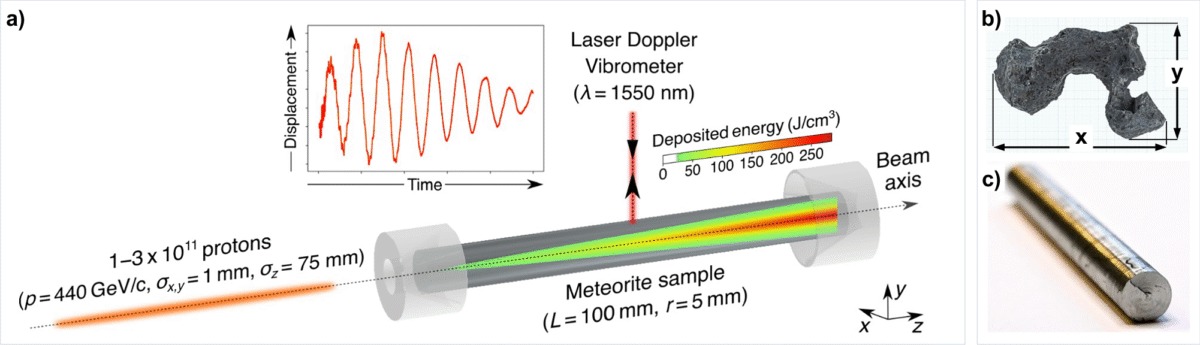 An experimental setup in which a laser was used to irradiate a cylindrical sample cut from a meteorite. Credit: Bochmann et al., Nat. Commun.
“This is the first time we have been able to safely observe, in real time, how a real meteorite sample deforms and adapts in extreme conditions without being destroyed,” explains physicist Gianluca Gregori.
The sensors recorded surprising dynamics. Under the influence of a powerful impulse, the meteorite first softened and bent, and then — unexpectedly — hardened again. It also demonstrated the ability to dissipate impact energy more effectively than the stronger the impact itself. This explains why previous estimates of asteroid strength were incorrect.
Consequences for planetary defense
This research is critical for choosing a strategy. Missions such as DART, which deflect asteroids with a kinetic impact, are effective but require high precision. The nuclear option, as simulations have shown, may be safer.
“The world must be able to execute a nuclear deflection mission with high confidence, yet cannot conduct a real-world test in advance. This places extraordinary demands on material and physics data,” notes Karl-Georg Schlesinger of OuSoCo.
In real life, it’s not like in the movies
In reality, no one is planning to drill into an asteroid and place a bomb inside it. Physicists are proposing a different scenario: conducting a nuclear explosion at a certain distance from the celestial body. The mass vaporized by radiation will create a reactive thrust that will gradually change the asteroid’s orbit, directing it away from Earth.
Thus, humanity’s last argument in the fight against cosmic threats is scientifically justified. Fortunately, in reality, it will not be as dramatic, but much more reliable than in the movies.
Earlier, we reported on how an asteroid impact caused a 100-meter tsunami.
According to sciencealert.com