
In 2023, the detection of an unusually high-energy neutrino puzzled scientists, as no known cosmic source could explain its immense power. Now, physicists at the University of Massachusetts Amherst propose a groundbreaking theory: the neutrino may have come from the explosion of a primordial black hole (PBH), a mysterious remnant from the early universe. Published in Physical Review Letters, this theory not only explains the neutrino but could also shed light on dark matter and Hawking radiation, offering new insights into some of the universe’s deepest mysteries.
The Surprising Discovery of a High-Energy Neutrino
The neutrino detected by the KM3NeT Collaboration in 2023 defied all expectations. This particle had an energy level 100,000 times greater than anything ever recorded by the Large Hadron Collider, leaving researchers stumped. How could a single particle possess such extraordinary energy? Traditional sources, like cosmic rays or supernova explosions, couldn’t account for it. In their search for answers, the UMass Amherst team proposed a bold new theory: the neutrino could have originated from the explosion of a primordial black hole.
Primordial black holes, unlike the black holes that form from the collapse of stars, are theorized to have formed in the early universe, shortly after the Big Bang. These black holes are much lighter than typical stellar black holes, and their size and density allow for a unique and potentially explosive life cycle. The UMass team’s research suggests that as these PBHs gradually lose mass through a process called Hawking radiation, they become increasingly unstable. Over time, they could release bursts of energy, resulting in an explosion that could explain the high-energy neutrino.
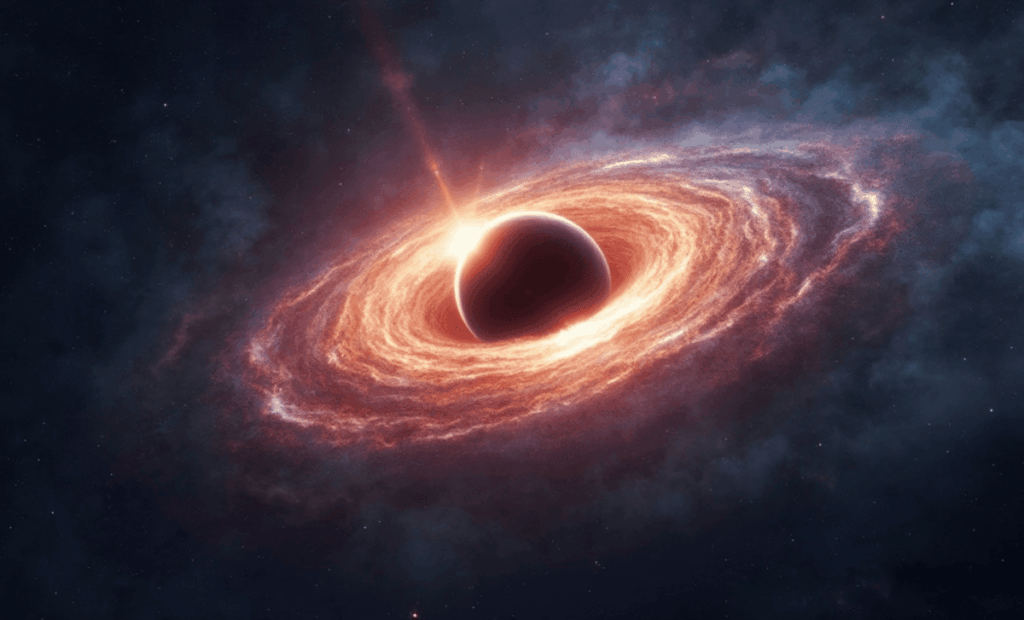
 This artist’s concept takes a fanciful approach to imagining small primordial black holes. Credit: University of Massachusetts Amherst
Hawking Radiation: The Key to Understanding PBH Explosions
At the heart of the researchers’ theory is a concept introduced by physicist Stephen Hawking in the 1970s, Hawking radiation. This phenomenon refers to the gradual emission of particles from a black hole due to quantum effects near its event horizon. The UMass team suggests that as PBHs evaporate through this process, they become lighter, hotter, and more energetic.
“The lighter a black hole is, the hotter it should be and the more particles it will emit,” explains Andrea Thamm, assistant professor of physics at UMass Amherst and co-author of the study. “As PBHs evaporate, they become ever lighter, and so hotter, emitting even more radiation in a runaway process until explosion. It’s that Hawking radiation that our telescopes can detect.”
According to the team’s model, these explosive events could occur much more frequently than previously thought, possibly every decade or so. If this is true, we may be on the verge of detecting more of these high-energy bursts in the near future. The researchers speculate that the reason we haven’t observed more of these explosions yet is that the detection of such high-energy particles is challenging. But with advancements in cosmic observatories and particle detectors, the search for PBH explosions could soon become a routine part of astrophysical research.
Quasi-Extremal PBHs: The Dark Charge Connection
While the idea of PBHs exploding due to Hawking radiation is already intriguing, the UMass team took things a step further with their introduction of quasi-extremal primordial black holes. These PBHs, they argue, possess a unique property, what they call a “dark charge.” Unlike the familiar electric charge we observe in normal matter, dark charge involves a hypothetical particle, a “dark electron”, which is much heavier than regular electrons and interacts only with other dark matter particles.
“We think that PBHs with a ‘dark charge’—what we call quasi-extremal PBHs—are the missing link,” says Joaquim Iguaz Juan, a postdoctoral researcher at UMass Amherst and co-author of the study. “The dark charge is essentially a copy of the usual electric force as we know it, but which includes a very heavy, hypothesized version of the electron, which the team calls a ‘dark electron.’”
This concept could explain the unusual behavior of PBHs, as well as help solve some of the inconsistencies observed in experimental data, particularly when it comes to high-energy particle detection.
A Model for Dark Matter
In addition to explaining the neutrino anomaly, the dark charge hypothesis could also hold the key to solving the riddle of dark matter. Dark matter has been theorized for decades, but it has never been directly detected. Astronomical observations of galaxies and cosmic background radiation suggest that dark matter exists, but its true nature remains elusive. The UMass team believes that the existence of PBHs with dark charge could provide the missing link in understanding dark matter.
“There are other, simpler models of PBHs out there; our dark-charge model is more complex, which means it may provide a more accurate model of reality,” explains Michael Baker, co-author of the study and assistant professor of physics at UMass Amherst. “What’s so cool is to see that our model can explain this otherwise unexplainable phenomenon.”
If the dark charge hypothesis is correct, PBHs could not only explain the high-energy neutrino but also account for the mysterious mass in galaxies that has been attributed to dark matter.
A New Era of Astrophysical Exploration
The implications of the study, Physical Review Letters, are profound. By proposing a model that connects PBHs, dark matter, and high-energy particles like neutrinos, the researchers are opening up new possibilities for exploring the early universe and the fundamental forces that govern it. As Thamm notes,
“A PBH with a dark charge has unique properties and behaves in ways that are different from other, simpler PBH models. We have shown that this can provide an explanation of all of the seemingly inconsistent experimental data.”
If further research supports the dark-charge model and the PBH explosion theory, it could mark the beginning of a new era in astrophysical research. The discovery of Hawking radiation, the verification of primordial black holes, and the identification of new particles beyond the Standard Model could radically transform our understanding of the cosmos.
In conclusion, the detection of the high-energy neutrino in 2023 has provided scientists with a potential breakthrough in astrophysics. By proposing a link between PBHs, dark charge, and dark matter, the team at UMass Amherst has offered a compelling theory that could explain some of the universe’s most mysterious phenomena. As research in this area progresses, we may soon find ourselves on the verge of unraveling some of the most fundamental secrets of the cosmos.