
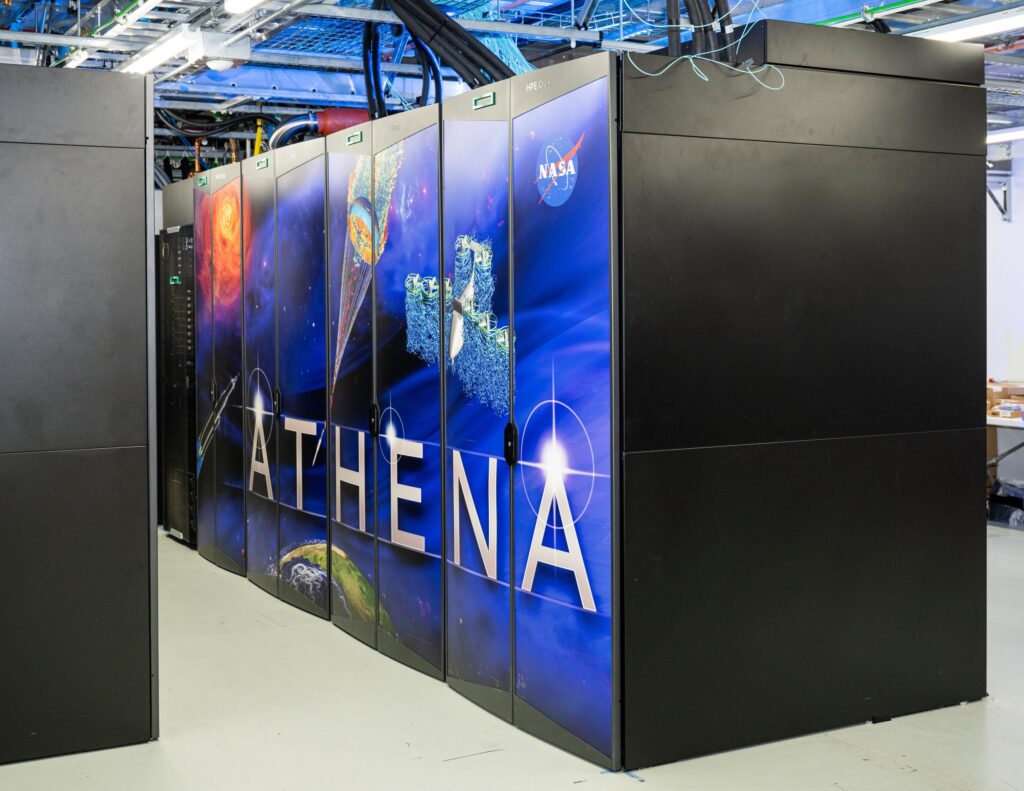
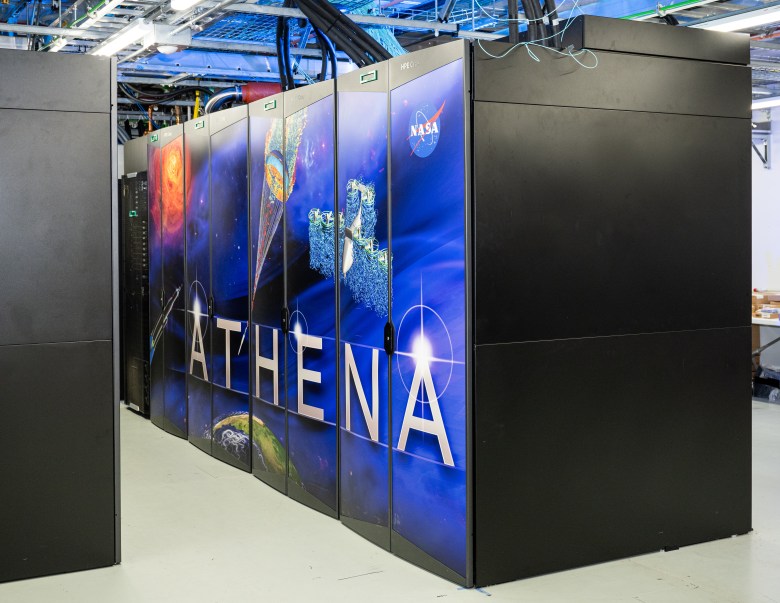
 Athena modular supercomputer, which recently became available for use by scientists and researchers, is located at Ames Research Center. Courtesy Brandon Torres-Navarrete/NASA.
NASA’s newest and most powerful supercomputer – Athena – is up and running at its research center in Mountain View, ready to help the agency advance its mission of getting humans back into deep space.
Athena, which officially debuted in January after a beta-testing period, is four times more energy efficient and can do about 75% more work per year than its predecessor, Pleiades, according to Donovan Mathias, division chief of the NASA Advanced Supercomputing Division. Athena is housed at NASA’s Ames Research Center and is expected to play a critical role in the agency’s ability to send people to the moon and Mars.
“The big thrust of the analysis that we’re looking for Athena to do at this time is supporting human spaceflight, to get our crew safely into space and back home,” Mathias told the Voice.
From analyzing data to simulating space environments to designing control systems, supercomputing technology touches nearly every element of NASA missions, Mathias said. While people are responsible for writing the software, setting up the problems and defining the conditions, supercomputers can solve the equations and run the experimental simulations. Additionally, the systems can train large-scale artificial intelligence models, which can analyze huge amounts of data.
“A supercomputer can help ensure the highest level of safety that we can for human spaceflight,” Mathias said.
For Mathias, the idea of humans landing on Mars in his lifetime is “really exciting,” he said. When asked if he thinks this will happen, he noted that it is the priority of the agency right now and “definitely possible.”
With the launch of Athena as its newest supercomputer, NASA can now do more work in less time. Something that took weeks to run on Pleiades might only take a couple of days on Athena, Mathias said.
Athena’s calculating speed is measured at more than 20 petaflops of peak performance, meaning it can execute about 20 quadrillion operations per second, Mathias said. For context, it would take every human on earth, so approximately 8 billion people, each solving one equation every second continuously for about one month, to reach that level of computation.
When Pleiades first debuted in 2008, it was the third most powerful supercomputer in the world. Now, with all of the technological advances that have taken place, including the emergence of cloud computing, artificial intelligence and large-scale data centers, Athena ranks about 116th in the world – even though it is significantly more powerful than Pleiades.
Mathias described Athena as the “next generation of supercomputing” for NASA, adding that it will carry on the tradition established by Pleiades of being a workhorse for the agency.
The name Athena was picked through a contest among NASA’s supercomputing workforce. Athena, the Greek goddess of wisdom and warfare, is the half-sister of Artemis, which is the name of a NASA program that aims to get humans back onto the moon for the first time since 1972.
Most Popular