
I have been thinking about this recently. Something in me told me to look up more on this. Now here I stand, certainly with more questions than answers.
Jupiter's outer Moon, Callisto, has some intringuing things going for it that make me ponder what its actual nature is. Here are the unusual elements I have taken note of so far.
– Callisto is not in resonance with its companion moons: the universe keeps demonstrating time and time again with diligence, how much it abides to the laws of harmony. Jupiter's first three moons are in a 4-2-1 rotational resonance, orbiting in a harmonious, repeated sync like strings in a chord. Callisto however, despite their proximity to them and seemingly sharing the same origin as them, does not abide to this resonance in any way.
– Callisto is very light. Despite being almost as big as planet Mercury, it is shockingly undense: at a whopping 1.8g/cm3, it is over three times lighter than our Earth's content, and overall barely half as dense as our own Moon. This could only be explained naturally by an elmost entirely ice body, with hardly any rock and possibly a "foamy" surface at least: this is difficult to reconcile with the high amount of impacts visible on its surface, as well as how these would be expected to bring in some denser rock into the mix.
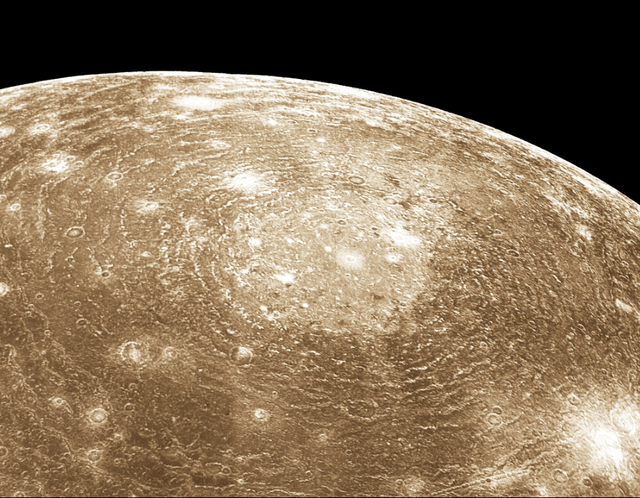
– Speaking of impact crators: it is clear that Callisto is smooth in the sense that its craters, although very numerous and of all ages and sizes, never seem to carve too deep into the object; almost like some king of harder shell prevents them doing so. This is especially obvious in the attached picture of the humongous structure NASA named "valhallah", which caused clear vribational effects all around it, while not even carving a dent. I find it difficult to imagine this being in line with some king of fragile ice ball, especially the way no form of glass-like fracture is visible anywhere around the orb.
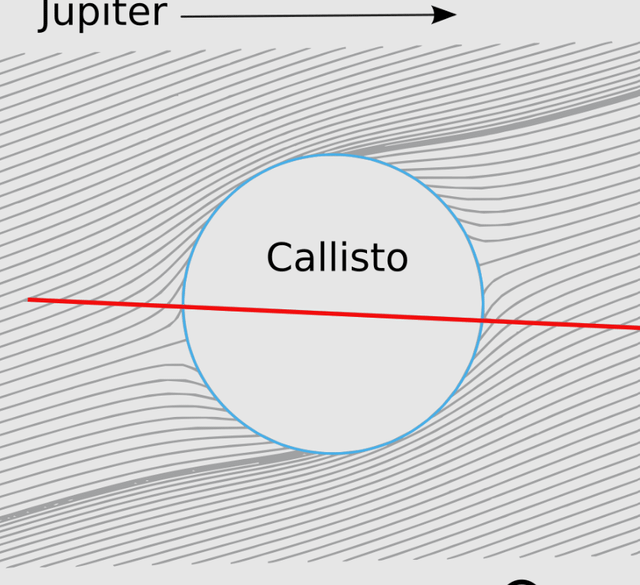
– Lastly, let's talk magnetism. For sure, you wouldn't expect a collection of cold, solid stone like our Moon to have any magnetism in it, nor would you a bunch of ice, alledgedly deprived of any amount of metal owing to its extremely low density. It is true that Callisto does not have an active magnetic field, but yet, when bathed into Jupiter's magnetic lines, it interacts with, distorts and deflects them, not unlike what you would expect a passive sheet of conductive metal to do. This certainly brings its outer shell contents into questions, especially how such conductive material is expected to stay above and not sink into the much less dense material underneath, assuming a naturally formed ball with no adapted supportive structure.
All this ends up having me wondering: could it be that Callisto is some kind of station, planted there perhaps to observe us? It certainly makes sense in terms of location, as it is far enough and drowned in Jupiter's light that we were only made aware of its existence 400 years orso ago; who's to know how long it's been there, or what other places its visited completely unbeknownst to humanity?
Thank you very much for reading through this. Eyes open, stay alert brothers🪬Wishing you all a pleasant, fruitful evening.
by nanpossomas