
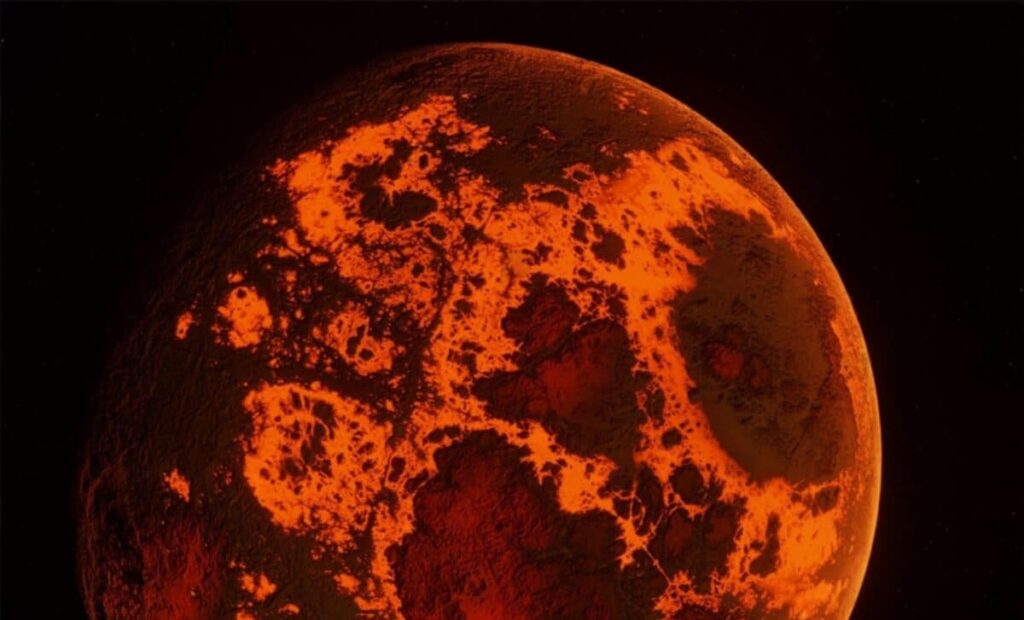
Life from Earth surviving the harsh conditions of Mars? New research suggests it’s possible, but only if you’re a tough hybrid like a lichen. A fascinating study reveals that certain lichens can withstand the intense radiation on Mars, hinting that these resilient organisms might play a role in future missions to the Red Planet.
Mars has long captivated scientists as a potential home for life, whether past or present. With its frigid temperatures, thin atmosphere, and intense radiation, the Red Planet seems far from welcoming.
Lichens: A Hybrid Lifeform Built for Extremes
Lichens aren’t exactly a single organism. Instead, they’re a partnership between fungi and photosynthetic bacteria or algae. This unique collaboration allows lichens to survive in some of Earth’s most extreme environments, from dry deserts to freezing mountaintops. They’re incredibly resilient, capable of enduring drought, extreme temperatures, and even space itself.
 The experiment arrangement includes a vacuum chamber with a metal grate (lichens), cooling table, sensors, X-ray lamp, CO2 valve, and controllers for pressure and cooling. Credit: Pensoft
In a recent experiment, avaliable on IMA Fungus, scientists tested two species of lichen, Diploschistes muscorum and Cetraria aculeata, to see if they could handle the intense radiation found on Mars. The team placed the lichens in a vacuum chamber that mimicked Martian conditions, bombarding them with radiation equivalent to one Martian year. Remarkably, both species survived the exposure, remaining active and metabolizing throughout the test.
“These findings expand our understanding of biological processes under simulated Martian conditions and reveal how hydrated organisms respond to ionizing radiation,” said Kaja Skubała, one of the researchers, in a statement.
Why Lichens Could Be Mars’ Toughest Survivors
What makes lichens so special in this context? The ability of Diploschistes muscorum to endure the radiation stood out in the study. It showed less cellular damage compared to Cetraria aculeata, which suggests that some lichen species may be better suited to Mars than others. But just because a lichen can survive radiation doesn’t mean it can thrive on Mars.
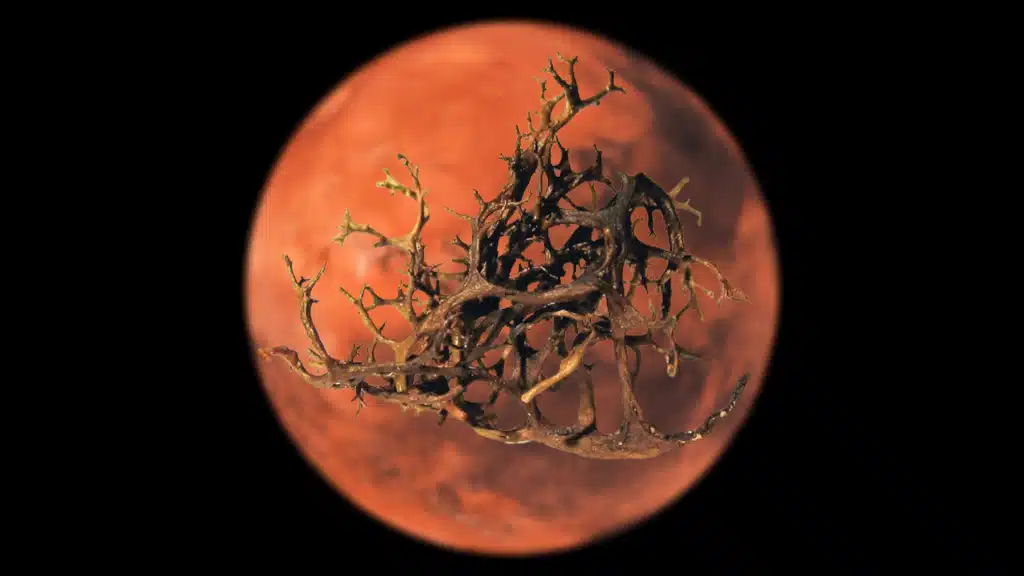 An artistic representation of life in space, where terrestrial plants might one day float freely above Mars’ vast, red surface. Credit: Pensoft
One of the biggest challenges for life on Mars is the lack of liquid water on the surface. While lichens are known for their ability to go without water for long periods, they still need some moisture to survive. That’s one reason why Mars, with its barren, dry landscape, is such a tough place for any life to thrive. Without water, even these resilient organisms would face an uphill battle.
The Extremophiles That Could Make Mars Their Home
Lichens aren’t the only lifeforms that could handle the Martian environment. Tardigrades, or “water bears,” are microscopic creatures known for their nearly indestructible nature. They can survive extreme heat, cold, and radiation, and even go without water by entering a state of suspended animation. Some scientists think that tardigrades could survive on Mars, provided they’re shielded from radiation.
Mosses, too, are in the running. Certain species of moss are resistant to gamma rays and liquid nitrogen, suggesting they might be able to handle the Martian climate. These hardy organisms, like lichens and tardigrades, could one day be sent to Mars as part of a long-term experiment in space exploration.