
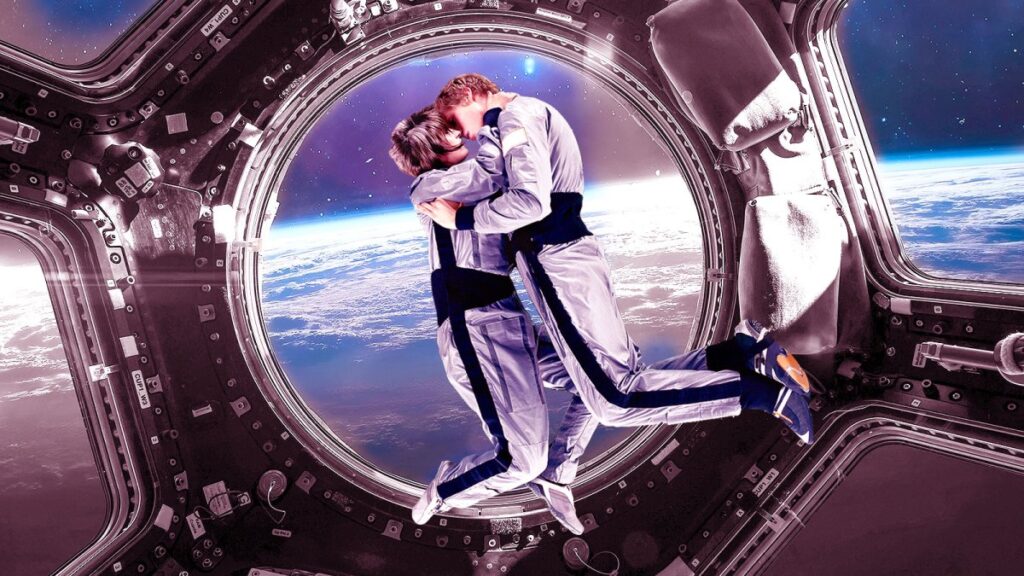
For decades, space has been treated as a workplace — bureaucratic, rule-bound and strictly professional. But as commercial flights become more common and civilians begin slipping the bonds of Earth for pleasure rather than science, a new question is drifting into view: what happens if these adventurers choose to join the 100-mile-high club?
Engineers have contemplated the challenges of having sex in space. In a weightless environment, where even a gentle nudge can send bodies drifting apart, intimacy may not be straightforward. One proposed solution is the “unchastity belt”, a kind of elastic harness designed to keep lovers together.
The real problem, though, may be biology rather than mechanics. According to a new study overseen by Fathi Karouia, a senior Nasa scientist, what spaceflight does to human fertility, pregnancy and early foetal development remains dangerously underexamined.

More people are going into space, the report notes, and they are staying there for longer. Nasa is preparing to send a crew around the moon. But an environment once reserved for a handful of highly trained professionals is also opening up to tourists and thrill-seekers.
Short suborbital “joyrides” are already possible, longer private missions are on the horizon and the United States and China are making plans to establish permanently crewed bases on the moon.
As access widens, the chances of sex — and therefore conception — will rise. Just as pressing, however, is what time spent in space may do to astronauts’ fertility.
• Lust in space: joining 100-mile high club won’t be easy
Guidelines are needed before “things get out of hand”, Giles Palmer, a clinical embryologist and one of the authors of the paper, said.
Published in the journal Reproductive BioMedicine Online, the study reviews everything scientists know about fertility beyond Earth. The authors conclude that it is not very much.

An all-female crew, including Lauren Sánchez and Katy Perry, took a suborbital flight on Blue Origin last April
ALAMY
What we do know is that space is a hostile environment. Weightlessness weakens bones and muscles and disrupts hormones. Radiation levels are far higher than on Earth.
Experiments using animals suggest that radiation and microgravity can disrupt menstrual cycles and damage eggs. Sperm exposed to spaceflight conditions can suffer DNA damage.
Women who flew on short Space Shuttle missions generally went on to have normal pregnancies later in life. But those missions lasted days, not months. There is almost no reliable information about the reproductive effects of long-duration spaceflight, Palmer said.
• Space tourism threatens tranquillity of moon, scientists fear
A pregnancy in space would introduce further unknowns. Bone loss quickly occurs in microgravity even when astronauts follow rigorous exercise regimes. Whether a pelvis weakened by months in orbit could withstand labour is an open question. No one knows whether a foetus would develop normally without gravity’s constant pull, or whether a baby born in space could later adapt to life on Earth.
In animal experiments, embryos exposed to spaceflight conditions divided abnormally or developed more slowly than those on Earth.
National space agencies treat pregnancy as a medical disqualification for flight. Nasa already supports female astronauts who choose to freeze eggs or ovarian tissue before missions, primarily as a safeguard against the effects of cosmic radiation on fertility.
Commercial operators, however, may operate in a regulatory grey zone. There are no binding, industry-wide rules governing sex and fertility risks among space tourists — a gap the study highlights as increasingly troubling.
The authors stress that they are not advocating for reproduction in space. Instead, they argue that the risks are foreseeable, and that waiting until something goes wrong would be irresponsible.
“The question of human fertility in space is no longer theoretical but urgently practical,” they write.