
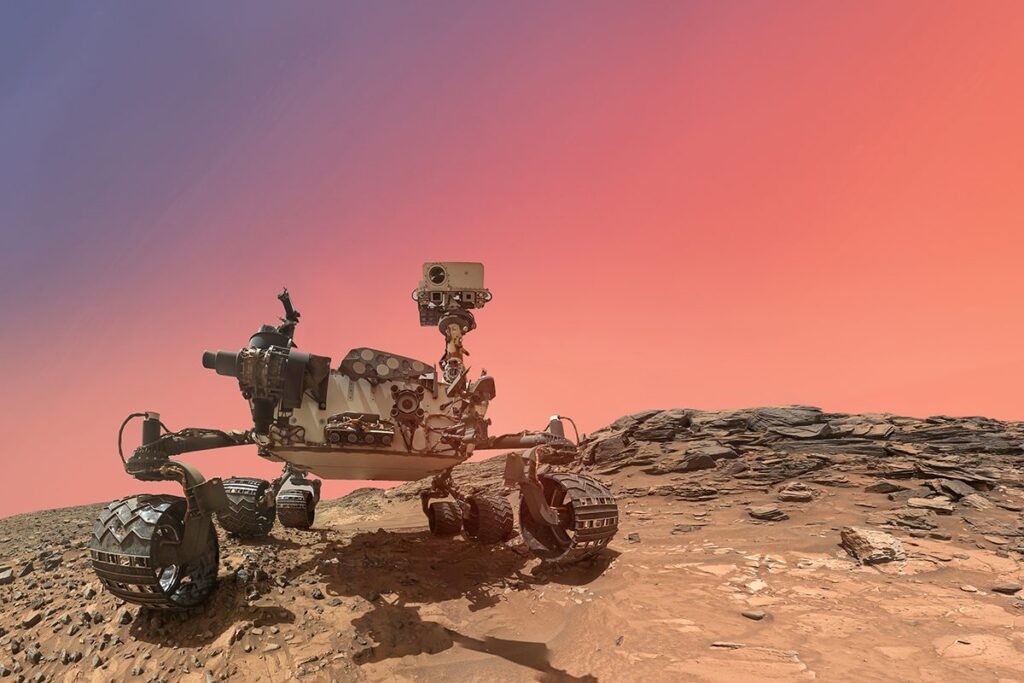
A NASA rover on Mars has completed the first ever trip on another world entirely planned by Artificial Intelligence.
The Perseverance Mars rover completed the journey on 8 and 10 December 2025, its various way points designated by generative AI.
 Credit: NASA/JPL
This, says NASA is a complex, decision-making task that’s normally performed by human mission scientists on Earth.
But this time, the team used vision-capable AI to create a route over the Martian surface without the use of human input.
Animation showing NASA’s Perseverance rover’s point of view during a drive of 246 metres (807 feet) along the rim of Jezero Crater on 10 December 2025, the first route driven on another world planned by AI. Credit: NASA/JPL-Caltech
AI finds the way
To carry out this demonstration, the Perseverance rover team used a type of generative AI called ‘vision-language models’ that had access to existing data from the mission’s dataset.
The AI used the same imagery and data that humans use to generate fixed locations on Mars where the rover picks up new instructions. These are known as ‘waypoints’.
Generative AI also used imagery from the HiRISE camera onboard NASA’s Mars Reconnaissance Orbiter, which orbits Mars.
And it used data from digital elevation models to study the Martian terrain and identify potentially hazardous features like boulders, sand ripples and outcrops.
Using all this data, the AI was able to produce a continuous path for Perseverance on the surface of the Red Planet, including waypoints.
On 8 December 2025, Perseverance drove 210 meters (689 feet). Then on 10 December, it drove 246 meters (807 feet).
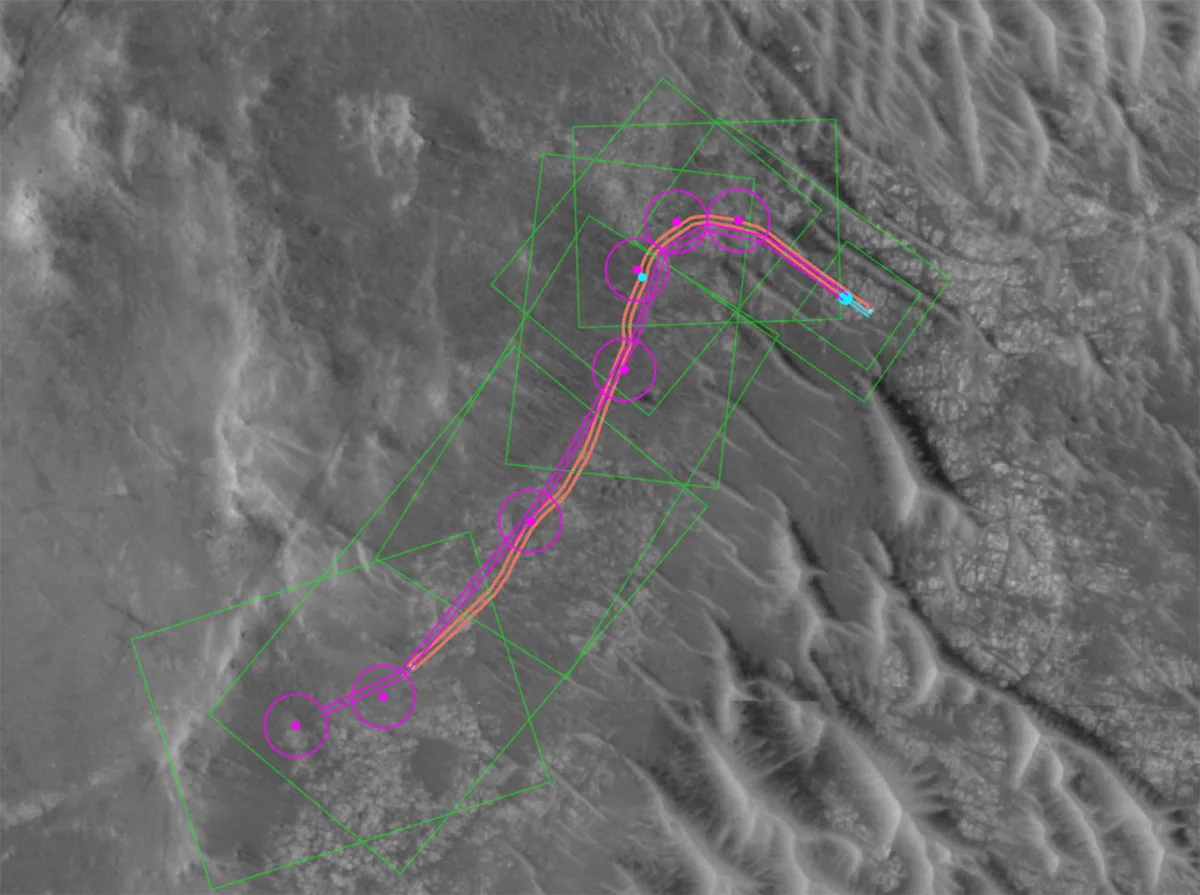 Annotated image showing the AI-planned (magenta) and actual (orange) routes NASA’s Perseverance Mars rover took during a demonstration drive planned by generative AI, 10 December 2025 Credit: NASA/JPL-Caltech/UofA
What the scientists say
“This demonstration shows how far our capabilities have advanced and broadens how we will explore other worlds,” says NASA Administrator Jared Isaacman.
“Autonomous technologies like this can help missions to operate more efficiently, respond to challenging terrain, and increase science return as distance from Earth grows. It’s a strong example of teams applying new technology carefully and responsibly in real operations.”
“The fundamental elements of generative AI are showing a lot of promise in streamlining the pillars of autonomous navigation for off-planet driving: perception (seeing the rocks and ripples), localisation (knowing where we are), and planning and control (deciding and executing the safest path),” says Vandi Verma, a space roboticist at JPL and a member of the Perseverance engineering team.
“We are moving towards a day where generative AI and other smart tools will help our surface rovers handle kilometer-scale drives while minimising operator workload, and flag interesting surface features for our science team by scouring huge volumes of rover images.”
“Imagine intelligent systems not only on the ground at Earth, but also in edge applications in our rovers, helicopters, drones, and other surface elements trained with the collective wisdom of our NASA engineers, scientists, and astronauts,” says Matt Wallace, manager of JPL’s Exploration Systems Office.
“That is the game-changing technology we need to establish the infrastructure and systems required for a permanent human presence on the Moon and take the U.S. to Mars and beyond.”