
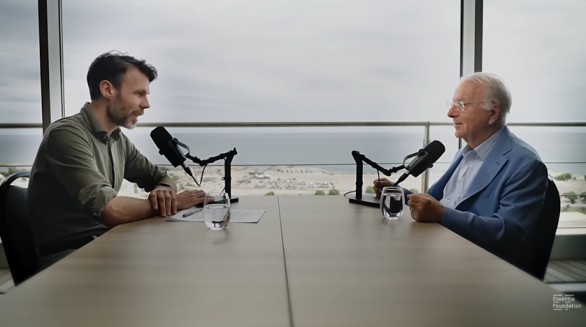
Right. So we’re living in a sort of consciousness speaking, writing to itself. Right. That’s the way to understand it.
FEDERICO FAGGIN: Yeah, yeah. One, the totality of what exists, knows itself through our own knowing ourselves, which requires communicating with each other because we are parts, whole of one. In other words, we are parts that contain the whole. The reality is holographic, in other words. And holographic means that the whole is containing the part.
I notice often that the cells of our body are built the same way. Each cell has the genome of the egg that created the entire organism. So each cell has the blueprints of the entire organism. So look at that. Even the body, which is a perishable thing, perishable construction, has the same holographic properties and organization.
Reversing the Big Bang Story
HANS BUSSTRA: And for people to understand your sort of cosmology. Right. So let’s, if you’re okay with that, let’s start with the very, very beginning. So the classical story we know is sort of the Big Bang stories that we have the Big Bang, we have the formation of stars. Then we have chemistry.
And chemistry, somehow, that’s sort of a first miracle, you could say, leads to biology. No one truly understands how. And then biology leads somehow to consciousness also. Again, no one truly understands how. But that’s sort of the story we all grew up with. So people will know that story. Then come you, you turn it around, because it’s no, consciousness is not the end of genesis. It starts with consciousness.
FEDERICO FAGGIN: Okay, all good.
HANS BUSSTRA: So that’s a nice, nice picture. But then you do also have a lot to explain, right? Because how, from being a one conscious field, do we get to sort of this here? I mean, that’s just, it’s also a crazy story in a sense. But please explain your sort of line of reasoning there.
Starting With the Whole
FEDERICO FAGGIN: Yeah, well, you know, scientism is materialist and reductionist. So scientism starts with the idea that there are separate aspects, separate parts. You know, atoms, molecules, particles, they’re separate. And so they are trying to understand the universe, combining aspects, particles, atoms and molecules, as if you could express and understand the whole using parts that are separated when their nature is not to be separated.
This is what quantum physics, the quantum field theory, have shown that the foundational aspect of reality are the quantum fields of particles. So already quantum physics is saying everything is interconnected. And the interconnection comes from what is called quantum entanglement.
The entanglement is that the aspects of the states of the fields, when they interact, they create properties in common that connects them independent of the distance. And therefore, you have properties here that says that nonlocality is the way the universe is built.
Where the old idea of science, up until, you know, the understanding that there is entanglement, was that there is locality. In other words, properties and actions can only occur if you have interactions which are at the vicinity of where the, you know, where the species are, where the atom or molecules or particles are.
But in this case, there is what appears to be action at a distance, instantaneous action at a distance, which is incomprehensible with the way in which we understand the world. And now it has been proven. The last experiment that proved without any doubt that this must be so was done in 2014.
So here we have in front of us a reality that says everything is interconnected. There are no parts, no separable parts. You cannot start with separate parts. Then you have to start with the whole. And if you start from the whole, you have to explain then why the parts come out of the whole.
This is a complete reversal from the way science, science in the beginning now becomes scientism, a belief system. You know, a dogma says that the world has to be built this other way. No, in fact, probably 100 top physicists today want to start from the whole and derive the parts because they have understood that trying to go the other way gives, you know, leaves you empty handed.
HANS BUSSTRA: Yeah.
FEDERICO FAGGIN: In fact, you know, string theory, which tried to explain reality from the parts, which are strings that vibrate, did not succeed. And you know, it took about 80 years of hard work. At one point, 90% of the, you know, the physicists, theoretical physicists were working on string theory. They didn’t get anywhere.
So that’s telling you that no, we have to start with the whole. Wow. That’s difficult because the whole not being able to being separated into parts brings into question even the nature of mathematics. Because the nature of mathematics, mathematics starts with parts. These sets, the sets that define that, you know, this element is either in the set or outside the set. You have to find true and false.
But if everything is interconnected, what is true and what is false? You see, you know, there may be areas where they are both true and false. For example, look at the color. Let’s take the color red and the color orange. Do you, is there a boundary between the two? Can you define a boundary that says from this side of the boundary is red, the other side of the boundary is orange. Is that possible?
No, no. There is a region where you can say is both orange and red or is neither orange or red.
HANS BUSSTRA: Yeah.
FEDERICO FAGGIN: This is reality. This is the deeper reality is made that way. It is in our face. The colors which are qualia are that type of reality.
The Participatory Universe
HANS BUSSTRA: I love what you’re saying in that sort of, I think it’s nice for people to dive as we now are in the quantum and discussing the oneness and interconnectedness. It makes me think about sort of John Wheeler, who came up with that participatory universe.
FEDERICO FAGGIN: You.
HANS BUSSTRA: Right, and yeah, but we have the Big Bang and with the conscious observer and he sensed that both are connected in a way we don’t understand yet. And it’s participatory. So and basically when you say sort of the red and the orange. If we, sorry, yeah, red and orange. If you would say red and orange in that, where is it red? Where is it orange? Where’s the observer and an objective outside world, subject, object, divide, where do you point it?
And then the question becomes if you, that dualistic picture is naive. He knew that. I mean, and quantum physicists now know that subject object divide is arbitrary, where to put the cut. And then we have to pick. Right. Then we’re in this position. Are you staying putting your bets on an objective world matter and then saying somehow dualistic needs to arrive at sort of that subject?
Or you put your bets on subjective experience and you clearly are on that side. Same thing. That’s consciousness first. And I get that. But for people who find that hard to do, just grew up, but, but Federico, it’s matter. I just have a body. It’s a material universe. How can you say it starts with consciousness? What’s your most simple reply to them to make that, that leap?
The Hard Problem: Consciousness Cannot Emerge from Matter
FEDERICO FAGGIN: How can you get consciousness from matter that doesn’t have any consciousness? How can something – how can more come from less? You have to start there because you cannot explain how matter can know itself. If it is matter, it shouldn’t be conscious and it is defined as non-conscious. So how can you get consciousness out of something that doesn’t have it?
Even worse, free will. How can you get free will from a world that is supposed to be deterministic? Objects in space and time are deterministic. And in quantum physics, quantum physics does not describe the motion of objects in space and time. The state of a field has nothing to do with – it doesn’t describe reality. It describes all the possibilities that you could possibly measure of something, but with their probability.
So it only can tell you what is possible to know about reality. That’s not what is possible to know about reality. It’s not reality because reality is what actually is shareable. We can all see the same thing. Quantum physics, in fact, is actually pointing to the mind of the universe, to a quantum computer of the universe that makes predictions about what might happen. But what will happen is based on free will decisions of the fields which are the components of this reality.
HANS BUSSTRA: Einstein said like God doesn’t play dice, right? And he pointed to sort of – he couldn’t live with that idea that this random – so I guess I thought about that in preparing this interview, thinking, linking this to Einstein, because you would agree it is not playing dice. It’s free will, it’s a decision.
FEDERICO FAGGIN: That’s right. Yeah. You know, Einstein being – because he believed in determinism.
HANS BUSSTRA: Yeah.
FEDERICO FAGGIN: Couldn’t make that leap. Yeah, exactly. Say and say, no, no. You know, the fact that quantum physics only gives us probability of all the – of whatever might happen, but it doesn’t tell you what will happen. And so – and there is a known – there is a postulate that is essentially that says that from the probability to what you – the actuality, many probabilities to one actuality. What actually manifests in space and time. Nobody knows how that process works.
HANS BUSSTRA: No single particles we do not know, right?
FEDERICO FAGGIN: It’s called collapse of the wave function.
HANS BUSSTRA: Yeah.
The Collapse of the Wave Function and Free Will
FEDERICO FAGGIN: And nobody has an explanation for that. We know that it is random and it is non-algorithmic. So all of a sudden, what can be random and non-algorithmic? A free will decision. A will of the field that you observe, not of the observer. See, in the past there was this theory that the observer may collapse the wave function. Yeah, this is not what this theory is saying.
What I’m talking about is the field that you observe, but in fact the field that interacts and plays the role of an observer. Because each field is observer, observed and agent. All three. Every field plays all these three roles because there are only fields that interact with each other.
HANS BUSSTRA: Yeah, so this – yeah, yeah, this – but here we definitely sort of pause and explain because this is again your sort of – I call it like your cosmology. But it would be like the conscious field starting to – in starting to – wanting to know itself, so to speak. I’m trying to understand this. It starts communicating. And you say that you need symbols to communicate. You need symbols and you need to agree on those symbols, otherwise you cannot talk.
So that would be like consciousness reflecting on itself. And it would be the first, what Bernardo would call dissociation. I’m curious how you though, reflect on that process, how we get from one to that first divide of it looking upon itself. It would need a symbol to communicate. And those symbols have to look like something. And they are sort of physical reality.
But at a certain moment, that physical reality had sort of special features, life. Right? Because stars is all that’s physical. But then we had the magical moment where somehow it started to be able to recreate itself. Like recreating symbols that sort of I write down. And then all of a sudden the symbols start doing stuff like wow. And I created that. And then – but correct me if I’m wrong.
FEDERICO FAGGIN: I –
HANS BUSSTRA: Find a way to incarnate in that. Like, can I enter that? Like I built this in your image. In our previous conversation we had the metaphor of the drone, right? You said the drone metaphor. Okay, I create this drone and I created the space where a drone flies. And then I all of a sudden notice, hey, wait a minute, there’s a way for me to communicate in a drone. Hey, how cool would it be if I’m in that drone? That’s amazing. And then the story gets – and there we get lost, right? Then we got – but is this a way to get it? I thought sort of how to get my head around it, based on a previous conversation.
Starting with One: The Principle of Wholeness
FEDERICO FAGGIN: Yeah. So let’s start with a principle.
HANS BUSSTRA: Yeah.
FEDERICO FAGGIN: Okay. We have to start with everything, with the whole, with one. We cannot start with the parts. The parts are emanation of one. Now, there are parts because we experience parts. Even quantum theory says there are quantum fields. And those are considered separate, though they interact with each other. And when they interact, they entangle. So they’re not really separate because that entanglement remains independent of space and time.
So yeah, so even that is not right. Okay. But this preconceived idea that we had to start with parts and that everything is material is all this, you know, is weighing heavily on us as we try to figure out what’s going on. So we had to get rid of that for a second.
So let’s think that one, which is defined as the totality of what exists, has three properties: is dynamic, holistic, and wants to know itself. Dynamic and holistic is what quantum physics is already saying. The, you know, all that exists is never the same. Instant after instant keeps on changing, changes all the time. And everybody agrees with that and is holistic. Everything is interconnected. It’s not made of separable parts. This is what entanglement is shown. The world is like this.
I have added “and wants to know itself.” Why am I doing that? Because the evidence is that consciousness and free will, which are the aspects of wanting and the aspect of knowing itself – because for one to know itself, it must be conscious, it must experience itself. And in that experience, know itself must be fundamental because they cannot be explained with something that doesn’t have those properties.
Matter without consciousness and without free will cannot create consciousness and free will, period. Lots of people are trying to figure it out, but myself tried to figure out how to make a robot that was conscious. I couldn’t do it. There is no way that you can transform electrical signals, biochemical signals, any kind of signal, any kind of information into consciousness and free will. There is no way. So you got to start there.
So if you start there now, all of a sudden, and by the way, if you start there, when you say one, one also has – since one wants to know itself, where does it come? The self-knowing? Where is self-knowing of one coming from? It cannot come from nothing. Well, it’s coming from a potentiality, a potentiality, some possibilities. That potentiality is actually the best fit for explaining the quantum vacuum.
The Quantum Vacuum as Potentiality
Because in physics, quantum physics, there is the quantum vacuum, which is what is left when you take all the fields out of reality. And there is a quantum vacuum that has an inner energy with a density which is astronomical. It’s incredible how much energy there is in what’s supposed to be vacuum.
HANS BUSSTRA: Crazy.
FEDERICO FAGGIN: And this vacuum is kind of boiling up and is creating forms, you know, but they are not forms. They are kind of chaotic things. They appear, disappear, and, you know, and they’re called quantum, you know, foam. But, you know, this stuff is what is there before there is anything. Before there is form, there is this quantum vacuum. So that’s the potential of one. That’s new.
HANS BUSSTRA: This is not in –
FEDERICO FAGGIN: This is a little, you know, a little further, you know, into, you know, into the connection between, you know, physics and spirituality. Right. So now the first time that one knows itself – because there has to be a first time where one knows itself.
HANS BUSSTRA: Yeah.
FEDERICO FAGGIN: At least in the narrative. Okay. Because they may – but, you know, the question is, what is time? We have to figure out what is time. Okay? So let’s not – let’s not go too far. Let’s start from, you know, from the first time the one knows itself. What happens? It brings – one brings into existence what he knows. So knowing and existing are two faces of the same coin.
HANS BUSSTRA: Yeah.
FEDERICO FAGGIN: So now knowing, we now understand what knowing is. Knowing is an experience. That’s me. One says, oh, that’s me. It knows itself.
HANS BUSSTRA: Yeah.
The First Act of Self-Knowing: Creating Part-Wholes
FEDERICO FAGGIN: It brings into it – at the same time that it knows itself, it brings it into existence. Okay. And it must be a part-whole of itself. Why? It’s not made of parts. One is not made of parts. It cannot see itself just a little bit. It’s got to see itself completely in the direction in which it looks at itself.
What is direction? The direction is the identity of what it brings into existence. That’s the identity of the sat. It brings into existence a satiety, a part-whole of itself, that now being a part-whole, must want to know itself. That part wants to know itself, just like one wants to know itself. And it can create other parts out of itself just exactly like a cell that duplicates.
HANS BUSSTRA: That’s exactly what I was wanting to say.
FEDERICO FAGGIN: Life starts with one. It doesn’t start with a cell.
HANS BUSSTRA: I had that image of one, and I was wanting to say to you that’s the true Big Bang, that moment of self –
FEDERICO FAGGIN: Yeah. The Big Bang is the moment where you go from nothing – nothing, the quantum vacuum, the potential existence – to, you know, one knows itself.
HANS BUSSTRA: But like a full – Federico, would it be like a full self-knowledge, like a full part-whole, like a full copy of itself, so to speak?
FEDERICO FAGGIN: Well, it contains the totality of itself, but within that direction which has known itself.
HANS BUSSTRA: Yeah, exactly. That perspective on itself, like a snapshot.
FEDERICO FAGGIN: Next time around, it sees itself in another perspective. It brings into existence another part-whole of itself.
HANS BUSSTRA: Okay. Then we have those part-wholes.
FEDERICO FAGGIN: That’s how part-wholes are created. They are just like cells. Yeah, they’re cells out of it, you know, of it. The egg being one is the egg that creates another cell, another part-whole. Yeah, just like life, man. Same way.
The Metaphor of Life: Cells and Self-Knowing
HANS BUSSTRA: Yeah. For people who think this is crazy stuff. I mean, the other story –
FEDERICO FAGGIN: Crazy stuff. To think that life comes from nothing.
HANS BUSSTRA: Yeah, exactly. The other story is crazy as well. The other story is just as crazy to start saying that we need to build up stuff. It’s called the combination problem. And it’s a very profound philosophical problem, practical problem. It’s a problem panpsychism has. And this is sort of the decomposition problem, how we get from one to those separate parts. And I do think, in a sense nature is giving us more metaphorical images that we can relate to that are in favor of that. That we see splitting off.
FEDERICO FAGGIN: Of course.
HANS BUSSTRA: Yeah, that’s cool stuff.
FEDERICO FAGGIN: But it explains, for example, why life has to occur because, you know, and it starts from the concept of self-knowing, knowing, which is foundational. Even science is about knowing, for Christ’s sake. It’s not about something else. It’s about knowing.
HANS BUSSTRA: And then we have fiery course. So then the knower, the that which knows. So that’s that – that’s that part-whole, that satiety that now can also know. Start knowing, right?
FEDERICO FAGGIN: Yeah.
HANS BUSSTRA: Yeah. Okay.
FEDERICO FAGGIN: She knows itself. That – that sat. It knows itself with that identity, with that point of view.
HANS BUSSTRA: Yeah.
FEDERICO FAGGIN: It’s like a, you know, it’s like a, you know, the Satan becomes conditioned to observe reality with that same point of view with which one knew itself when it created this satiety.
HANS BUSSTRA: Yeah. And then that which is known, so the knowing bit starts. Knowing itself has to – because, I mean, think where – so we get to physical reality, how we get to information, what you call sort of information and physical, sort of life information and the physical, how we get there.
The Nature of Creation and Knowing
FEDERICO FAGGIN: Yeah. Anything that a satiety knows for the first time brings into existence the same way that One brought into existence the satiety when he knew itself that way. Same way, in other words, any new knowing is a creation, is not a combination of stuff, is a new creation. That’s where creation comes from.
HANS BUSSTRA: Yeah. And sort of physics, the metaphor physics gives us is the collapse of the wave function.
FEDERICO FAGGIN: Yeah.
HANS BUSSTRA: Because that’s potentiality. And when we want to gain knowledge, we have to collapse. And then we have a particle.
FEDERICO FAGGIN: Yeah, but that is – you see, the crucial thing is that knowing is about meaning. It’s not about symbols. So far I haven’t even mentioned symbols. The symbols are what are needed for the satieties to communicate with each other. Why? Because what they feel, their own experience and their own knowing cannot be duplicated. Exactly. The property of quantum fields. The state, the quantum state of a field cannot be reproduced. Now you see the connection of what I’m talking about with quantum physics explaining why it has to be that way.
HANS BUSSTRA: Yeah.
FEDERICO FAGGIN: Because the self knowing, that’s a property of consciousness. It’s not a property of information. The information of a computer can be copied as many times as you want. But the love that I feel for my son, I cannot even give it to him. No, I’m the only one to know that love. How do I know it? By feeling it, by experiencing, by qualia. But qualia are the bringers of meaning. What I really care about that feeling is what does it mean and the meaning.
So the meaning of information, or quantum information in this case, is the essence of the spiritual aspects of reality, of who we are. So there is body, mind and spirit. The body is classical information, the mind is quantum information. And the spirit is meaning. The meaning of quantum information.
Body, Mind, and Spirit: The Color Wheel Model
HANS BUSSTRA: That’s beautiful. This is also –
FEDERICO FAGGIN: That’s a step forward.
HANS BUSSTRA: I’m somewhat myself, sort of find it hard to distinguish between mind and spirit. Right. Where to exactly? Where’s that boundary? And also in sort of how we can experience that boundary. Ah, this is the mind, Federico. Oh, no, this is my spirit talking. How, how’s that. Where’s that boundary?
FEDERICO FAGGIN: But the way to understand is, you know, every satiety – and of course, One itself, when it creates, when it knows itself, it knows itself in these three ways. So body, mind and spirit cannot be separated. Remember, just like the colors. In fact, a good way to think of this is the color wheel. You know, the color wheel. Okay. Red, green and blue, right.
So if red is the body, green is the mind and blue is the spirit, they have overlap regions. There is no single boundary between red and green. There is an overlap. What is that overlap? What does it represent? That represents what I’ve called live information. Quantum and classical information. The information that describes life, biological life, which is not classical information. You need that kind of new type of information. It is a deep overlap between body and mind. What is the overlap between mind and spirit?
HANS BUSSTRA: That’s qualia.
FEDERICO FAGGIN: Qualia. The quantum state. Quantum states that become experience in the consciousness of the entity, which is this aspect, the spiritual aspect that has consciousness, free will and identity is in the spirit. It’s not in the mind, it’s not in the body. Oh, what is the overlap between – and this is the new thing, because normally we think of spirit, mind and body in linear fashion. Yeah.
HANS BUSSTRA: Hierarchy. Yeah.
FEDERICO FAGGIN: No, in this way is a circle. So there has to be an overlap between spirit and body. What is there?
HANS BUSSTRA: Yeah, tell me.
Spacetime as Permanent Memory
FEDERICO FAGGIN: The permanent memory of the experience of the self knowing of One – space, time and matter. Permanent matter, because the memory must be permanent. Remember that I said that in the previous conversation that we had that the quantum state keeps on changing. So you need to put – if you need to remember the quantum state, you need to put whatever happens, you know, your experience in the quantum state must be put into symbols, into permanent symbols so that you can recall your experience.
You need memory because the experience only lasts in a very short period of time in the present. And in the present you must put into memory what you experience. And so there is no past. What you experience becomes permanent memory. So there is no past – you experience in the present. In the present you got to put in memory your experience. So you put into – you transform what you think of time into matter, permanent matter, which is what gives you the memory of what you just experienced.
Also in that same present, you want to predict what might happen in the future. Right. That’s what the mind does. That’s the quantum computer, which is mind does for you. It can give you probabilities of what might happen in the future. But what might happen in the future is exactly what you need to decide to express or the satiety need to decide to express. So all of a sudden that happens also in the present.
So in the present you have the memory of the past experience and the prediction of the future. And also in the present you make the decision of what to manifest. What you manifest then becomes the new body.
HANS BUSSTRA: Wow.
FEDERICO FAGGIN: Because it has to be in the shareable. That’s like the display of the system, the display, which is where we all exist, you know, where all physical things exist in a sort of a display of reality, which is the body. Yeah, but there is also behind that body there is a computer. And the computer is a quantum computer, which is what I call mind.
HANS BUSSTRA: Yeah.
FEDERICO FAGGIN: And, but it goes beyond that. And that’s what most people don’t – some people got that you need body and mind, but they didn’t get the spirit, the meaning of the experience. So what do you put into – you cannot copy the state, the state of the field. You know, you cannot do that, but you can put into symbol. You can put into symbol the meaning of that experience.
HANS BUSSTRA: Yeah.
FEDERICO FAGGIN: The meaning of the state that you experience. The qualia that you experience, that you can put into symbols.
The Display of Reality
HANS BUSSTRA: I’m trying to bring it back and to exactly how I’m sitting here with you. I mean the overlap. We’re literally talking physical body. Are we talking physical – my physical body here. So this overlap to the spirit body overlap manifests itself right here then, right?
FEDERICO FAGGIN: Yeah, it manifests in this shareable. This is shareable reality. Think of space, time and matter. You know, matter, energy as the display of a, the classical display of a quantum computer.
HANS BUSSTRA: Yeah. And a memory display. It gives us all states. It’s a memory.
FEDERICO FAGGIN: But then the interpretation of the bits that exist in that display is in our consciousness. Yeah.
HANS BUSSTRA: It’s again in consciousness, not in space. And time is again in consciousness. But then, then the reality as we perceive it is this big library of experience, states of consciousness. It’s a library of content of consciousness. Would that be a way to put it?
FEDERICO FAGGIN: The, you know, our experience. Right, our experience, the meaning of our past experience is also something accessible only by my consciousness – is not in space and time that is in some. But it is in some kind of space time matter. But it’s not the kind of space time matter that we normally think about.
HANS BUSSTRA: Yeah, yeah.
Dark Matter as Cosmic Memory
FEDERICO FAGGIN: For example, right now the only hypothesis that I have for the matter that will represent permanent memory of the experience will be dark matter. Because dark matter doesn’t interact with real matter or energy. It’s just something we just discover. Fifty years ago we discovered that we have to have dark matter, which is a lot more percentage wise.
HANS BUSSTRA: Yeah.
FEDERICO FAGGIN: Than the matter that we knew.
HANS BUSSTRA: Yeah.
FEDERICO FAGGIN: Okay. So dark matter could be a candidate for structures that are permanent and represent the memory of the experience of the satiety and the experience of One.
HANS BUSSTRA: Yeah.
FEDERICO FAGGIN: Also the expansion of the universe has to occur if there is a continuing self knowing of One that keeps on growing.
HANS BUSSTRA: You need that knowledge needs to be stored somewhere. You need more –
FEDERICO FAGGIN: More and more space and space time.
HANS BUSSTRA: More space time as a hard drive for that experience.
FEDERICO FAGGIN: What we call space time. Yeah, but this is all – you know, this is highly speculative at this point, but it gives you a sense of the way I’m thinking.
The Challenge of Idealist Thinking
HANS BUSSTRA: It’s super interesting. It’s also highly abstract and I think it’s very hard to follow. I find it hard to follow. But I do think it’s just important to notice that one should take that leap – that first postulates of your postulates and which are close to idealism. They are idealists. If you – once you say all its consciousness, then everything you perceive reflects back and it’s just consciousness reflecting back on itself. And then it starts, it does start making sense. It’s just our – we are so biased in our – we’re so immersed in our materialist thinking.
FEDERICO FAGGIN: But Hans is conditioned. It’s hard to follow. Quantum physics. Quantum physics. The same physicists that know the equation say, “I don’t understand what they mean.”
HANS BUSSTRA: Yeah.
FEDERICO FAGGIN: It’s actually crazy if you think about it. Now, if you start from this posture that I said earlier, you can explain why quantum physics must have those properties and nobody has understood. Come on. I mean, this actually explains. Now there is a posture that explains what nobody has ever been able to understand. And that’s – to me, that’s a big step forward.
HANS BUSSTRA: Absolutely.
FEDERICO FAGGIN: You know, now the quantum fields are conscious and therefore you can interpret – now the collapse of the wave function as a free will decision of that quantum field is the one that decides where to show the electrons in the double slit experiment.
HANS BUSSTRA: Yeah.
FEDERICO FAGGIN: Is the field that interacts with the field of the instrument. But that interaction is the field inside. I’m going to show the electron over here. For whatever reason he does, that’s his own will. Free will. You see, I think how you explain, you know, otherwise is everything is just chaos. It’s just randomness.
HANS BUSSTRA: Yeah.
FEDERICO FAGGIN: We explain life as randomness. How can you explain life with randomness? The same way that we explain, you know, consciousness with something that doesn’t have consciousness. Same way we pull it off, you know, out of a hat.
HANS BUSSTRA: Yeah. Love it when you’re fired up like that. It’s amazing. I like it.
The Epistemic Turn in Physics
HANS BUSSTRA: My take on it is, Federico, I’ve been exploring for the last year the foundations of physics, talking to like super smart physicists that you will understand much better than I do. But what I did get from them and visiting these conferences is sort of this, what they call this epistemic turn. Right. That now also in the foundational physics, they won’t go as far as you, but they are saying, “Wait a minute, this is not about objective reality, it’s about our knowledge of reality.” That’s right.
So that’s a bit sort of still Copenhagen interpretation. Yeah, but then they still shy away from stuff like they want to stay away from what an observer really is or what measurement really is. Yeah, they just say it’s about knowledge. Right. That’s as far as they now go.
Sometimes I think that it takes a deep, profound personal experience to be able to make that leap. And I – to what degree do you think you would be able to come up with this theory hadn’t you had that deeply personal experience?
The Part-Whole Experience
FEDERICO FAGGIN: I would not have been able to, no, because you have to experience yourself as a part-whole. Otherwise how can you say that there are parts-whole? It’s such a different kind of explanation. Then after you have experienced yourself as a part-whole, then you can understand that ourselves are also parts, all of the organisms.
But I never read in any book of biology that our cells are parts all of the organism. I can say it because I understand that I am a part all of One. And therefore, and also that the nature has a fractality. You know, the same structure is repeated at different scale. I mean, a cell of our body is just like we are part of One.
Now there may be many, many steps in between, but at least there are, you know, we have the smallest one that we know and the largest one, which is us being part all of One.
HANS BUSSTRA: Yeah, but I do think, I mean, amongst scientists and physicists, it wouldn’t count. And I’m not saying, I’m saying that, but it wouldn’t count as a strength if people, the fact that you have had to add a deeper spiritual… It wouldn’t count as a strength. It would rather, it would be suspicious. Right. Because we want to be objective. Right.
And even in psychedelic sciences it is sort of… People are wrestling ethically, should I myself undergo a deep psychedelic journey or should I stay outside? And it’s, it just… I don’t have a very strong opinion here. The only thing is that it all relies on a basic object-subject divide that you think you can uphold. As if there is this position as a scientist.
FEDERICO FAGGIN: Look, I mean, you know, you can find out by yourself, not by taking drugs. I don’t suggest to take drugs to experience yourself as a part-whole. You have the capacity to experience yourself as a part-whole without drugs. Otherwise, how can you be sure that you know? You don’t know. You know.
HANS BUSSTRA: Yeah.
FEDERICO FAGGIN: So you experience yourself as a part-whole. Each one of us can. You don’t need a big atom smasher. Right. You are now believing what a scientist is telling you by having used instruments, multi-billion dollar instruments to tell you what reality is. Now I’m telling you a deeper reality, the most profound reality, and you can find out by yourself. Okay.
HANS BUSSTRA: No Large Hadron Collider.
FEDERICO FAGGIN: No Large Hadron Collider. Isn’t that better?
HANS BUSSTRA: Absolutely. Please, please, please tell us how. How can people… Because it is a big question.
FEDERICO FAGGIN: You got to want to know.
HANS BUSSTRA: You got…
FEDERICO FAGGIN: I mean, the same way I wanted to know.
HANS BUSSTRA: It starts with wanting.
The Path to Self-Knowledge
FEDERICO FAGGIN: Unhappy about myself. I knew that I was responsible for my unhappiness because as a, you know, as an entrepreneur, I found out that the buck stops there. Right? So I have to accept that the good or bad of the company depends on me being in charge of the company that I started.
So once I made that step, meaning I am responsible for most things or everything that happens in my life. Okay. I made that. Then when I found out that I was unhappy and I pretended to be happy, I said, well, I am responsible for that stuff. So now being responsible, I want to know. Because how can I be responsible if I don’t have the capacity to then find out? It would be a joke that the universe is playing on me.
No, I trusted the universe not to take me to a loop. Right. I trusted it and I said, I want to know. And I got the experience. I didn’t know. I never read anything like what I experienced. I could not even imagine that it would be possible to have that experience. Right. So, but it came. The same can happen to you if you want.
HANS BUSSTRA: Yeah. It has to do with truly wanting to find out. Yeah, yeah.
FEDERICO FAGGIN: But why do we want to know ourselves? Right. You know, what is so fundamental? One wants to know itself.
HANS BUSSTRA: Yeah.
FEDERICO FAGGIN: We want to know ourselves. Same thing.
HANS BUSSTRA: Federico, have you continued sort of, once you had that deep experience and you wanted it, did it become something, a place where you found your way to go to whenever you feel… Now it’s time again to connect to spirit, so to speak.
FEDERICO FAGGIN: If I’m talking spiritually, I mean, that experience drove me to spend 20 years of my time at 30, 40% of my time to explore, to understand that experience. So that experience had the power to drive me to spend, you know, one third of my time, more than one third of my time to find out about and understand that experience. And it took 20 years to arrive to the, you know, to the hypothesis. The consciousness and free will must be foundational.
HANS BUSSTRA: And Federico, is it, is that theory in that, in that sense also… Is it that interaction of body, spirit, mind that also led you to the theory? Because many, very often science is associated with mind and body. Of course we study body within our minds and then we come and spiritual people then start being critical about that.
All those scientists and they all… Federico wanting to grasp it with his mind. The yogis knew, Buddha knew. And we have now this guy from Italy. Yeah sure he’s smart, he, I mean he invented the microprocessor but ah, so funny he wants to grasp this intellectually and they knew. What’s your response to that? They already knew.
FEDERICO FAGGIN: That response is that that is the same, the same arrogant point of view of scientism that believes to know everything.
HANS BUSSTRA: But then the spiritual, spiritual version of…
FEDERICO FAGGIN: The spiritual version of it, same stuff.
Bridging Inner and Outer Science
HANS BUSSTRA: The Essentia Foundation is all about the metaphysics of idealism, also known as non-dualism. And Federico Faggin’s theory roots this ancient intuitive worldview in science. And this is where the sponsor of this video comes in.
Consensus is an AI-powered science search engine that lets you instantly search over 220 million peer-reviewed papers with direct links to the studies. For instance, if I ask “Do neural processes explain consciousness?” Consensus immediately surveys the most highly cited studies and papers and presents me with a consensus meter. You can directly click through the scientific sources. For example, this highly cited paper by Christoph Koch who we recently featured on our channel.
If I now ask the million dollar question, “Is the universe fundamentally mental or material?” The honest answer is now that there is no scientific consensus on this metaphysical question. But I do get a comprehensive overview of the scientific debate with all its different claims and the strength of their empirical support.
This makes Consensus a great research tool that stands out in comparison to other LLMs because it is not clouded by blog posts, social media or other pseudo-scientific sources. And it helps me in creating podcasts like these because I need to get a quick, efficient and reliable overview of where the science actually is.
Consensus can be used for free, but if you want access to the pro features, you can click in the link below in our description to get a one week free trial and a 30% discount for the first year thereafter.
Since this is the first sponsor that the Essentia Foundation presents, I do want to make an ethical statement. Our foundation is editorially completely independent. We’re not affiliated with any of our sponsors and we only accept sponsorships if they are compatible with our mission and scientific standards. And now back to Federico.
Finding answers within whether we call that spirit, One… Those are all labels, of course, in the end. And then coming back, I’m talking about in your theory, something that is not shareable. In a sense, it’s non-clonable. We know that. So I need a translation there. So what is the truth value? How can we sync it? How can it lead to a new science that sort of incorporates this in its methodology? Right.
That scientists start meditating, start accessing other states of consciousness and we can talk about that as if that’s something exotic. But I always like to mention the fact that Einstein himself would say that general relativity came to him sort of in dream states. Tesla we can mention, I mean, there are numerous people. And now you are openly saying that your theory also sort of in a sense came to you, right?
FEDERICO FAGGIN: Of course.
HANS BUSSTRA: But how to make a system of rigorous science out of that, a methodology and a new science.
FEDERICO FAGGIN: Well, basically, if you take this seriously, you begin to investigate it using the rationality and the experiments. But now the experiments must be both inner and outer because you cannot, you know, you cannot talk about consciousness if you accept, if you do not accept that there is an inner reality.
You have to start with some, you know, with a postulate. The postulate is the, you know, consciousness starts from the field that we are, not from the body that we are. Because, you know, if you start with scientism, we are the body. So everything that happens in us should be, you know, should come from the body. Okay. I don’t know if you know the experiment of the rubber arm.
HANS BUSSTRA: Yeah. Please, please explain it to our viewers.
The Rubber Arm Experiment
FEDERICO FAGGIN: The experience of the rubber arm is that you have your arm here. Then you put a barrier so that you don’t see your arm, you see another arm next to it which is made of rubber. And then you kind of cover it up in such a way, you know, with something similar to what you were wearing, you know, so, and now you only see that rubber arm. Yeah. And then you start stroking, you know, with, you know, with say with a feather, stroking both hands.
HANS BUSSTRA: Yeah.
FEDERICO FAGGIN: Okay. After a while, your consciousness shifts from the true arm to the fake arm. After that, if you, with a pin, you put a pin on the fake and you ask, “Do you feel, do you feel?” “Yes, I feel, I feel, you know, I feel pinching.”
HANS BUSSTRA: Yeah.
FEDERICO FAGGIN: And you put the pin on the true hand, you don’t feel anything.
HANS BUSSTRA: Amazing.
FEDERICO FAGGIN: Now that type of experiment is being used to prove that consciousness is epiphenomenal, but in fact this actually is a much more of a proof that it’s not epiphenomenal. Because how can you feel pain in something that cannot feel pain? You see?
HANS BUSSTRA: And exactly tells you how your preconceived…
FEDERICO FAGGIN: Ideas force you to decide, you know, that one thing is true or false and you present it that way as a scientist and then you, you know, then basically you perpetrate a total misunderstanding of what’s going on.
HANS BUSSTRA: Also, I would say if you pinch the arm, then your real arm, you don’t feel it anymore. Is such a strong proof that there’s something profoundly strange here. Because I mean, a physicalist would say those signals, we know, we measure them. And now all of a sudden in my brain those signals do not enter anymore. That’s right. Yeah.
FEDERICO FAGGIN: You see, it’s really, this actually is a proof that consciousness is deeper than the body, goes beyond the body. Should be a proof of that or certainly a plausible proof of that as opposed to a proof that it is epiphenomenal because it’s not in the body. Because you start with the presumption that consciousness has to be in the body. Therefore if it’s out of the body, it must be epiphenomenal. You see what I mean?
HANS BUSSTRA: Yeah, yeah. Crazy, crazy.
Out-of-Body Experiences and Physics
HANS BUSSTRA: And also, of course we know we are here at the conference of science of consciousness and there’s a lot of psi research on stuff like out-of-body experiences, extra-ocular vision, you name it. You know the phenomena. Right, phenomena that physicalist scientists, they cannot even study it because it would point to anomalies. Right. So you don’t want to go there.
FEDERICO FAGGIN: That’s right. Nobody wants to go there.
HANS BUSSTRA: Yeah. And you do have, I’m curious, sort of just speculating or thinking about the mechanisms there. If the self has an out-of-body experience and it can see itself, it is not using the quantum-classical device, which is my brain at that moment. Right. Because it’s accessing it from a different perspective. What mechanism is it using then?
FEDERICO FAGGIN: Well, there has to be a body associated with that.
HANS BUSSTRA: I’d say so.
FEDERICO FAGGIN: Yeah, absolutely. Which also shows that there must be aspects of physics that go beyond what we understand in physics.
HANS BUSSTRA: Yeah.
Because, you know, it’s called astral body in the literature that describes this kind of phenomena. But you know, clearly if this body, if you see yourself in the bed, where are the eyes that see? Clearly they are not your eyes. They are the eyes of this body that now your consciousness, your field is now using to have this experience.
HANS BUSSTRA: Yeah.
FEDERICO FAGGIN: You see, so it shows that there may be hierarchies about this as well.
Hierarchies of Bodies and Spiritual Experiences
HANS BUSSTRA: Do you have any clue how that? I mean, it could be. Of course it could be theoretically. Also in your theory, that could be endless. Could there be a sort of an endless hierarchy of different bodies?
FEDERICO FAGGIN: Not turtles all the way down.
HANS BUSSTRA: Turtles all the way down. No, but people who have had deeply life changing spiritual experiences, encountering entities, angels, you name it, God, deceased ones. That could all fit in this theory. That could all be sort of higher dimensional.
FEDERICO FAGGIN: Yeah, it could fit. It could fit. No, certainly can be. It can be explained with this, you know, with this theory. It cannot be explained with scientism. Yeah. You have to say this is bull.
HANS BUSSTRA: Yeah. And of course it’s important to say it doesn’t prove it, but it can explain it.
FEDERICO FAGGIN: Exactly.
HANS BUSSTRA: Yeah, yeah, yeah. Which I find super fascinating.
FEDERICO FAGGIN: But very often we use even, you know, extraordinary things like this thing of the arm that I mentioned earlier to actually pretend to prove your point, which is the consciousness is epiphenomenal.
HANS BUSSTRA: Yeah.
FEDERICO FAGGIN: You see?
HANS BUSSTRA: Yeah.
FEDERICO FAGGIN: When in fact it proves the exactly the opposite.
Science, Ethics, and the Nature of Good and Evil
HANS BUSSTRA: Yeah, that’s crazy. That’s crazy. And I mean, science is in the end about what nature, how nature behaves. Right. And it’s not about what ought to be, it’s about what is and not what ought to be. It’s not about ethics. That’s sort of our human problem, that we have divisions of good and bad. What are your thoughts there in your theory? Is there some sort of higher morality?
FEDERICO FAGGIN: If the foundational aspect of reality are fields that have these three properties, body, mind and spirit, which are inseparable, how can you separate matter from ethics? Cannot. You cannot. How can you separate the stuff? You can only separate this stuff if you believe in reductionism.
HANS BUSSTRA: But good and bad at one moment had to originate from one. Right. And our mythologies will. I mean, I was brought up Christian. I assume you brought up Catholic of course.
FEDERICO FAGGIN: You know, but I’m not a. Yeah.
HANS BUSSTRA: And we like to, we like to start our story. Right. As Christians. Also Catholics like to start their story sort of dualistically like God and Satan. But if you just read The Bible, we can all read that. It’s the fallen son.
FEDERICO FAGGIN: Yeah. No, that’s why I speak of spirituality in other religions. Religions go beyond spirituality, building a structure, you know, a dogmatic structures on top of spiritual experiences of the founders of those religions.
HANS BUSSTRA: But I do like to dive a bit deeper, if you’re okay with that, and make it personal for me as well, because ever since my journey into idealism, reading Bernardo’s work, who’s also sort of. He’s not agnostic about ethics, but he does see sort of that mind at large. But I wouldn’t say that it doesn’t care, but would say it is not metacognitive. It doesn’t know what it’s doing, so to speak, at that level.
And that is always. Ever since I left my Christian faith have been sort of my struggle. How do you get to sort of a new ethics if it is not sort of godly ordained? Good and evil. And I could see the problem already in Christian thinking that it had to come from one. So somehow there was a one started dividing and then started to have preferences, saying, this is good, this is bad, and here we are in a world with good and evil, things we call good and evil and suffering, and all of that you can hear.
FEDERICO FAGGIN: I’m puzzled. Yeah. Okay. My sense of that is that what we call bad is absence of good, just like darkness is absence of light. So there is no ontological evil, because if it was ontological evil, there would be no salvation. It would be no, you know, you can never destroy something that is real.
HANS BUSSTRA: Yeah.
FEDERICO FAGGIN: Okay, so it must be a misunderstanding or a miscomprehension or some sort of, you know, something that needs to be understood and repair in understanding it. You repair it, you find that it was a misunderstanding. And so that’s the way. That’s the way, I think. So there is no evil in this sense of ontological evil.
HANS BUSSTRA: No, exactly. But there is sometimes an absence of light.
FEDERICO FAGGIN: Undeniably so.
HANS BUSSTRA: Yeah.
FEDERICO FAGGIN: But especially in this life. But this life, I see it as this reality is a constructed reality. It’s not. I mean, what we think is this table is real in the sense of, you know, ontologically real is not ontologically real in the same sense that we as fields are real. This is construction. Construction by the interaction of a body that is made of the same matter with this table, interacting with each other and in our consciousness, creating the impression that there is reality.
Personal Transformation and the Journey to Understanding
HANS BUSSTRA: And how does this work for you personally? Just when you go about in your day, in your work, does it sort of sitting here with me, how does that play into sort of just your daily consciousness? Does it change your behavior directly, this awareness? I mean, do you feel more one with people? Have you like profoundly changed your behavior or how does that work?
FEDERICO FAGGIN: Absolutely. I mean I was very unhappy.
HANS BUSSTRA: Yeah.
FEDERICO FAGGIN: And now. And of course I was very unhappy, but I didn’t even know what happiness was supposed to be. Some kind of, you know, I was probably the idea of being happy was probably the idea of a three or four year old and never quite, you know, ask himself, what does it mean to be happy? Because I always put happiness after I reached certain goals in life. Right. So it was only after I check all the boxes that I, you know, I thought I should be happy and I wasn’t.
So, you know, only then it was, you know, why am I not? And then at that time I was studying neuroscience and you know, I was doing neural networks, I’m talking about almost forty years ago. And so it was at that time that the idea of consciousness as a property that nobody understood came to mind. So then I wanted to understand consciousness because it was consciousness that made me unhappy.
So I wanted to understand this quality that we have called consciousness. And that’s when I had the experience, the awakening experience. And then I began a journey that took me about twenty years from 1990 to 2009, roughly, you know, to actually conclude that consciousness and free will and identity had to be foundational properties as a hypothesis. And then I decided to stop what I was doing and dedicate myself to united science and spirituality, starting from the premise the conscious and free will must be fundamental.
HANS BUSSTRA: And would you say that your satiety, who you truly are, made a free will decision? Because that’s what I’m really thinking, to be unhappy. For you to be so unhappy that you would start this journey and sit here now to bring this message to the world so that in the end it was all free will decision by the satiety knowing it all. I mean, this is what people sometimes describe, right? And near death, they get back and say what I thought it was so miserable was actually just all meant to be.
The Satiety, the Ego, and Multiple Lives
FEDERICO FAGGIN: Yeah, well, you know, I believe that clearly this way of thinking means that clearly we have more than one life. It doesn’t make any sense to only have this life. Now it may be that someone may have just one life, but it’s much more meaningful that you have to repeat, you know, many lives in order to understand deeper aspects of this is the satiety’s aspect of itself.
The ego is an emanation of the satiety in order to know itself, not the ego to know itself. The satiety wants to know itself. The ego is a gopher of the satiety. Okay, so, you know, so when.
HANS BUSSTRA: We think the satiety needs the ego also. It needs it.
FEDERICO FAGGIN: Oh yeah, it needs the. The ego is the operator if you want to this body, you know, that believes to be the body and so is behaving in the way the satiety wants to, you know, in some crazy ways. And the satiety wants that ego to that entity to behave in order to see better, understand better why. What is it that it doesn’t understand about itself?
See, so it’s not the ego that is supposed to figure it out. If you think that the ego that you are to figure it out, you are going to screw it up for sure. Because you don’t have the capacity. You don’t even know why you’re here as an ego. I don’t know why I’m here. I’m beginning to suspect why I’m here, but only because I have awakened to the fact that I’m part of a vaster entity.
Without that awakening, I would continue to be unhappy perhaps and kind of, you know, do whatever, you know, whatever I was going to do. But I think that part, you know, it was my job to come here, go through this journey, figure it out. I could have missed it and then I would have to repeat it. But if I succeeded, then I continue, I continue to go into this path and do whatever, whatever, you know, whatever I’m doing.
And that’s why I feel so energetic about. Because, you know, I have this mission. I see it, I perceive it. I, you know, that’s what I want. And I’m happy, but not in the happy, go lucky kind of thing, you know. I’m happy because I know that I’m doing what I came here to do.
HANS BUSSTRA: And everyone has something they need to do.
FEDERICO FAGGIN: Oh yeah, even if you don’t know what you’re doing because no matter what you do, you’re going to show to the satiety that you are the issues that she is here to find out. So by your good or bad action that you do, you are showing the aspect that satiety wants to find out. It just look at, look like a simulation, you know?
HANS BUSSTRA: Yeah.
FEDERICO FAGGIN: Just like when you simulate an equation in a computer. You want to find out under these parameters with these parameters, these initial conditions, what happens? You know, you see the behavior. Wow. And then say, well, let me change the initial condition. So that’s another life, you know. And then you see and so on. And so eventually you get this sense of what this equation contains and what all this kind of possibilities that are contained in this entity called that equation. Yeah.
Knowing, Knowledge, and the Expansion of Understanding
HANS BUSSTRA: And it also makes me think of your. The knowing and the knowledge. Right. And that the knowledge keeps on expanding and the knower, the knowing cannot beforehand know everything that’s to be known. Right. It has to go through that process.
What helped me. I’m curious what your thoughts are also with your Christian background. When I made a video on Carl Jung’s book on the answer to Job about the deep meaning of suffering or an explanation where he didn’t. Jung didn’t buy sort of the story that God knew all along, right. So that he had this. No Job is good. And he gave Satan permission to just hit Job with all that suffering.
But Jung said no, probably Yahweh in the story. God didn’t have that awareness. And it’s through sort of Job complaining to him at the end of the story of the book of Job that God realizes I put that good guy, gave him a pretty rough ride. Maybe that wasn’t such a good idea. And then Jung. I mean this is all speculation and theology, but Jung says, okay, that led to sort of the incarnation of Christ.
And actually this reading brought me a bit back to Christian thinking that I think, yeah, this I can relate to. Because can you relate to that sort of that story that we bring something back like we going through this life, like truly bring knowledge to the satiety that it sort of can expand on?
FEDERICO FAGGIN: Yeah. Well, you know, most Christian religions, you know, the God is omniscient. Right?
HANS BUSSTRA: Yeah.
The Creative Evolution of One
FEDERICO FAGGIN: That’s not. This. The place I start. I start with One wanted to know itself. It means that in fact knows very little in the beginning. And as it knows itself. But it knows itself by creating entities that know themselves because it connects all the entities from within. So it knows the experience of every entity. But it’s not. The sum of the experience is the quantum superposition of all those experiences, which is much more than the sum.
One is more than the sum of the parts. In quantum physics, this is true. In classical physics, it’s not. The sum of the parts is the whole, but it’s just the sum of the parts. There is nothing more than the sum of the parts. That’s what chemistry. The atom is much more than the sum of the properties of the protons and neutrons and electrons that form that atom.
So that’s the creative aspect of One. And so we have to really go there. And if you start with One that evolves, then the evolution of the knowing of One is the evolution of the universe. So the. Explain evolution by this self-knowing of One evolving as One knows itself. Everything gets more complex and so on. Not out of randomness. How can you make better things by changing them randomly? That’s silly to think that you can do better by just casual combinations. And besides, you cannot explain creation. Creation goes beyond the combination of what already exists.
HANS BUSSTRA: So also in your.
FEDERICO FAGGIN: For example, an atom of hydrogen is much more than the sum of the capacity, the property of the proton and the electron that make the atom. It has completely new properties. That’s the creative aspect. Where do those properties come from? From the quantum vacuum, which is the potentiality of the knowing of One. But that is the material aspect, meaning is the symbolic aspect.
The atom of hydrogen is not an entity. It’s not a conscious entity. It’s the field whose state is the atom of hydrogen, which is the entity that is conscious as an identity and has free will. You see?
HANS BUSSTRA: Yeah.
FEDERICO FAGGIN: So we call the atoms and molecules and so on as if they were ontology. No, they are states of the field. They’re symbols. They don’t. They’re not objects. Yeah.
HANS BUSSTRA: We are looking at the ocean here. There are drops of the ocean, behavior of the ocean, and it’s all the ocean. Yeah. Of course, in your theory it helps if you can sort of have that. Awakening is sort of a loaded term in a sense because it’s so much huge in so many different ways. But it does feel as if you are making a plea for that sort of. For people to awaken to that deeper reality.
Beyond the Body
FEDERICO FAGGIN: No, it’s. It’s realized that we are not the body. And if you. As long as you believe that you are the body, there is no way that you’re going beyond the limits of the body. And in fact, that’s exactly what’s wrong today, especially in the context of AI, artificial intelligence, basically being able to imitate us so well that it’s difficult to tell what is artificial and what is real. But the real part of us is not the body. The real part of us, the one that understands, the one that has free will and so on, is not in the body.
HANS BUSSTRA: But this is really important what you’re hitting here right now, because I think so many people are thinking that ChatGPT is about to become conscious or is already conscious because they’re having such wonderful personal chats and can really experience empathy from the machine.
FEDERICO FAGGIN: It appears that it experiences empathy, but.
HANS BUSSTRA: Yeah, please, Federico, just take some time to. I know it’s sort of asking you what you’ve already explained, but to those people, the inventor of the first microprocessor, please explain why that is a fantasy.
The Illusion of Artificial Intelligence
FEDERICO FAGGIN: Because the AI is simply repeating the symbolic aspects of. See, I have to take a step back. Okay, so what is information for science? For science, information is simply the logarithm of the probability that a certain symbol manifests in a series of symbols. Okay? So the more probable a symbol, the lower is the content of information of that symbol. Nothing to do with meaning for us.
When I say I got information, I mean I got meaning from the symbol. So the essence of information for me is the meaning of symbols. Completely different than what science is talking about. So we use the term information scientifically with something that has little to do with what information is for us. Major problem here.
Even worse, when we call artificial intelligence, we call intelligence what is non-intelligence. Because intelligence is about the meaning of information. It’s not about the symbol whether it appears or not, or how probable it is to appear or not. You see, we have a major problem here. And this lends itself to be abused by the powers that be and to basically control human beings, control society. That’s not good.
So a computer is not conscious. A conscious experience is private. The program and the data of a computer is not private, can be copied as many times as you want. Already you see the difference between what I’m saying as a theory of consciousness and what science is saying. And you know that you can copy programs of computers and data of computers.
So also what I feel is much more than what I can say about what I feel. In a computer, all that the computer says is all there is. There is nothing more in the. Because there is no experience in a computer. Again, big difference between our consciousness, the sense, the meaning, the meaning of love. I mean, you cannot even tell to the person that you love because you know that there is more where there is that love. The love is a depth that goes beyond what you can say, but you know, there is something to find out so that love also has the power to make you want to find now what it means, to explore it, to go beyond.
HANS BUSSTRA: Yeah.
FEDERICO FAGGIN: See that computers don’t have that. Computers, they are algorithmic machines. So if you give them a question from that series of words, they find in their world of symbols the next symbols that has the highest probability to follow the symbol that you’ve already given. That’s it. There is no meaning. It’s just a simple computation. A computation has nothing to do with meaning. We are the one that give the meaning to the output of a computation.
Even in a computer, when we do a simulation and we see a picture in the display, is the display having an experience of what it shows you? No, you are the one having an experience of what a display shows to you. Right?
HANS BUSSTRA: Yeah. Yeah. And you said in our previous conversation that AI is not the beginning of a new era, but it marks the end of one.
FEDERICO FAGGIN: I hope so. Yeah, I hope so. I hope that the AI ends the era of scientism. It shows that we are more than machines.
HANS BUSSTRA: Yeah.
FEDERICO FAGGIN: By exactly the reasoning that I just went through.
HANS BUSSTRA: Yeah.
FEDERICO FAGGIN: And more so. So AI is just showing us a fake. A fake copy of what we are. And so once you realize that, that you’re more than that, then the spell is broken. But you get to realize it within yourself. Not because I tell you. Everyone, every one of us has to find out who he is by an experience of who he is, not by reading a book and repeating what is. That’s what AI does.
HANS BUSSTRA: Yeah, yeah.
FEDERICO FAGGIN: They repeat what we told them, they recombine what we told them, and they give you another combination of what we already told them. That’s not. That’s not understanding. That’s recombining, changing the chairs in the room, but we put the chairs, we put the room, we put the table.
HANS BUSSTRA: Yeah.
FEDERICO FAGGIN: And AI simply rearranges it.
The Future of AI and Human Intelligence
HANS BUSSTRA: What’s your biggest fear now? Because developments are going so fast now in this space. Are you sort of. Are you hopeful? I mean, you just said what your hope is, but are you.
FEDERICO FAGGIN: I can be very useful, but my fear is that the smart people will become smarter and the not so smart people will become dumber. Just like the rich gets richer and the poor get poorer. Because these smart people will use AI with understanding, and they can ask different questions, understand more, get new inputs out of which they would put their own creativity into it.
Yeah, the not so smart people will be happy with what the AI tells them. And so they don’t use their critical sense and next time they will not even come up with the right question.
HANS BUSSTRA: Yeah, that’s, that’s, that’s not good.
FEDERICO FAGGIN: That’s not good. That’s not good.
The Nature of Happiness and Creativity
HANS BUSSTRA: What in your opinion is happiness? What is it to be energetically alive as you are? I mean, what’s that spark?
FEDERICO FAGGIN: Well, you see, when you find out something new, you get it. You have an intuition or even more important, an understanding. When you have been struggling to understand and you finally get it, there is a burst of happiness energy. “Ah, got it.” Yeah, I got it. Right. I mean, where does it come from? It comes from your deepest part. Because that’s what we are here for. We are here to know each other.
So if I know myself or I know another like myself, and if any new knowledge is a creation, it wasn’t there before. See, a free will decision is a creation. It’s not something that can be predicted. There is no algorithm. So we live in the creative space.
HANS BUSSTRA: Yeah, yeah, yeah. In consciousness space. But it is in the information space, us interacting and the physical space that somehow consciousness gets enriched. It can learn. And it.
FEDERICO FAGGIN: Also learns when there’s no body. So in fact it might learn much more without a body. But here is here expressly to understand certain aspects of self.
HANS BUSSTRA: Yeah.
FEDERICO FAGGIN: As we were talking earlier, the Sati. We are. We. Ego and body are servant of who we are really, which is the Sati. To understand what we are here to find out.
HANS BUSSTRA: Yeah.
FEDERICO FAGGIN: And so once we find out something, our who we are is really happy.
HANS BUSSTRA: Yeah. So there’s really stuff to be mined like truly precious knowledge to be gained here. And that can only be gained here in space-time, sitting here. And that’s what Sati is here for in us.
FEDERICO FAGGIN: Intuition, for example, many intuitive inputs that we get, they come from the Sati, from who we are that simply gives an idea that comes. Appears to come out of nowhere.
HANS BUSSTRA: Right.
FEDERICO FAGGIN: Where is it coming from? Yeah, it comes from the master self or some other guides or some other entity in this deeper reality where we exist.
Exploring Beyond Space and Time
HANS BUSSTRA: As your theory, your way of thinking is so permissive to, let’s just say, woo ideas. Anyone who has had channelings with extraterrestrial intelligences, you name it, entities. It’s permissive to all of that, right? Yeah, exactly. But how do we still discern? So is that sort of that scientific mindset? Say we move towards a science where we are much more open to all of this. How to discern still, how to know?
FEDERICO FAGGIN: Well, we discern with our consciousness. Consciousness then becomes the real tool to find out who we are. Right now we think that it is reasoning is the real tool or experiments in space and time. Certainly those are good tools, but not enough, especially if you want to explore things that can only be explored with consciousness. Other realities, for example, beyond space and time.
But as far as physics is concerned, scientism is concerned, there is no other reality than what is space and time. Right? Yeah, but we know that it cannot be that way because you cannot explain all kinds of other stuff otherwise.
HANS BUSSTRA: Exactly.
FEDERICO FAGGIN: People that go out of body and meet other entities that are not in this space and time. The space and time that they experience is completely different than this space and time. Many of the people that go out of body, they also, they can also experience this space and time and actually this reality. They can report what they see like we would report, but then they can go beyond that. Where is that coming from?
HANS BUSSTRA: And it’s also.
The Nature of Out-of-Body Experiences
FEDERICO FAGGIN: That certainly cannot be explained. Explore with an instrument. Right. What kind of instrument do you, you know, the body, the instrument which is the, you know, the astral body of the, you know, the person that goes out of body. It goes through the windows without crashing the window, it goes through the wall.
So, you know, it cannot be this physical body and yet it is a body that has senses and then understands what’s going on. How does that coming from, how can you study that? Certainly nowadays, you know, the Hadron collider.
HANS BUSSTRA: And you are a smart, smart guy, Federico. I mean, and you’re an entrepreneur and working on this theory, you must have sort of like hinges, if startups of ways to sort of build sort of companies around this whole idea of startup new research. Perhaps you’re working on stuff you cannot share with us, but can you just give us a tip of the iceberg on how you are working or you are sort of practically working with this now?
FEDERICO FAGGIN: Well, yeah, I mean, you know, clearly there is still some more theoretical work to do and there will be for forever. Really? Yeah, of course, you have to connect on in all kinds of ways. Then there is the mystery.
My attention is moving more toward the falsifying this theory or the competing theories by experiments and then also bringing into the world ways in which people can actually experience, helping people experience their own unity with one. Because once you have that experience, you cannot go back. You cannot go back because you know that that experience is real. And you know, so you, you make, you know, you may refuse it for a while, but then, you know, you know.
Practical Applications and Awakening
HANS BUSSTRA: So you are working on ways to contribute to more people realizing who they truly are. Correct doing things. How are you doing that?
FEDERICO FAGGIN: Well, you know, that’s once. One thing at a time, Jack.
HANS BUSSTRA: I got you. I get you. I won’t prompt you further, but I just had to ask.
FEDERICO FAGGIN: After my awakening experience, it was clear that I. That was just a taste of something that I didn’t even understand how it could be possible. So I had to find out. So it wasn’t like, oh, now I know everything. In fact, no, now I know that I know something that I didn’t know before but is so much more powerful than anything that I had learned before that I must go deeper and find out.
So I started looking for help. People that knew more than I and so on. I found a therapist, for example. They would, you know, give me some, some hints about, you know, transpersonal therapy. Obviously I didn’t go to a psychiatrist to get a pill right. To do, but basically, you know, started that way.
So little by little, you find your way. Because once you decide, decide that you’re going to find out, the world will present you the next step to do. Once you want, the world will respond. In fact, the world responded to my asking, I want to know why I’m not happy. And that’s a problem of consciousness. So I want to know what consciousness is. And so I got the experience that opened, you know, a little bit, then close, and then you’re on your own again.
HANS BUSSTRA: Beautiful, beautiful. It reminds me of Alan Watts saying that hide and seek aspect, right? You’re finding and then closing off again. Because it also wants you to continue it once. Yeah, yeah. Which is beautiful.
FEDERICO FAGGIN: And it’s also an adventure, yet you have to love it. I mean, it’s not like, oh, now what am I going to do? You know, you know, fear, right? No, no way. No, it’s actually, in fact, it’s is the first step of, you know, just almost like you, a door opens and there is a new world that you didn’t even know existed before. So. Man, what a bounty. Yeah.
The Ever-Expanding Nature of Knowing
HANS BUSSTRA: Thank you, Federico. We talked about a lot and one of the comments to the previous video was, this is the most important video of my life. Awesome. People saying that about a conversation we had and though I only got 20% of it, but I really hope this conversation has given people the next 20%. Maybe we should do three more. I’d be in for it once in a while to check in with you, but to give you sort of the final just space to share. If there’s anything left you would like to share with our audience, please do so.
FEDERICO FAGGIN: Well, one will never stop knowing itself, right? It will be because the more you know, the more there is to know. Because the more connections since it. Since we are not made of separable parts, the more you know, then the new knowing has to be connected with everything else that you know. And that’s all new.
So you can imagine if one is like that, you know, that’s for us too. Right. So there is ever more to know, ever more to enjoy. But most important is to work together. Because the moment that we understand that we are parts all of one, competition is out. Cooperation is in.
For me to know myself, I need to know you like myself. And for you to know yourself, you need to know me like yourself and everybody else. So you can see how this com. There is a complete change in the attitude that we have to our life.
The attitude of scientists or our life is the survival of the fittest. What is that about? Copper is that corporation that actually sanctifies competition. It gives a reason why we have to compete.
HANS BUSSTRA: Yeah.
FEDERICO FAGGIN: And I give you a reason why, you know, to cooperate. And that changes from this way to that way.
Closing Reflections
HANS BUSSTRA: Yeah. Beautiful. And I. You embody it. I felt it again today. I felt in our previous conversation. Thank you so much.
FEDERICO FAGGIN: Thank you.
HANS BUSSTRA: And it’s a.
FEDERICO FAGGIN: It’s a pleasure always.
HANS BUSSTRA: I really enjoyed it. Federico, to you watching this, I think it’s a great time to be alive. Not only for the developments and theories like Federico’s, but also the fact that on our channel you can find a lot of videos that go deeper in this. And also YouTube is just an amazing space.
We discuss sort of how can people give hands to this in your day and age? It would be like finding the right people in the community. Now you can just go online, watch videos also in all sorts of ways to just experience this.
We as essential try to be the hub where you can sort of have come back with those experiences. We’re not about that direct experiences very often, but we are about hardcore science and to make sense of it and to be rigorous about that. And you’re part of that journey. Thank you so much.
FEDERICO FAGGIN: Thank you.
HANS BUSSTRA: Okay.
FEDERICO FAGGIN: It’s a pleasure.
Related Posts