
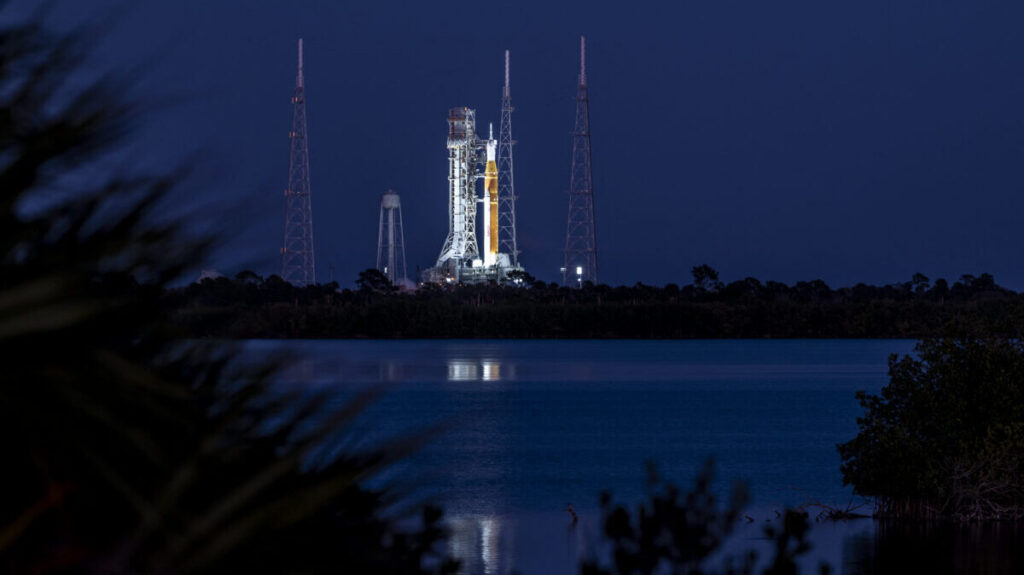
NASA is now targeting no earlier than March for the launch of its first crewed mission to lunar orbit since 1972, after leaks of cryogenic hydrogen during a Monday test stymied plans to launch this month.
The agency had been targeting as early as Feb. 8 to launch NASA’s Reid Wiseman, Victor Glover and Christina Koch, and Canadian astronaut Jeremy Hansen on the 10-day Artemis II flight around the moon.
For Monday night’s wet dress rehearsal, a practice run for launch day operations, the SLS rocket’s core stage was filled with about 2 million liters of cryogenically cooled hydrogen fuel and 742,000 liters of liquid oxygen oxidizer. At multiple points throughout the test, NASA detected hydrogen leaks in the tail service mast umbilical that runs from the base of the mobile launch platform to the main tank in the core stage.
The risk of such a leak is that “you can have just a small flame that can’t sustain itself, or something much worse than that” if the hydrogen mixes with ambient air and combusts, John Honeycutt, chair of NASA’s Artemis II Mission Management Team, told reporters during a Tuesday press conference.
The countdown clock was halted at T-5 minutes, 15 seconds, when the leak reached 16%, a level that NASA’s previous research and testing concluded would not prompt ignition, said Launch Director Charlie Blackwell-Thompson. As a part of that research, “an outside test agency introduced hydrogen to see when you could actually get it to ignite, and at 16% you could not,” she said.
A similar issue arose during the leadup to the uncrewed Artemis I mission that lifted off in November 2022. NASA called off a September launch attempt to investigate a persistent hydrogen leak in the same umbilical, traced to a fitting that is designed to allow a quick disconnect prior to launch.
Since Artemis I, NASA has conducted numerous tests of how the hydrogen system fittings need to be properly sealed and joined, Honeycutt said, so their reappearance during the Artemis II rehearsal “took us off guard.” However, he noted, it’s difficult to replicate the behavior and performance of a fully assembled SLS — 98 meters, the equivalent of a 30-story building — in subscale and ground tests.
Monday’s rehearsal was “a tremendous success” in many ways, said Lori Glaze, acting head of NASA’s Exploration Systems Development Mission Directorate, at the same press conference. “We got to full tanking yesterday on the first try” and “we gathered an enormous amount of data on the processes and how we want to go forward with that in the future.”
NASA plans to conduct a second wet dress rehearsal this month, the outcome of which would dictate the new launch target for Artemis II. The agency’s calendar indicates March 6 is the earliest launch opportunity.
Blackwell-Thompson said technicians can service SLS on the launch pad for a few weeks. “There are some things that we can do through servicing out on the pad,” she said, such as swapping out batteries on the Flight Termination System, noting that NASA expanded that capability after the Artemis I delays.
However, the batteries in the rocket’s upper stage cannot be changed on the pad, so “if we go beyond the March time window, we probably would have to roll back” to the Vertical Assembly Building, she said.