
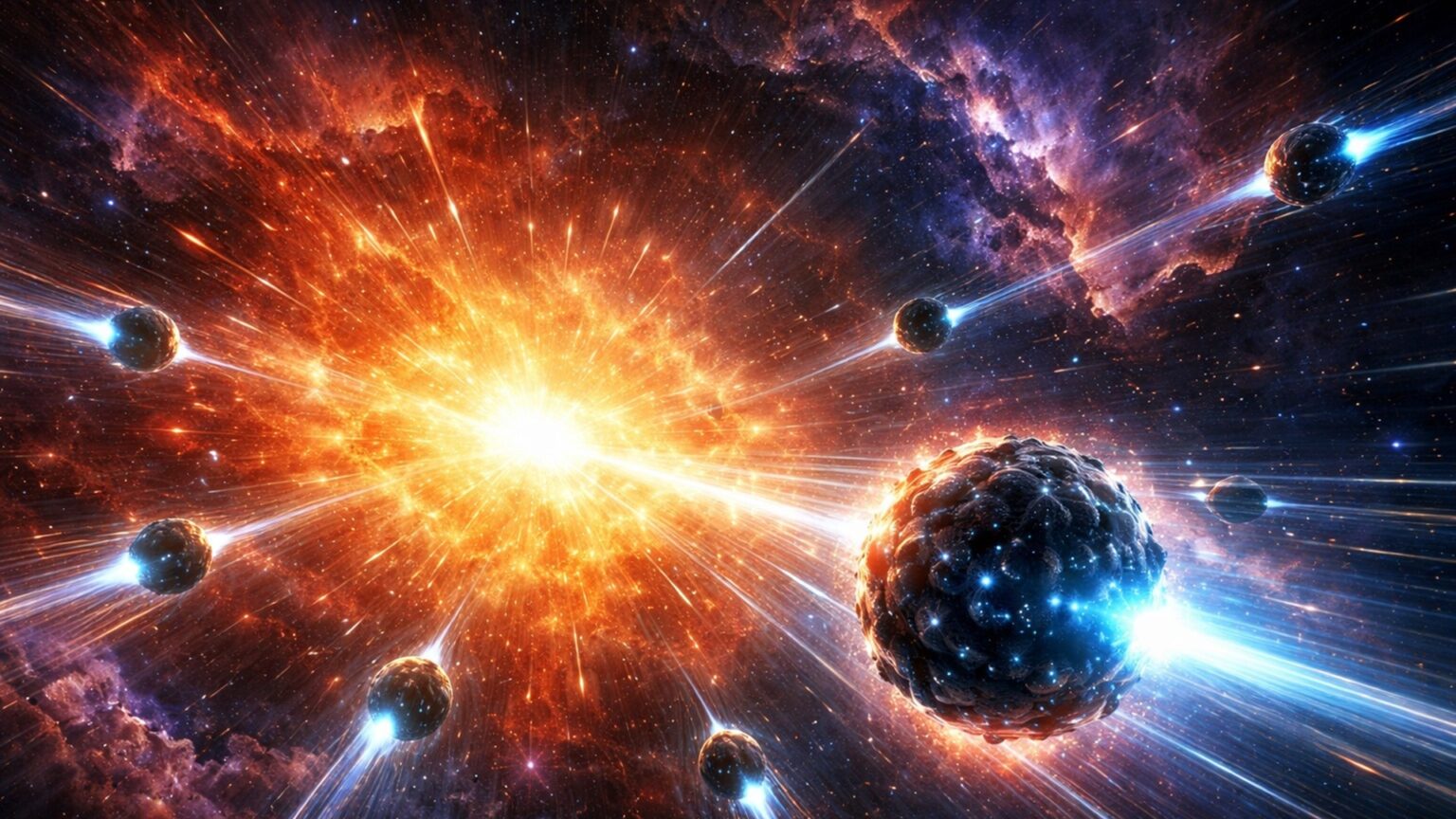
A study by universities in the United States and France proposes that dark matter may have formed in an ultra-relativistic state shortly after the Big Bang, during post-inflationary reheating, without preventing the formation of galaxies, contradicting models accepted for more than four decades in modern cosmology.
A study by the universities of Minnesota Twin Cities and Paris-Saclay suggests that dark matter may have been born extremely hot, nearly at the speed of light, during post-inflationary reheating, challenging decades of cosmological models based on the idea of cold dark matter.
Revision of a central hypothesis about dark matter.
Dark matter, the invisible component responsible for shaping the structure of the Universe, has traditionally been described as cold and slow-moving since its formation. This view underpinned cosmological models for decades and influenced our understanding of the origin of galaxies.
Researchers from Minnesota Twin Cities University and Paris-Saclay University challenged this premise by analyzing the formation of dark matter during a specific early period of the cosmos. Their work was published in Physical Review Letters, a journal of the American Physical Society.
— ARTICLE CONTINUES BELOW —
The authors propose that dark matter may have formed in an ultra-relativistic, extremely hot state, without preventing the subsequent formation of large-scale cosmic structures.
Why was dark matter considered cold?
For many years, it was believed that dark matter needed to be cold at the moment it decoupled from the radiation of the young Universe.
This process is known as freezing and occurs when particles cease to interact intensely with other forms of energy.
The hypothesis was based on the argument that particles moving too fast would smooth out density fluctuations, preventing the formation of galaxies. This understanding guided the rejection of candidates considered too hot for dark matter.
To test this idea, the new study analyzed the behavior of dark matter during post-inflationary reheating, a phase that followed cosmic inflation and marked the rapid creation of energy and particles in the early Universe.
Lessons from neutrinos and early theories
Keith Olive, a professor at the School of Physics and Astronomy, recalls that low-mass neutrinos were dismissed as candidates for dark matter more than 40 years ago. According to him, particles of this type would destroy galactic structures instead of favoring their formation.
Neutrinos have become the prime example of what has been termed hot dark matter, reinforcing cosmology’s reliance on cold dark matter models. This distinction has shaped theories and experiments for decades.
The new work, however, shows that particles produced under specific conditions can cool down over time. If generated during reheating, they would have enough space to lose energy as the Universe expanded.
How can hot dark matter become functional?
The study indicates that dark matter can separate from other forms of matter while still in an ultra-relativistic state. Even so, this material could cool down before the start of galaxy formation.
According to the authors, the decisive factor is the timing of the production of these particles. Post-inflationary reheating provides a wide time window for dark matter to gradually reduce its kinetic energy.
Stephen Henrich, lead author of the paper, states that the assumption that dark matter must be born cold has dominated research for about four decades. The results show that this requirement is not mandatory for the formation of cosmic structures.
Implications and next steps of the research
The team aims to advance the identification of ways to detect this type of dark matter. Strategies include direct experiments with particle accelerators and indirect methods based on cosmological observations.
Yann Mambrini, professor at Paris-Saclay University and co-author of the study, points out that the new findings allow for the investigation of a period in the history of the Universe very close to the Big Bang, expanding the scope of experimental cosmology.
The research was funded by the European Union’s Horizon 2020 program, under the Marie Sklodowska-Curie grant. The seminal paper, entitled “Ultrarelativistic Freeze-Out: A Bridge from WIMPs to FIMPs”, was published on November 24, 2025, with DOI 10.1103/zk9k-nbpj, consolidating a new line of research on the origin of dark matter and the early Universe.