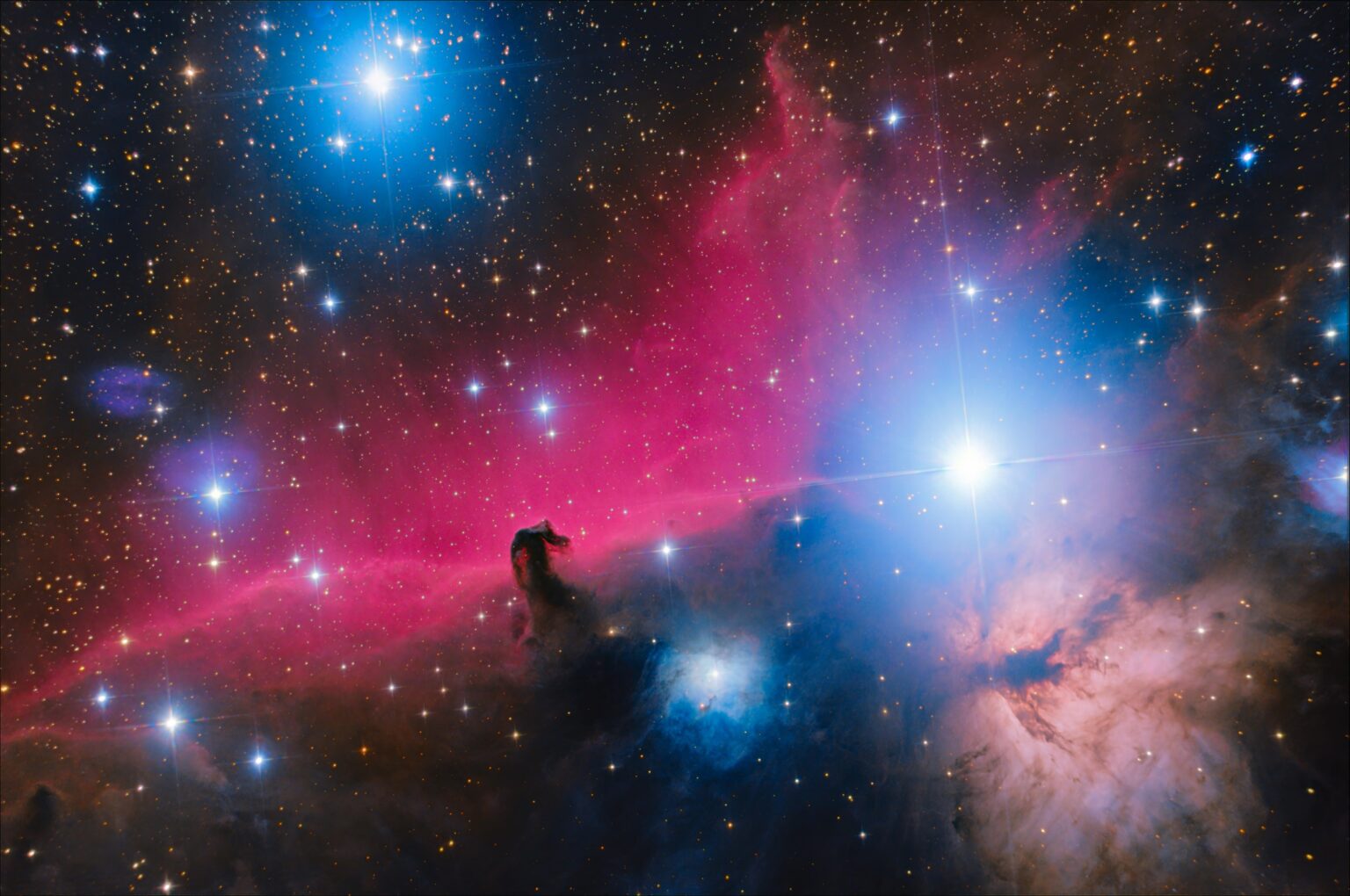
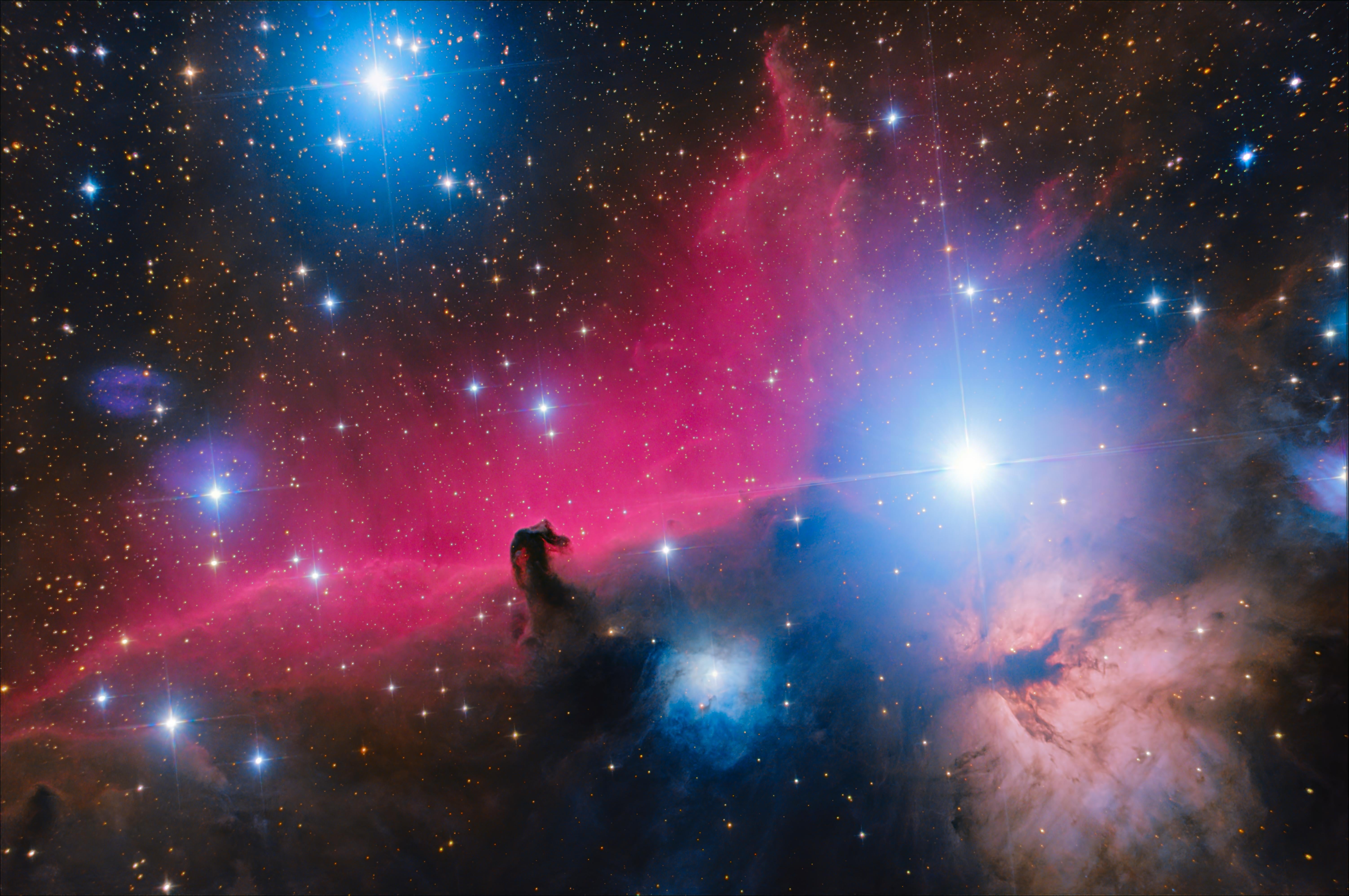
The Horsehead Nebula is a dark nebula that sits between Earth and a bright red emission nebula (IC 434). The Flame Nebula, located to the right in this image, is illuminated by an incredibly hot, rare, and massive O-type star. Between the two is Alnitak, the lowest star in Orion’s Belt when viewed from the Northern Hemisphere. This star is very bright and apparent in this image!
I’ve always wanted to shoot this photo but have never had the time to do it justice. I was fortunate to have an entirely clear night a few days ago, and to top it off, it was a moonless night! This allowed me to pull out a ton of faint detail and color without the use of filters. In the future I’d like to isolate the hydrogen emission and use that to enhance this image as it will help show the fainter parts of the red glow.
Actually imaging this was made extremely difficult by two things. The first was that it was 20 degrees Fahrenheit (I’ve gone out in colder), but the second and more challenging was that I spent 2 hours in that cold trying to perfectly align my telescope’s mirrors. Before leaving the rig to shoot for the night, I got it as close as I could after making a few modifications to the focuser and optical train. Thankfully though, this struggle helped me realize I have a few bolts loose in the focuser that have been causing a handful of other issues for the last year! I’m excited to get this fixed, as the result will be sharper photos that aren’t as blurry. My new 3D printer is going to be put to good use designing some custom parts!

1 Comment
The Horsehead Nebula is a dark nebula that sits between Earth and a bright red emission nebula (IC 434). The Flame Nebula, located to the right in this image, is illuminated by an incredibly hot, rare, and massive O-type star. Between the two is Alnitak, the lowest star in Orion’s Belt when viewed from the Northern Hemisphere. This star is very bright and apparent in this image!
I’ve always wanted to shoot this photo but have never had the time to do it justice. I was fortunate to have an entirely clear night a few days ago, and to top it off, it was a moonless night! This allowed me to pull out a ton of faint detail and color without the use of filters. In the future I’d like to isolate the hydrogen emission and use that to enhance this image as it will help show the fainter parts of the red glow.
Actually imaging this was made extremely difficult by two things. The first was that it was 20 degrees Fahrenheit (I’ve gone out in colder), but the second and more challenging was that I spent 2 hours in that cold trying to perfectly align my telescope’s mirrors. Before leaving the rig to shoot for the night, I got it as close as I could after making a few modifications to the focuser and optical train. Thankfully though, this struggle helped me realize I have a few bolts loose in the focuser that have been causing a handful of other issues for the last year! I’m excited to get this fixed, as the result will be sharper photos that aren’t as blurry. My new 3D printer is going to be put to good use designing some custom parts!
**Equipment:**
ES N208CF
1 ZWO ASI2600MC Air Camera
ZWO AM5 + TC40 Tripod
Jackery 500 Battery
**Acquisition:**
153 x 120s
Total: 5.1 hours
Bortle 3
**Processing**
Siril:
Stacking
Cropped edge artifacts
Graxpert background extraction
SPCC
Starnet ++
Graxpert denoise
GHS tweaks
Star recomposition
AberrationRemover script
Cosmic Clarity sharpening
VeraLux Curves