Is it possible we only just see it every 20 minutes but actually rotates,precesses, nutates at different rates; perhaps caused by impurities of the object or orbiting elements we don’t see?
NHI Mothership decelerating from deep space in pulses of it’s drive to conserve energy
suspectyourrussian on
Immediately thought that maybe it could be reflecting off another object close or maybe in its path. Is that possible? Possibly it is a pulsar that is acting appropriately and there’s something in the way that has an interval of 10-20 min?
I’m thinking a gravitational disturbance so big that by the time light waves get to the cusp of the disturbance that it causes a rollback effect like the crest of a wave and the crest finally breaches. Like a light tsunami.
RaisinBran21 on
I don’t understand why they don’t point the James Webb at these things
Landy0451 on
Is that the inspiration for the game Outer Wilds ?
tminus7700 on
I’m surprised they didn’t talk about this kind of periodic energy bursts.
>A neutron star has an immense gravitational pull that can capture hydrogen and helium from a nearby star. The material amasses on the neutron star surface until it ignites in repeated explosions that create new chemical elements.
I call this process a [Relaxation Oscillator](https://en.wikipedia.org/wiki/Relaxation_oscillator) Similar to the Pearson–Anson oscillator. With a constant flow of gases from the companion star, there will be a time delay until the surface density reaches ignition, The surface “burns off” over a fixed amount of time, them goes quite and another cycle starts.
Birdy_Cephon_Altera on
Someone needs to build a ladder big enough to get up there and change the smoke detector batteries.
keepontrying111 on
now you know what that switch in the halway does.
Andromeda321 on
Radio astronomer here! This is a cool find! (Worth noting though that it’s not like we’ve been observing it constantly since 1988 and only just noticed- instead it’s more that an archival observation as far back as 1988 was found that also had this period.)
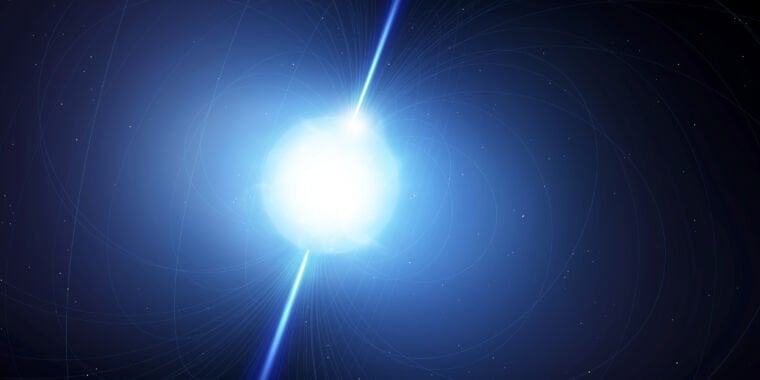
Lots of things in space have a periodic signal- the most famous of course are pulsars, which are neutron stars that spin rapidly and have a radio beam, leading us to see a radio “pulse” every few seconds (or less!) as the pulsar spins and the beam passes. The discovery paper actually suggests a really slow pulsar as a possibility for this signal! (This would be amazing if shown to be true, because we think pulsars need to spin much faster to still send out that radio beam- under a certain rotation rate, they turn off.) Another suggestion is that it could be an unusual white dwarf- the core of a dead star like what the sun will be someday- which in this case is highly magnetized. But we definitely don’t know the truth for sure.
In broader context, though, it’s worth noting that finding unusual signals that repeat in weird time scales isn’t *that* unusual and happens somewhat often in radio astronomy. My favorite example, called “The Great Galactic Burper,” was observed to burst 10 minutes every 77 minutes ([link](https://en.wikipedia.org/wiki/GCRT_J1745%E2%88%923009)), and did so for several years, but hasn’t been recorded since 2007. No one knows what caused it! Lots of weird things that go bump in the night that we don’t yet understand… which is what makes radio astronomy so exciting and fun!
Edit: a lot of people are asking if there could be a wobble in the object’s motion in addition to its spinning and that’s what is causing true delays. Short answer is probably no, we can look at the structure of the individual pulses we detect and that appears inconsistent with such a model.
NuArcher on
Short and to the pont:
GPM J1839−10 is a unique [1] ultra-long period magnetar located in the Scutum constellation which was discovered by the Murchison Widefield Array in Western Australia. Its unusual characteristics in violation of theory (which had never been before seen) were such they prompted a search of the archives of numerous other radio telescopes; data was found on the object dating back to 1989, heretofore unanalyzed inasmuch as it had not been an object of study or even known to exist at all.
The current understanding of neutron stars is that below a certain rate of rotation (called “the death line”) they cease emissions. Uniquely not only does GPM J1839−10 have an extremely slow rotation of approximately 20-minutes, it emits radio waves, circumstances for which there is as yet no theory.
It’s like a pulsar but slower – we don’t know why.
Jumpman-x on
It’s gotta be those little green fucks in the saucers.
KFR42 on
Probably something with a low battery, that’s what mysterious flashing lights usually are in my house.
ergzay on
I don’t get everyone griping about the article. Compared to the standard junk that’s posted from space.com and other sites this was free of the usual hyperbole and clickbait (the title is exactly what the article is about). Besides a few jokes, that are of the dad joke variety that people seem to be unable to get, the article was fine and educational.
etfvpu on
the wikipedia page is way better than this article
this article seems like it was written by chatGPT
sodone19 on
Couldn’t it be an irregular shaped object that is rotating at a constant speed so that one of its faces happens to reflect light towards earth every rotation?
AlexisFR on
Yes, this is what a pulsar does, thanks you for your mediatic input, arstechnica.
Dr0110111001101111 on
Lighting up every twenty minutes since the 80’s? Sounds like my uncle
mjzimmer88 on
It’s visible light in a cycle lasting 30-300 seconds within a 400 second window then disappears for 22 minutes.
Thinking creatively here, this sounds less like a pulsar and more like a constant light source (star) that’s regularly blocked from view by something(s) orbiting it or somethings-else between us and it blocking the view.
Perhaps it’s a star that’s rotating around a black hole, such that light emmision only reaches us when the star is directly between us and the black hole.
Or, my uneducated guess is there’s an independent binary+ system between us and the star where two or more non-light emitting objects (planetoid with moons?) that rotate around each other regularly block our view but occasionally line up where we can see the star in between.
Hard to imagine a planet big enough, in a stationary orbit relative to the star, with a moon or second planetoid rotating each other this quickly, but imagine it I have done nonetheless. Someone call Liu Cixin.
TheWorldmind on
Turns out it’s just a Coke bottle caught on the string of a window shade.
Gojisoji on
Are we sure this isn’t someone in deep space trying to communicate with us after being adrift? We need to send Brad Pitt to figure it out. Ad Astra was an amazing film and worth a watch!
ToMorrowsEnd on
I figured it’s the construction sign warning people about the Hyperspace Bypass that they will be installing. The Vogons filed the paperwork back in 1988.
tselliot8923 on
Snoop Dogg has been doing the same thing but here on Earth.
longhegrindilemna on
Interstellar lighthouse, a beacon for recalibration of interstellar navigation.
Only useful to species with warp drives?
But, seriously:
The current understanding of neutron stars is that **below a certain rate** of rotation (called “the death line”) they cease emissions. Uniquely not only does GPM J1839−10 have an extremely slow rotation of approximately 20-minutes, it **also** emits radio waves, circumstances for which there is as yet no theory. https://en.wikipedia.org/wiki/GPM_J1839%E2%88%9210
InternationalBand494 on
“The list of known objects that can produce this sort of behavior is short and consists of precisely zero items”
Haha. Nice
[deleted] on
I left my space ship parked with the left blinker on. I know that I should go and turn it off, but who has the time?
headloser on
Somebody forgot to turn off their spaceship’s blinker.

32 Comments
[removed]
Is it possible we only just see it every 20 minutes but actually rotates,precesses, nutates at different rates; perhaps caused by impurities of the object or orbiting elements we don’t see?
[removed]
Poorly written article but interesting subject.
You mean it is pulsing?
Sorry, I don’t have a clue…
reminds me of [this](https://www.inverse.com/article/18647-mika-mckinnon-stargate-star-trek-beyond-sci-fi-physics) where life imitates art in science advising.
Outer wilds fans are just losing it right now
NHI Mothership decelerating from deep space in pulses of it’s drive to conserve energy
Immediately thought that maybe it could be reflecting off another object close or maybe in its path. Is that possible? Possibly it is a pulsar that is acting appropriately and there’s something in the way that has an interval of 10-20 min?
I’m thinking a gravitational disturbance so big that by the time light waves get to the cusp of the disturbance that it causes a rollback effect like the crest of a wave and the crest finally breaches. Like a light tsunami.
I don’t understand why they don’t point the James Webb at these things
Is that the inspiration for the game Outer Wilds ?
I’m surprised they didn’t talk about this kind of periodic energy bursts.
https://phys.org/news/2023-05-element-creation-lab-deepens-surface.html
>A neutron star has an immense gravitational pull that can capture hydrogen and helium from a nearby star. The material amasses on the neutron star surface until it ignites in repeated explosions that create new chemical elements.
I call this process a [Relaxation Oscillator](https://en.wikipedia.org/wiki/Relaxation_oscillator) Similar to the Pearson–Anson oscillator. With a constant flow of gases from the companion star, there will be a time delay until the surface density reaches ignition, The surface “burns off” over a fixed amount of time, them goes quite and another cycle starts.
Someone needs to build a ladder big enough to get up there and change the smoke detector batteries.
now you know what that switch in the halway does.
Radio astronomer here! This is a cool find! (Worth noting though that it’s not like we’ve been observing it constantly since 1988 and only just noticed- instead it’s more that an archival observation as far back as 1988 was found that also had this period.)
Lots of things in space have a periodic signal- the most famous of course are pulsars, which are neutron stars that spin rapidly and have a radio beam, leading us to see a radio “pulse” every few seconds (or less!) as the pulsar spins and the beam passes. The discovery paper actually suggests a really slow pulsar as a possibility for this signal! (This would be amazing if shown to be true, because we think pulsars need to spin much faster to still send out that radio beam- under a certain rotation rate, they turn off.) Another suggestion is that it could be an unusual white dwarf- the core of a dead star like what the sun will be someday- which in this case is highly magnetized. But we definitely don’t know the truth for sure.
In broader context, though, it’s worth noting that finding unusual signals that repeat in weird time scales isn’t *that* unusual and happens somewhat often in radio astronomy. My favorite example, called “The Great Galactic Burper,” was observed to burst 10 minutes every 77 minutes ([link](https://en.wikipedia.org/wiki/GCRT_J1745%E2%88%923009)), and did so for several years, but hasn’t been recorded since 2007. No one knows what caused it! Lots of weird things that go bump in the night that we don’t yet understand… which is what makes radio astronomy so exciting and fun!
Edit: a lot of people are asking if there could be a wobble in the object’s motion in addition to its spinning and that’s what is causing true delays. Short answer is probably no, we can look at the structure of the individual pulses we detect and that appears inconsistent with such a model.
Short and to the pont:
GPM J1839−10 is a unique [1] ultra-long period magnetar located in the Scutum constellation which was discovered by the Murchison Widefield Array in Western Australia. Its unusual characteristics in violation of theory (which had never been before seen) were such they prompted a search of the archives of numerous other radio telescopes; data was found on the object dating back to 1989, heretofore unanalyzed inasmuch as it had not been an object of study or even known to exist at all.
The current understanding of neutron stars is that below a certain rate of rotation (called “the death line”) they cease emissions. Uniquely not only does GPM J1839−10 have an extremely slow rotation of approximately 20-minutes, it emits radio waves, circumstances for which there is as yet no theory.
[https://en.wikipedia.org/wiki/GPM_J1839%E2%88%9210](https://en.wikipedia.org/wiki/GPM_J1839%E2%88%9210)
tldr;
It’s like a pulsar but slower – we don’t know why.
It’s gotta be those little green fucks in the saucers.
Probably something with a low battery, that’s what mysterious flashing lights usually are in my house.
I don’t get everyone griping about the article. Compared to the standard junk that’s posted from space.com and other sites this was free of the usual hyperbole and clickbait (the title is exactly what the article is about). Besides a few jokes, that are of the dad joke variety that people seem to be unable to get, the article was fine and educational.
the wikipedia page is way better than this article
this article seems like it was written by chatGPT
Couldn’t it be an irregular shaped object that is rotating at a constant speed so that one of its faces happens to reflect light towards earth every rotation?
Yes, this is what a pulsar does, thanks you for your mediatic input, arstechnica.
Lighting up every twenty minutes since the 80’s? Sounds like my uncle
It’s visible light in a cycle lasting 30-300 seconds within a 400 second window then disappears for 22 minutes.
Thinking creatively here, this sounds less like a pulsar and more like a constant light source (star) that’s regularly blocked from view by something(s) orbiting it or somethings-else between us and it blocking the view.
Perhaps it’s a star that’s rotating around a black hole, such that light emmision only reaches us when the star is directly between us and the black hole.
Or, my uneducated guess is there’s an independent binary+ system between us and the star where two or more non-light emitting objects (planetoid with moons?) that rotate around each other regularly block our view but occasionally line up where we can see the star in between.
Hard to imagine a planet big enough, in a stationary orbit relative to the star, with a moon or second planetoid rotating each other this quickly, but imagine it I have done nonetheless. Someone call Liu Cixin.
Turns out it’s just a Coke bottle caught on the string of a window shade.
Are we sure this isn’t someone in deep space trying to communicate with us after being adrift? We need to send Brad Pitt to figure it out. Ad Astra was an amazing film and worth a watch!
I figured it’s the construction sign warning people about the Hyperspace Bypass that they will be installing. The Vogons filed the paperwork back in 1988.
Snoop Dogg has been doing the same thing but here on Earth.
Interstellar lighthouse, a beacon for recalibration of interstellar navigation.
Only useful to species with warp drives?
But, seriously:
The current understanding of neutron stars is that **below a certain rate** of rotation (called “the death line”) they cease emissions. Uniquely not only does GPM J1839−10 have an extremely slow rotation of approximately 20-minutes, it **also** emits radio waves, circumstances for which there is as yet no theory.
https://en.wikipedia.org/wiki/GPM_J1839%E2%88%9210
“The list of known objects that can produce this sort of behavior is short and consists of precisely zero items”
Haha. Nice
I left my space ship parked with the left blinker on. I know that I should go and turn it off, but who has the time?
Somebody forgot to turn off their spaceship’s blinker.