
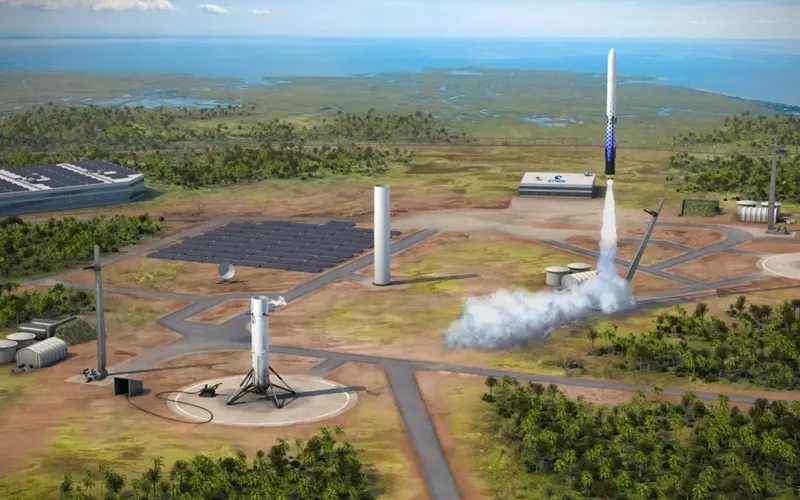
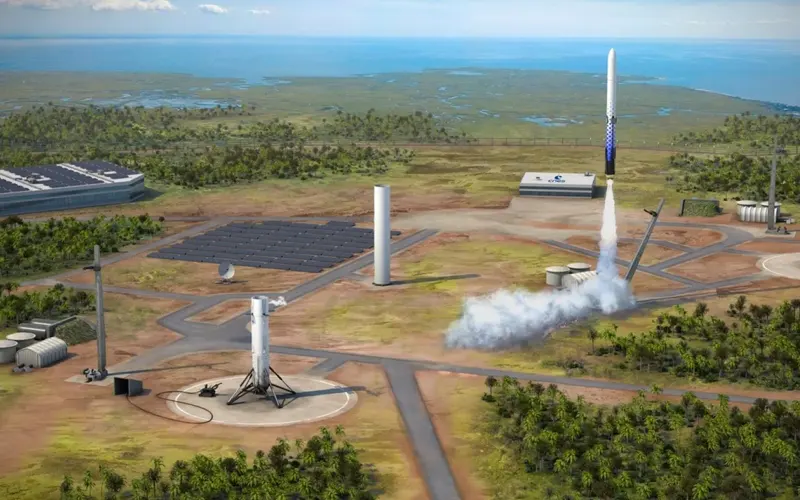
 Credit: CNES / L’Oeil du Chat
The French space agency CNES, operator of the Guiana Space Centre in French Guiana, has issued a call for launch operators interested in taking over a portion of its new multi-user commercial launch site following MaiaSpace’s withdrawal. The facility is being built on the grounds of the former Diamant launch site.
CNES announced plans to convert the former Diamant launch site at the Guiana Space Centre into a multi-user commercial launch facility in late 2021. A call for launch operators interested in utilising the new ELM (Ensemble de Lancement Multilanceurs) facility was issued soon after. In July 2022, CNES preselected Avio, HyImpulse, Isar Aerospace, MaiaSpace, PLD Space, Rocket Factory Augsburg (RFA), and Latitude. Binding Term Sheets (BTS) were then signed by Isar Aerospace, PLD Space, RFA, MaiaSpace, and Latitude, formalising their allocation at the future site.
In September 2024, CNES selected MaiaSpace to convert the old Soyuz launch facility at the Guiana Space Centre for its own use, following the suspension of Arianespace’s Soyuz operations in 2022. The company is currently working toward an inaugural suborbital flight from the facility later this year.
According to a 29 January call, CNES revealed that MaiaSpace had formally vacated the ELM launch facility in the last quarter of 2025. As a result, the agency is calling for interested launch operators to fill the vacancy left by the ArianeGroup subsidiary. Beyond the slot already vacated, the agency added that additional vacancies could become available if companies that have already signed term sheets fail to move forward with development contracts.
Interested launch operators will need to be headquartered in, and retain a significant portion of their production capacity within, EU or ESA member states. Applications will be evaluated using four criteria, with weightings of 25% for compatibility with applicable laws and regulations, 40% for launch system maturity, 20% for social and economic impact, and 15% for environmental impact.
The ELM launch facility will feature shared facilities, including power, fluid, and communication systems. These facilities are being built by CNES at a cost of €50 million, funded through the France 2030 investment plan. Individual launch operators will then be responsible for building launcher-specific facilities, including launch tables and assembly buildings. According to CNES, construction of the shared facilities is already underway and is expected to be completed in the second half of 2026.
While Germany’s Isar Aerospace is the most advanced in its preparations to begin commercial operations of its respective rocket, all of its initial flight activity is being conducted from Andøya Space in Norway. The most likely operator to conduct the ELM facility’s inaugural flight is Spain’s PLD Space, with its MIURA 5 rocket expected to be launched for the first time from the facility later this year.
Keep European Spaceflight Independent
Your donation will help European Spaceflight to continue digging into the stories others miss. Every euro keeps our reporting alive.