
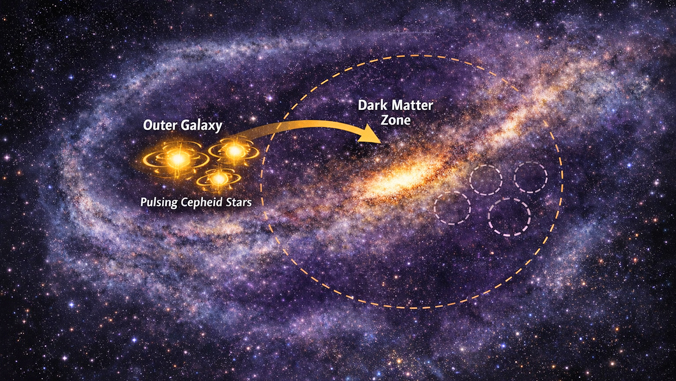
Reading time: 2 minutes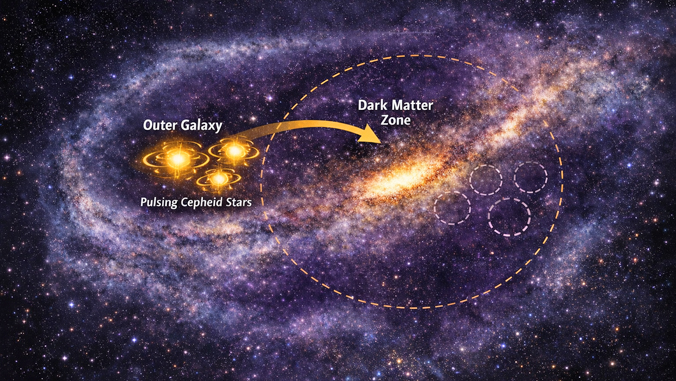 AI-generated image provided by lead researcher and Assistant Professor Jeremy Sakstein
A new study out of the University of Hawaiʻi at Mānoa’s Department of Physics and Astronomy could help solve the mystery surrounding why a key type of star used to measure cosmic distances appears to be missing.
Assistant Professor Jeremy Sakstein led the research, published February 3, by the American Physical Society. It shows that dark matter may prevent certain stars, called Cepheid variables, from forming near the Milky Way’s crowded core. Cepheid stars are often described as cosmic metronomes. They brighten and dim in a steady rhythm, making them essential tools for astronomers to measure distances across the universe. In most parts of the galaxy, these stars are common and well understood. However, none have been clearly observed near the galactic center.
The new study offers a possible explanation. According to the researchers, dark matter—an invisible substance thought to make up most of the universe’s mass—may collect inside stars that form in regions where dark matter is especially dense, such as the galaxy’s inner core. There, dark matter could release extra energy inside stars, subtly changing their evolution.
“This work highlights how research at UH Mānoa is helping to address some of the biggest unanswered questions in science,” Sakstein said. “By combining theory and computation, we’re helping to open up entirely new ways to test ideas about the universe. The next generation of telescopes will tell us whether we’re on the right track.”
For Cepheid stars, that extra energy may be enough to stop them from ever entering the phase where they pulse and become visible. The effect appears strongest for smaller Cepheids with shorter rhythms, which would be the first to disappear. Importantly, the study finds that Cepheids are more sensitive to dark matter than many other types of stars. That makes their absence a potential new clue in the decades-long effort to understand what dark matter is and how it behaves.
Powerful new telescopes, including the James Webb Space Telescope and the next generation of extremely large ground-based observatories, are expected to peer deeper into the galactic center than ever before. If these instruments still fail to find Cepheid stars where they should exist, it could be a strong sign that dark matter is influencing stellar life in ways scientists are only beginning to uncover.
The Department of Physics and Astronomy is housed in UH Mānoa’s College of Natural Sciences.