
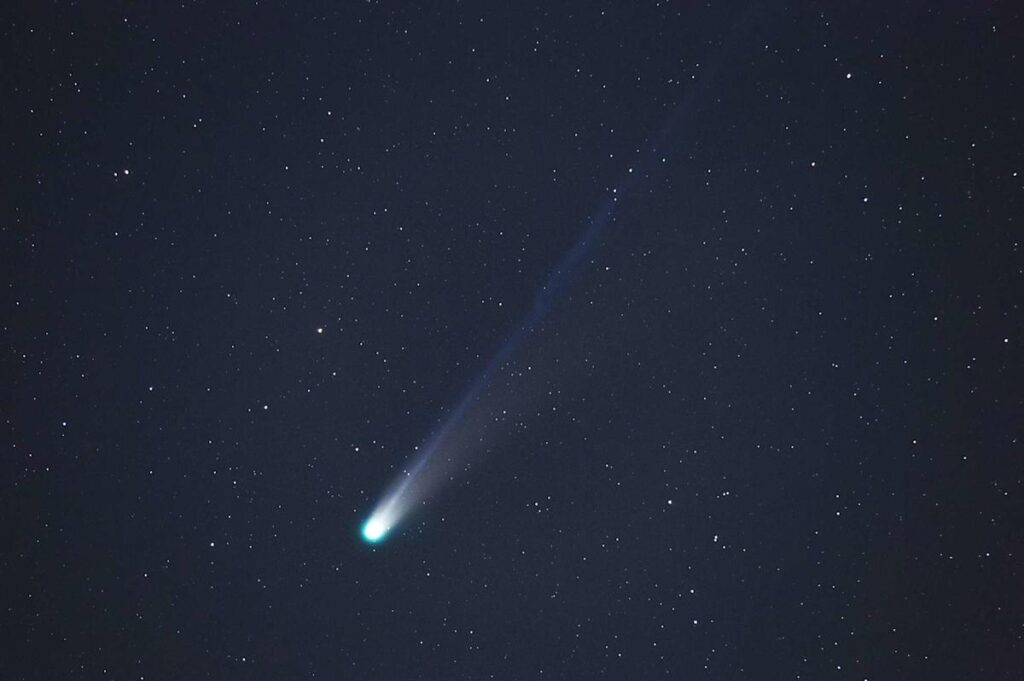
Dark sky enthusiasts may want to set aside a little time in April for a celestial wildcard: a newly-discovered comet that could become one of the brightest of 2026.
Known officially as Comet C/2025 R3 (PanSTARRS), this long-period comet was spotted in September and is currently racing through the inner solar system toward a close encounter with the sun. For travelers, the most promising viewing window runs from mid-April through early May, with an added advantage on the nights around the April 17 new moon when the skies will be at their darkest.
How bright Comet R3 ultimately becomes is still an open question.
As comets warm near the sun, some brighten dramatically, releasing gas and dust that form the glowing tails associated with “great comets.” Others, however, remain faint or even fragment or disintegrate entirely.
Early projections for Comet R3 span a wide range. It may brighten to roughly magnitude 8, according to Space.com, which would require binoculars or a small telescope to see. Or it could potentially reach a magnitude of 2.5, which would be bright enough to spot with the naked eye from truly dark locations.
For the best odds, aim for a dark horizon away from city lights and give your eyes about 20 minutes to adjust. If Comet R3 brightens enough, you may see it as a fuzzy blotch with a bit of tail, but as always, having a pair of binoculars handy will dramatically improve its detail.
Because the comet’s exact position and visibility will change from night to night, a stargazing app or a live tracker like TheSkyLive can help you to pinpoint where to look exactly.
As for timing, the best viewing conditions will likely demand a strong cup of coffee. When Comet R3 will make its closest approach to the sun in late April, it’s expected to be a morning object for viewers in the Northern Hemisphere shortly before sunrise. Viewing will then shift in favor of the Southern Hemisphere after sunset into early May when the comet (after hopefully surviving its encounter with the sun) will sit low in the western sky. A full moon on May 1, however, could complicate viewing conditions toward the end of the window.
Should Comet R3 ultimately fail to put on a show, the night sky has a reliable second act waiting in the wings. On April 22 and May 6, the Lyrid and Eta Aquariid meteor showers will reach their respective peaks, offering stargazers around the world a chance to see 10 to 20 meteors per hour under favorable conditions.
Read the original article on Travel & Leisure