
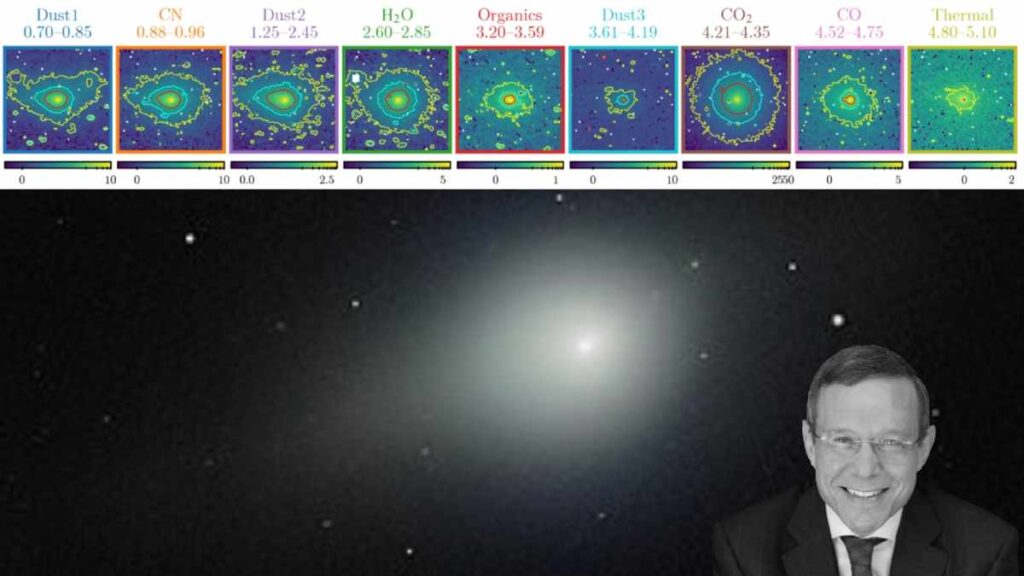
3I/ATLAS, the third-ever interstellar interloper in the solar system after 1I/Oumuamua (2017) and 2I/Borisov (2019), was first spotted by the ATLAS observatory on July 01, 2025. The odd exocomet soon became all the rage owing to its anomalous behavior. Speculations that the interstellar comet could be running on an internal engine crafted by extraterrestrial intelligence got some academic credentials as Harvard astrophysicist Avi Loeb started flagging 3I/ATLAS’s anomalies while also publishing papers. His growing list of 3I/ATLAS is at 18 right now.
Ahead of the 3I/ATLAS’s perihelion event of October 29, 2025, Prof Loeb dubbed the day as a plausible ‘black swan event.’ He speculated that the world was not ready if the interstellar visitor was an alien space probe. Such an unprecedented event would cause paranoia and throw the world into chaos, where money would be rendered useless. Well, that was the worst-case scenario, which thankfully never materialized.
The exocomet flew past Earth on December 19, 2025 at a distance of 1.8 AU or 270 million kilometers. The closest 3I/ATLAS ever got to us earthlings. While astrophotographers got a few mesmerizing portraits of the object, data from observatories around the world revealed anomalies hitherto unheard of in a textbook comet. The Anti-Tail for example which is sunward and three symmetric mini-jets on the exocomet, with detection of massive methane outgassing.
SETI’s radio probe did not reveal anything significant; however, Prof Loeb questioned the conventional method for probing outwardly objects beyond human comprehension. Does the object contain life or seeds of life for interstellar gardening? In his latest blog Avi Loeb notes
The latest data from the Webb telescope (reported here) indicates that the plume of gas and dust surrounding 3I/ATLAS contains water (H₂O), carbon dioxide (CO₂), carbon monoxide (CO) and methane (CH₄), which can all be consumed by terrestrial lifeforms.
He further states
The most notable finding from the latest SPHEREx and Webb data is the robust spectroscopic detection of methane (CH₄) production. Methane was only detected after the passage of 3I/ATLAS near the Sun. Its delayed production raises interesting questions because methane ice is hyper-volatile, with a significantly lower sublimation temperature than carbon dioxide (CO₂). This implies that methane ice near the surface of 3I/ATLAS would have been vigorously sublimating at the time of the first reports of outgassing from 3I/ATLAS before perihelion.
Prof Loeb further adds
However, neither the Webb spectroscopy nor the SPHEREx spectrophotometry from August 2025, detected methane. This suggests that methane is depleted in the outermost layers of 3I/ATLAS and was exposed to warming by sunlight only close to the Sun. Within this scenario, the early detection of carbon monoxide (CO) outgassing on 3I/ATLAS is surprising, as carbon monoxide is more volatile than methane and should therefore be depleted from the surface, yet it was detected prior to methane.
The astrophysicist questions
Could it be that the detected methane is produced by lifeforms?