
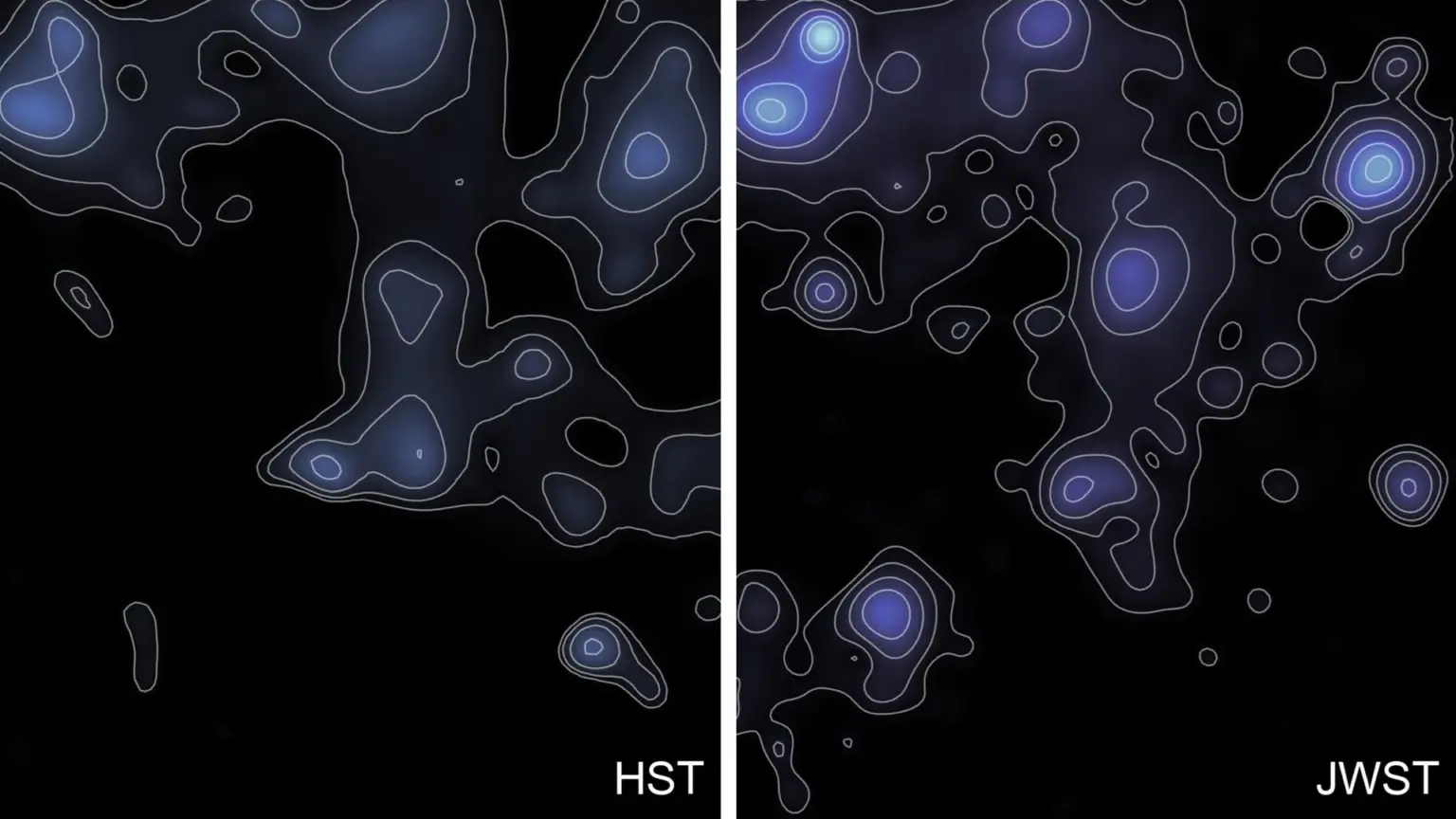
Scientists have produced the most detailed map ever created of dark matter that runs throughout the Universe, revealing how it has influenced the formation of stars, galaxies, and planets.
The research, which includes astronomers from Durham University in the UK, provides new insight into how this unseen substance helped draw ordinary matter together, forming galaxies such as the Milky Way and eventually planets like Earth.
The findings are based on new observations from NASA’s James Webb Space Telescope (Webb) and are published in the journal Nature Astronomy.
The international study was led jointly by Durham University, NASA’s Jet Propulsion Laboratory (JPL), and the École Polytechnique Fédéral de Lausanne (EPFL), Switzerland.
How Dark Matter Shaped the Universe We See Today
The newly created map confirms earlier studies while revealing finer details about the relationship between dark matter and the normal matter that makes up everything we can see, touch, and interact with.
At the beginning of the Universe, both dark matter and ordinary matter were likely spread thinly across space. Scientists believe dark matter began clumping together first. Its gravity then pulled in normal matter, creating dense regions where stars and galaxies could begin to form.
This process set the overall pattern for how galaxies are distributed across the Universe today. By allowing galaxies and stars to form earlier than they otherwise would have, dark matter also helped create the conditions needed for planets to develop. Without this early influence, the elements required for life may never have formed within our galaxy.
Research co-lead author Dr. Gavin Leroy, in the Institute for Computational Cosmology, Department of Physics, Durham University, said: “By revealing dark matter with unprecedented precision, our map shows how an invisible component of the Universe has structured visible matter to the point of enabling the emergence of galaxies, stars, and ultimately life itself.
“This map reveals the invisible but essential role of dark matter, the true architect of the Universe, which gradually organizes the structures we observe through our telescopes.”
Detecting the Invisible Through Gravity
Dark matter cannot be seen directly because it does not emit, reflect, absorb, or block light. It also moves through ordinary matter without interacting with it, much like a ghost.
Its presence is detected through gravity. The new map shows this effect with greater clarity than ever before. One key piece of evidence is how closely maps of dark matter line up with maps of normal matter.
According to the researchers, Webb’s observations show that this alignment is not accidental. Instead, it reflects dark matter’s gravitational pull drawing normal matter toward it throughout the history of the Universe.
Research co-author Professor Richard Massey, in the Institute for Computational Cosmology, Department of Physics, Durham University, said: “Wherever you find normal matter in the Universe today, you also find dark matter.
“Billions of dark matter particles pass through your body every second. There’s no harm, they don’t notice us and just keep going.
“But the whole swirling cloud of dark matter around the Milky Way has enough gravity to hold our entire galaxy together. Without dark matter, the Milky Way would spin itself apart.”
Webb’s Deep View of the Cosmos
The map covers a region of sky about 2.5 times the size of the full Moon, located in the constellation Sextans.
Webb observed this area for approximately 255 hours and identified nearly 800,000 galaxies, many of them seen for the first time. To locate dark matter, the team measured how its mass bends space, which in turn bends the light traveling to Earth from distant galaxies — as if that light had passed through a warped windowpane.
The resulting map includes roughly ten times more galaxies than earlier ground-based maps of the same region and twice as many as those produced using the Hubble Space Telescope. It reveals new concentrations of dark matter and provides a much sharper view of areas previously observed by Hubble.
Research co-lead author Dr. Diana Scognamiglio, of NASA’s Jet Propulsion Laboratory, said: “This is the largest dark matter map we’ve made with Webb, and it’s twice as sharp as any dark matter map made by other observatories.
“Previously, we were looking at a blurry picture of dark matter. Now we’re seeing the invisible scaffolding of the Universe in stunning detail, thanks to Webb’s incredible resolution.”
Instruments and Future Exploration
To improve distance measurements for many of the galaxies in the map, the research team used Webb’s Mid-Infrared Instrument (MIRI).
Durham University’s Centre for Extragalactic Astronomy contributed to the development of MIRI, which was designed and managed through launch by JPL. The instrument is especially effective at detecting galaxies hidden behind thick clouds of cosmic dust.
The team plans to expand their work by mapping dark matter across the entire Universe using the European Space Agency’s (ESA) Euclid telescope and NASA’s upcoming Nancy Grace Roman Space Telescope. These future observations will help scientists better understand dark matter’s basic properties and how it may have evolved over cosmic time.
The region of sky analyzed in this study will serve as a reference point, allowing future dark matter maps to be compared and refined with greater precision.
The latest research was funded by NASA, the RCUK/Science and Technology Facilities Council (STFC), the Swiss State Secretariat for Education, Research and Innovation (SERI), RCUK/STFC Central Laser Facility at the STFC Rutherford Appleton Laboratory and the Centre National d’Etudes Spatiales.