
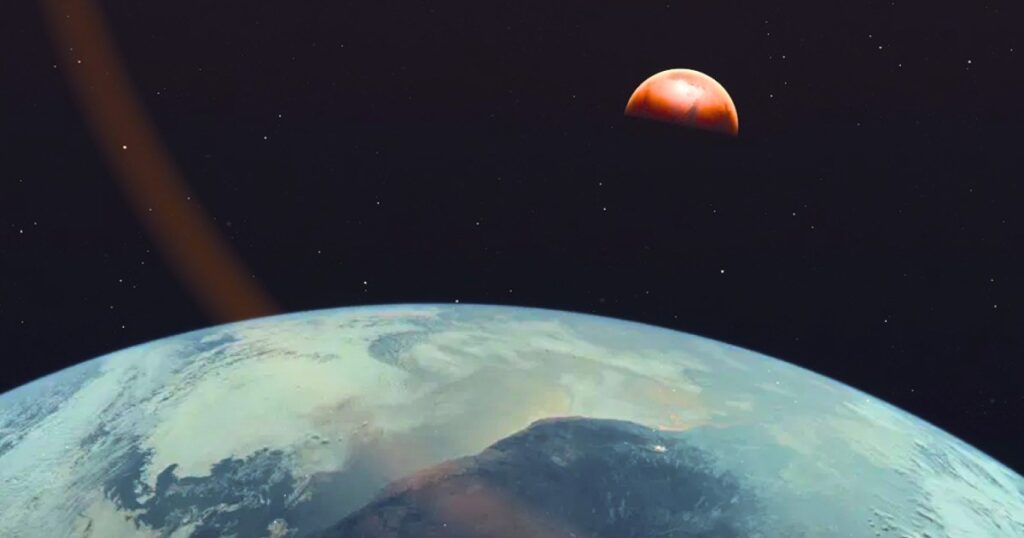
SARA SEAGER: The search for another Earth, the planet B, it’s a generations-long search. We want to find a true Earth twin with continents, oceans, and sunlight, and a thin atmosphere with oxygen, a place where we humans could potentially live.
The reason we’re doing it primarily is not to find a new home for humans, but it’s to understand our Earth, our origin of life. It’s today’s way of answering “Where did we come from?” “Why are we here?” A very astronomical, scientific way to answer that question.
I’m Professor Sarah Seager, an astrophysicist and planetary scientist. I work on the search for signs of life beyond Earth.
When I first saw the dark sky, it was completely by accident. I was ten years old. We went camping. And I don’t know why, but I stepped out of the tent in the middle of the night. I saw the stars, and I just couldn’t believe it. And at that moment, I understood at a deep level that there just has to be something else out there. It’s such a vast universe.
All the stars in the night sky are suns. And if our sun has planets—Mercury, Venus, Earth, Mars, etc.—it makes sense that other stars, you know, other suns should have planets also. And they do.
An exoplanet is a planet orbiting a star outside of our solar system. Thirty years ago, we didn’t know about any exoplanets, but when I was in graduate school in the mid 1990s, the first exoplanet around a sun-like star was reported. And it presented the possibility of life on another planet.
The line between mainstream research and research that’s considered completely crazy, the line is constantly shifting. Back in the early days of exoplanets, it was all considered crazy. No one thought the field would go anywhere. People thought it was silly to spend time on it.
But a while back, a journalist called me “the Indiana Jones of astrophysics” because in research I was willing to take risks, try out new ideas, explore in a way that makes most people a bit uncomfortable. And now it’s so mainstream. And we astronomers have found thousands of planets, and there’s several thousand planet candidates out there just waiting to be confirmed as planets.
But the search for planet B or Earth 2.0 is like a forensic crime scene. We have real data. But we have to interpret. We have to make a lot of interpretation to make the picture whole.
For example, Venus is sometimes called our sister planet because Venus is about the same size and the same mass as Earth, but the surface of Venus is so hot. It’s way too hot for life of any kind. But just like on Earth, if you hike up a mountain or go in an airplane, it gets colder and colder above the surface.
And so way above the surface, at 50km above, the temperature is just right for life. In fact, the temperature and pressure in the clouds is just like here on Earth’s surface.
So over half a century ago, Carl Sagan first proposed that perhaps there’s life in the clouds of Venus. But people didn’t know at the time what we know now—that the clouds are made of concentrated sulfuric acid. Sulfuric acid kills all of our life. It will burn a hole in your clothes and your skin instantly.
So this idea of life in the clouds of Venus, even tiny primitive bacteria, it sounds ridiculous. But, you know, throughout life, we hit a crossroads. Just like if you’re exploring in the wilderness or you’re driving somewhere, do you keep going straight or do you make a right?
Well, I came to one of these pivot points because of phosphine on Venus.
Could there be life on Venus? Astronomers discovered a gas on the planet that could suggest, “yes.” In the fall of 2020, we made an announcement. We reported the discovery of tiny amounts of phosphine gas in the atmosphere of Venus.
Phosphine on Earth occurs naturally in decaying organic matter like in dead fish or swamps. And so the researchers were puzzled. How in the world did phosphine get on Venus?
And we presented a hundred pages of chemistry. And we explained that all the known chemistry on Venus couldn’t produce the amount of phosphine that we reported to detect in the atmosphere of Venus. Thus, it could be a sign of life.
So it definitely points us to opening our minds to what is out there. What other types of planets might be out there, what other type of archetypes? There could be way more planet types out there that we just haven’t yet conceived of.
My goal is to find a true Earth twin, and to search for signs of life on it. But so far it’s hard to find, and we haven’t found any. And when we are ready to find them, whether they’d be just like Earth is more or less unlikely.
The other problem is stars and exoplanets are so far away. We can think of science fiction. We could hibernate. Perhaps we’d send our DNA and get ourselves printed out there on the new planet in the future. But right now it’s just infeasible.
So, although we love exoplanets, we’re trying to find signs of life. Ultimately, there is no planet B.
So definitely our search for another Earth informs us just how wonderful our planet is. All the pieces evolve together and fit in an amazing way. And I love our planet. And we really need to spend what resources we can taking care of our planet.
Honestly, I’d love to find signs of life anywhere in our solar system or beyond, but it’s going to be challenging. It’s very hard to find exoplanets. It’s very hard to study them.
My memoir is titled The Smallest Lights in the Universe, and that has a dual meaning. It means to find the other Earths, we have to really aim to find literally the smallest lights out there. But it also means something here on Earth.
It means when times are tough, whether that’s the world around us or like a personal tragedy, it means that we have to find those little lights, the smallest lights in our own internal universe, and grab onto those and cherish them.