
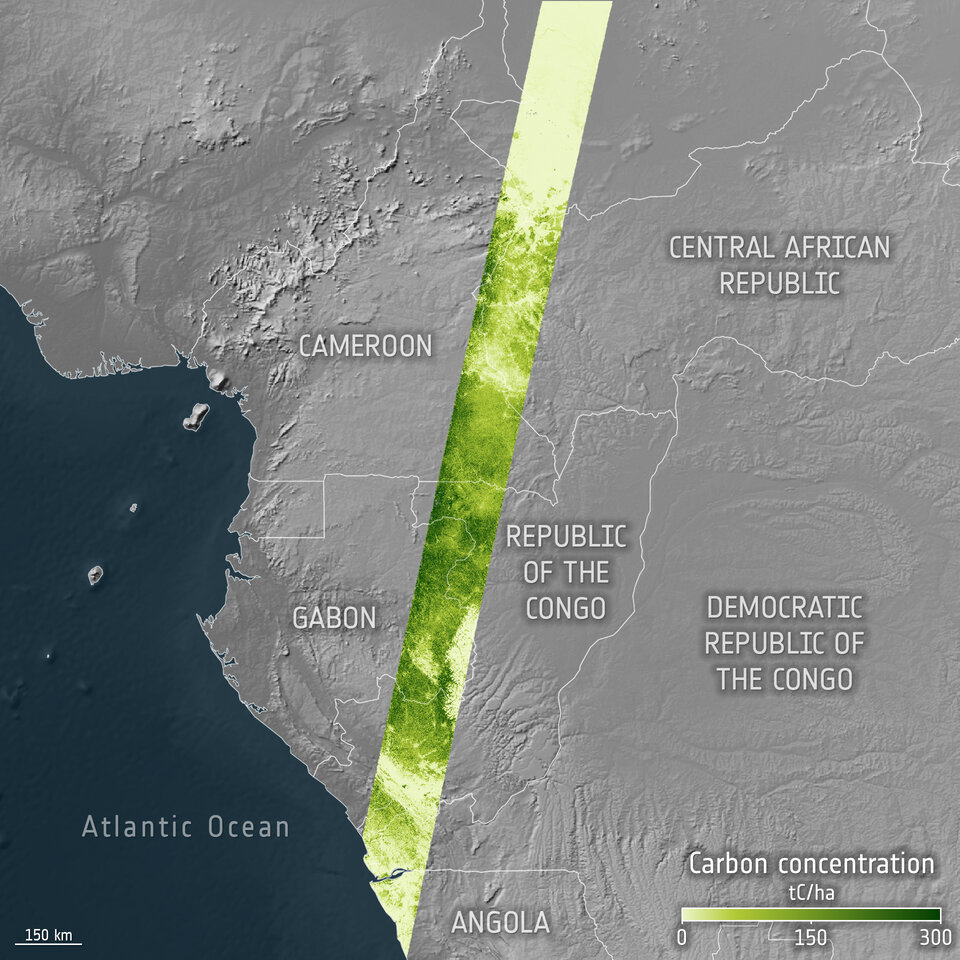
For years, forest carbon estimates have relied on indirect signals and incomplete coverage. That limitation is now being addressed. With commissioning finished, the European Space Agency has opened access to data from its Biomass satellite, moving the mission from technical validation into active science.
Measuring What Forests Actually Store
Most satellites observe forests from the outside. Biomass looks inside. Its P-band synthetic aperture radar penetrates dense canopies and interacts with trunks and large branches — the parts of forests where most carbon is stored. By measuring this woody structure directly, the mission provides a far stronger proxy for biomass than optical imagery or surface indicators.
That capability underpins the mission’s purpose: reducing uncertainty in how much carbon forests hold, and how those stocks change over time.
Why Commissioning Took Time
Although Biomass was launched in April 2025, its scientific usefulness depended on months of calibration and fine-tuning in orbit. Instrument stability, signal behaviour and geometric accuracy all had to be verified before data could be released.
That phase is now complete. Biomass has entered scientific operations, and its data are freely available to the global research community.
A Mission Designed To Track Change
The satellite’s science programme is structured in stages. An initial, 18-month tomographic global coverage is underway to resolve forest structure in 3D.
This will be followed by repeated nine-month interferometric coverages, allowing scientists to detect gains and losses in biomass over time.
Change, not just inventory, is the long-term target.
Confidence Built From The Ground Up
Accuracy is being reinforced through coordinated airborne campaigns over tropical forests, including extensive work in Gabon.
Aircraft equipped with specialised radar systems collected near-simultaneous measurements during satellite overpasses, enabling direct comparison between airborne and spaceborne data.
These efforts strengthen confidence in the mission’s calibration and ensure its measurements can support national monitoring and conservation efforts.
What This Enables Next
Reliable forest carbon data underpins climate policy, emissions reporting and land-use planning. Until now, global estimates have carried wide margins of error. Biomass is designed to narrow them. Not with a single map. But through consistent, repeatable observation. That is where its real value lies.
 Published by Kerry Harrison
Kerry’s been writing professionally for over 14 years, after graduating with a First Class Honours Degree in Multimedia Journalism from Canterbury Christ Church University. She joined Orbital Today in 2022. She covers everything from UK launch updates to how the wider space ecosystem is evolving. She enjoys digging into the detail and explaining complex topics in a way that feels straightforward. Before writing about space, Kerry spent years working with cybersecurity companies. She’s written a lot about threat intelligence, data protection, and how cyber and space are increasingly overlapping, whether that’s satellite security or national defence. With a strong background in tech writing, she’s used to making tricky, technical subjects more approachable. That mix of innovation, complexity, and real-world impact is what keeps her interested in the space sector.