

Feb. 2 is upon us once again. And during the 40+ years that I was a broadcast meteorologist, both on radio and television, I knew that this is the day that everyone looks to Punxsutawney, Pennsylvania for a forecast of whether we will see a continuation of winter, or whether we will enjoy an early spring. That forecast, of course, comes not from a person, but from a groundhog. And as such, Feb. 2 has become known as Groundhog Day.
And yet . . . this day originally was known as Candlemas; the 40th day since Christmas. As the old saying goes:
You may like
So how did a groundhog get involved? According to History.com, the first official celebration of Groundhog Day took place on Feb. 2, 1887. This inaugural celebration was the idea of Clymer Freas and took place in Punxsutawney, Pennsylvania.
And today, Bill Murray notwithstanding, should a certain groundhog named Phil see his shadow, we’ll see six more weeks of winter (6½ to be more precise). If he doesn’t see his shadow, then winter is over. According to Punxsutawney’s Groundhog Club, Phil, after making the prediction, speaks to the Club’s top-hatted President in “Groundhogese”, which only the current President can understand, and then his prediction is translated for the entire world.
By the way, according to Stormfax.com, as of 2025, Punxsutawney Phil has made 130 predictions, with an early spring (no shadow) having been forecast just a mere 21 times (16.2%). This site also states (without evidence or corroborative references) that as of 2025, Phil’s predictions have proved correct only about 39% of the time.
Halfway through on Tuesday
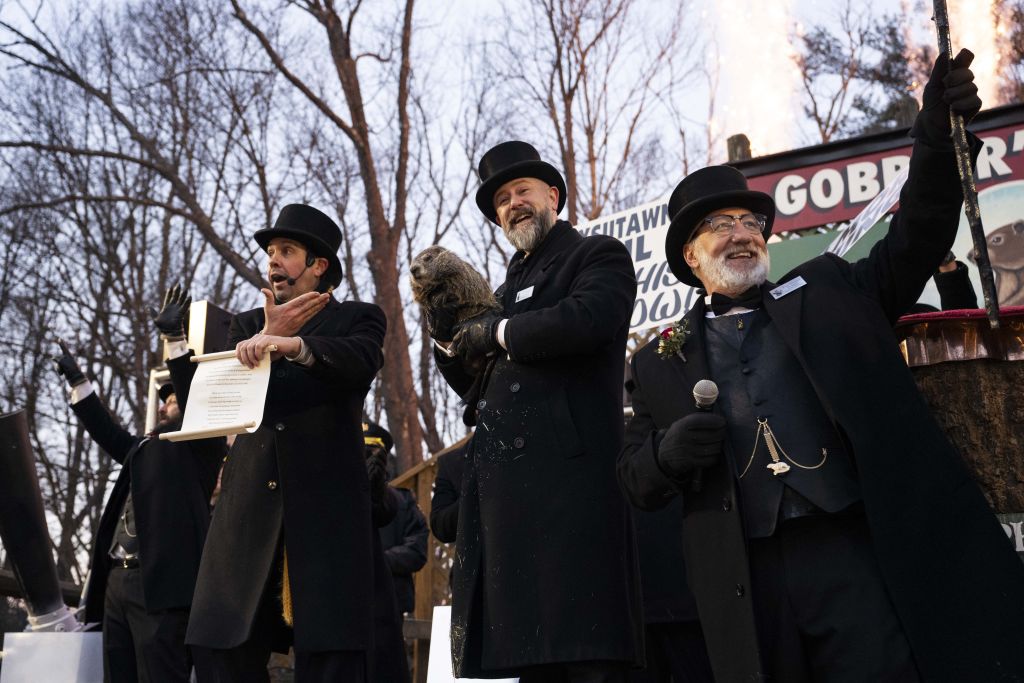
Groundhog Club handler A.J. Dereume holds Punxsutawney Phil, the weather prognosticating groundhog. (Image credit: Anadolu /Getty Images)
Although thought of as the “traditional” halfway point of the winter season, in reality, Groundhog Day actually comes up about one day short.
Winter’s midpoint will occur this week on Tuesday, Feb. 3 at 9:54 p.m. Eastern Time or 6:54 p.m. Pacific Time. But although the altitude of the sun has been slowly climbing and the length of daylight has been increasing since the winter solstice on Dec. 21, any changes up to this point have been relatively subtle.
However, from now through early May, the increasing altitude of the midday sun and its corresponding lengthening of the daylight hours will become much more apparent, for at no other time of the year do these two values rise so markedly.
For example, on the first day of winter in Denver, Colorado, sunset occurred at 4:38 p.m. and the length of daylight (from sunrise to sunset) reached a minimum of 9 hours and 21 minutes. Today, Denver sees the sun set at 5:23 p.m. with a mere 57 additional minutes of daylight having accumulated since Dec. 21.
You may like
But by March 20 — the date of the vernal equinox — the length of daylight in Denver will have increased by 110 minutes since Feb. 3. And because daylight saving time begins on Mar. 15th this year, by March 20, the sun will be setting well after 7 p.m. (7:11 p.m. to be exact) as viewed from The Mile High City.
Temperature-wise, we’ve bottomed out
Interestingly, for many northern locales, long-term records indicate the first four days of February are the coldest for the winter season. But average daily temperatures rise rapidly thereafter, so that by the last week of the month, they are higher than any day in January. Meteorologists, in fact, consider that the winter season is over at the end of February; they consider “meteorological winter” to be defined by the three coldest months of the year: December, January and February.
So, for all those weary winter souls, take heart: we’re about to turn the corner. In the days and weeks to come, you’ll more readily be able to sense the greater amounts of daily light and see the more northerly position of the afternoon sunsets on the horizon. And soon the weather will respond as well.
As for the groundhog forecast: To see or not to see . . . the shadow knows!