
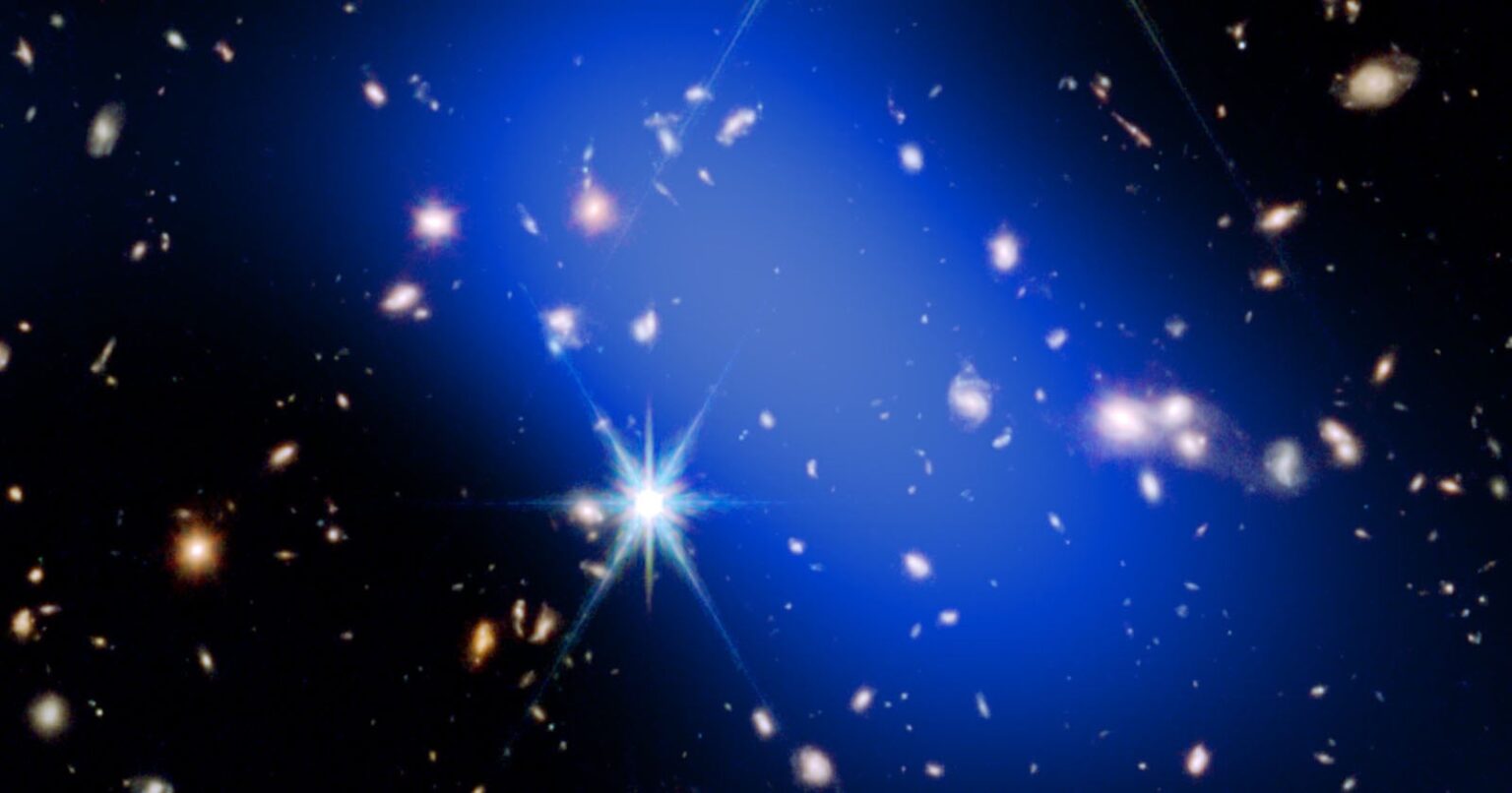
The James Webb Space Telescope (JWST) and NASA’s Chandra X-ray Observatory (Chandra) teamed up to deliver a new image of an ancient, distant galaxy cluster in the midst of its initial formation only a billion years after the Big Bang. Scientists previously thought galaxy cluster formation this long ago was impossible.
Webb, Chandra, and other cutting-edge telescopes and observatories are encouraging astronomers to rethink when and how the very largest structures in the Universe came to exist.
The imaged object, JADES-ID1, is located in the ongoing JWST Advanced Deep Extragalactic Survey (JADES) and is 12.7 billion light-years from Earth. This means that the light in the images captured by JWST and Chandra has been traveling through space for 12.7 billion years, nearly 2.8 times longer than Earth has existed and over 42,000 times longer than humans have existed.
The galaxy cluster has an exceptionally large mass that is about 20 trillion times that of the Sun. Technically classified as a “protocluster” because it is observed during an early, “violent” phase of formation, JADES-ID1 has been observed at a much farther distance — thus an earlier time in the Universe — than astronomers thought possible.
“This may be the most distant confirmed protocluster ever seen,” says Akos Bogdan from the Center for Astrophysics | Harvard & Smithsonian (CfA). Bogdan led the study. “JADES-ID1 is giving us new evidence that the universe was in a huge hurry to grow up.”
“We thought we’d find a protocluster like this two or three billion years after the big bang — not just one billion,” adds co-author Qiong Li of the University of Manchester in the United Kingdom. “Before, astronomers found surprisingly large galaxies and black holes not long after the big bang, and now we’re finding that clusters of galaxies can also grow rapidly.”
Galaxy clusters are essential for scientists studying the history of the Universe. They can be used to measure the expansion of the Universe alongside the cosmic importance of dark energy and dark matter. Galaxy clusters typically contain hundreds, or sometimes even thousands, of individual galaxies inside pools of superheated gas and invisible dark matter and energy. In the case of the JADES-ID1 protocluster, scientists have thus far identified at least 66 potential galaxies.
“It’s very important to actually see when and how galaxy clusters grow. It’s like watching an assembly line make a car, rather than just trying to figure out how a car works by looking at the finished product,” explains co-author Gerrit Schellenberger, who also works at CfA.
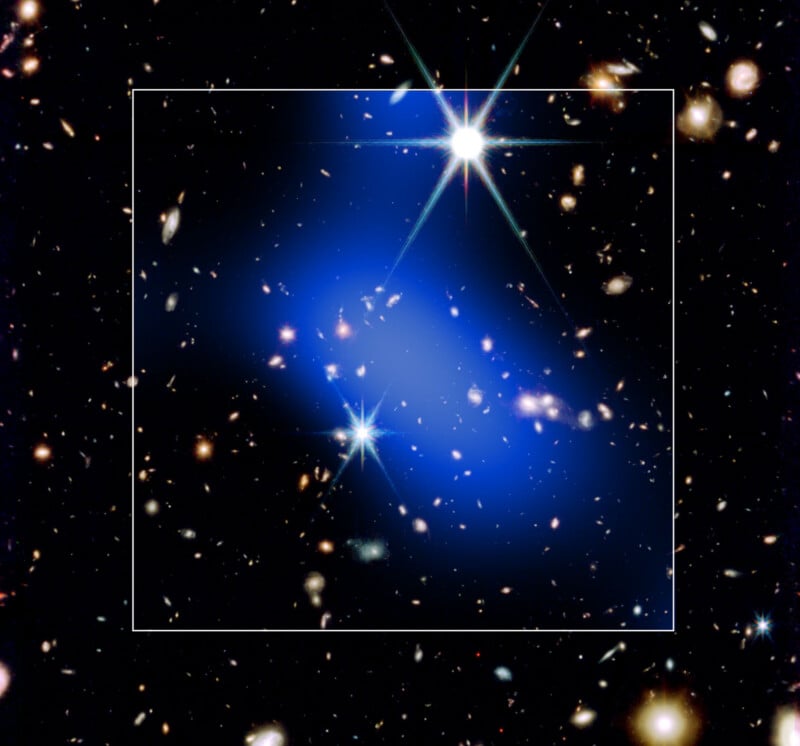
Most models of the Universe show that there wouldn’t be a high enough density of galaxies for a protocluster like JADES-ID1 to form only a billion years following the Big Bang. The previous record holder for a protocluster like this, one emitting X-ray radiation, was about three billion years following the Big Bang, or two billion years after JADES-ID1.
Unsurprisingly, given that JADES-ID1 is a record-breaking protocluster forcing scientists to rethink their models of the Universe, it required significant imaging power to uncover.
To find JADES-ID1 in the very far reaches of space, astronomers combined deep observations from JWST and Chandra.
“To find JADES-ID1, astronomers combined deep observations from both Chandra and Webb. By design, the JADES field overlaps with the Chandra Deep Field South, the site of the deepest X-ray observation ever conducted. This field is thus one of the few in the entire sky where a discovery such as this could be made,” the Chandra team explains in a press release. “In an earlier study, a team of researchers led by Li and Conselice found five other proto-cluster candidates in the JADES field, but only in JADES-ID1 are the galaxies embedded in hot gas. Only JADES-ID1 possesses enough mass for an X-ray signal from hot gas to be expected.”
Study co-author Christopher Conselice of the University of Manchester concludes, “Discoveries like this are made when two powerful telescopes like Chandra and Webb stare at the same patch of sky at the limit of their observing capabilities.” Now, Conselice and the rest of the team must figure out how JADES-ID1 is even possible at all.
The related research paper was published last week in Nature.
Image credits: Credit: X-ray: NASA/CXC/CfA/Á Bogdán; JWST: NASA/ESA/CSA/STScI; Image Processing: NASA/CXC/SAO/P. Edmonds and L. Frattare