
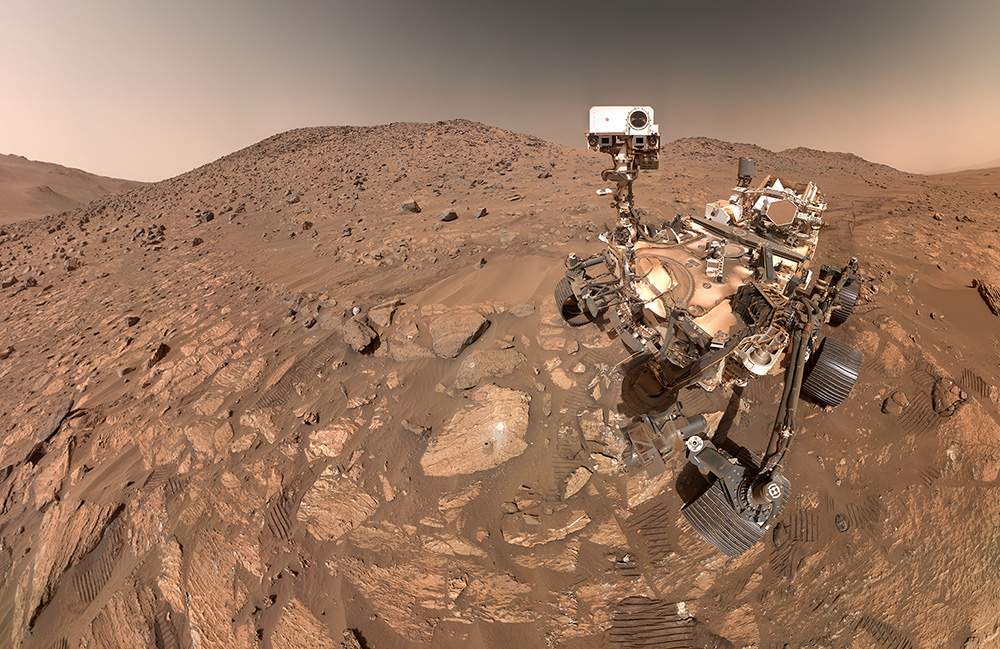
The Perseverance Rover taking a selfie on a rock named Cheyava Falls. | Source: NASA/JPL-Caltech/MSSS
NASA’s Perseverance rover has been exploring Mars for nearly five years now. However, the space agency’s team is still finding ways to push the boundaries with the robot. NASA recently shared that Perseverance completed its first drive planned by artificial intelligence.
During the demonstration, NASA engineers used vision-language models (VLMs) to create waypoints for Perseverance. This is typically a complex decision-making task performed manually by the mission’s human rover planners. The demo took place Dec. 8 to 10, and the NASA Jet Propulsion Laboratory (JPL) in Southern California led the mission.
“This demonstration shows how far our capabilities have advanced and broadens how we will explore other worlds,” said NASA Administrator Jared Isaacman. “Autonomous technologies like this can help missions to operate more efficiently, respond to challenging terrain, and increase science return as distance from Earth grows. It’s a strong example of teams applying new technology carefully and responsibly in real operations.”
The VLMs analyzed existing data from JPL’s surface mission dataset. The AI used the same imagery and data that human planners rely on to generate waypoints. These include fixed locations where the rover takes up a new set of instructions.
The initiative was led out of JPL’s Rover Operations Center (ROC) in collaboration with Anthropic, using the company’s Claude AI models.
NASA lets AI lead the way
Mars is on average about 140 million mi. (225 million km) away from Earth. This distance creates a significant communication lag, making remote operation impossible.
Instead, for the past 28 years, human “drivers” plan and execute mission routes. These drivers are tasked with analyzing the terrain and status data and sketching a route using waypoints.
An additional challenge is that these waypoints need to be spaced no more than 330 ft. (100 m) apart to avoid any potential hazards. Once the plan is made up, the human drivers send it via NASA’s Deep Space Network to the rover, which executes it.
Now, with Perseverance, NASA is trying something different. Generative AI analyzed the high-resolution orbital imagery from the HiRISE (High Resolution Imaging Science Experiment) camera aboard NASA’s Mars Reconnaissance Orbiter and terrain-slope data from digital elevation models.
After identifying critical terrain features — bedrock, outcrops, hazardous boulder fields, sand ripples, and the like — it generated a continuous path complete with waypoints.
To ensure the AI’s instructions were fully compatible with the rover’s flight software, the engineering team also processed the drive commands through JPL’s digital twin. The digital twin verified more than 500,000 telemetry variables before NASA sent commands to Mars.
On Dec. 8, with generative AI waypoints in its memory, Perseverance drove 689 ft. (210 m). Two days later, it drove 807 ft. (246 m).
“The fundamental elements of generative AI are showing a lot of promise in streamlining the pillars of autonomous navigation for off-planet driving: perception (seeing the rocks and ripples), localization (knowing where we are), and planning and control (deciding and executing the safest path),” stated Vandi Verma, a space roboticist at JPL and a member of the Perseverance engineering team.
“We are moving towards a day where generative AI and other smart tools will help our surface rovers handle kilometer-scale drives while minimizing operator workload and flag interesting surface features for our science team by scouring huge volumes of rover images,” she added.
What’s next for Perseverance?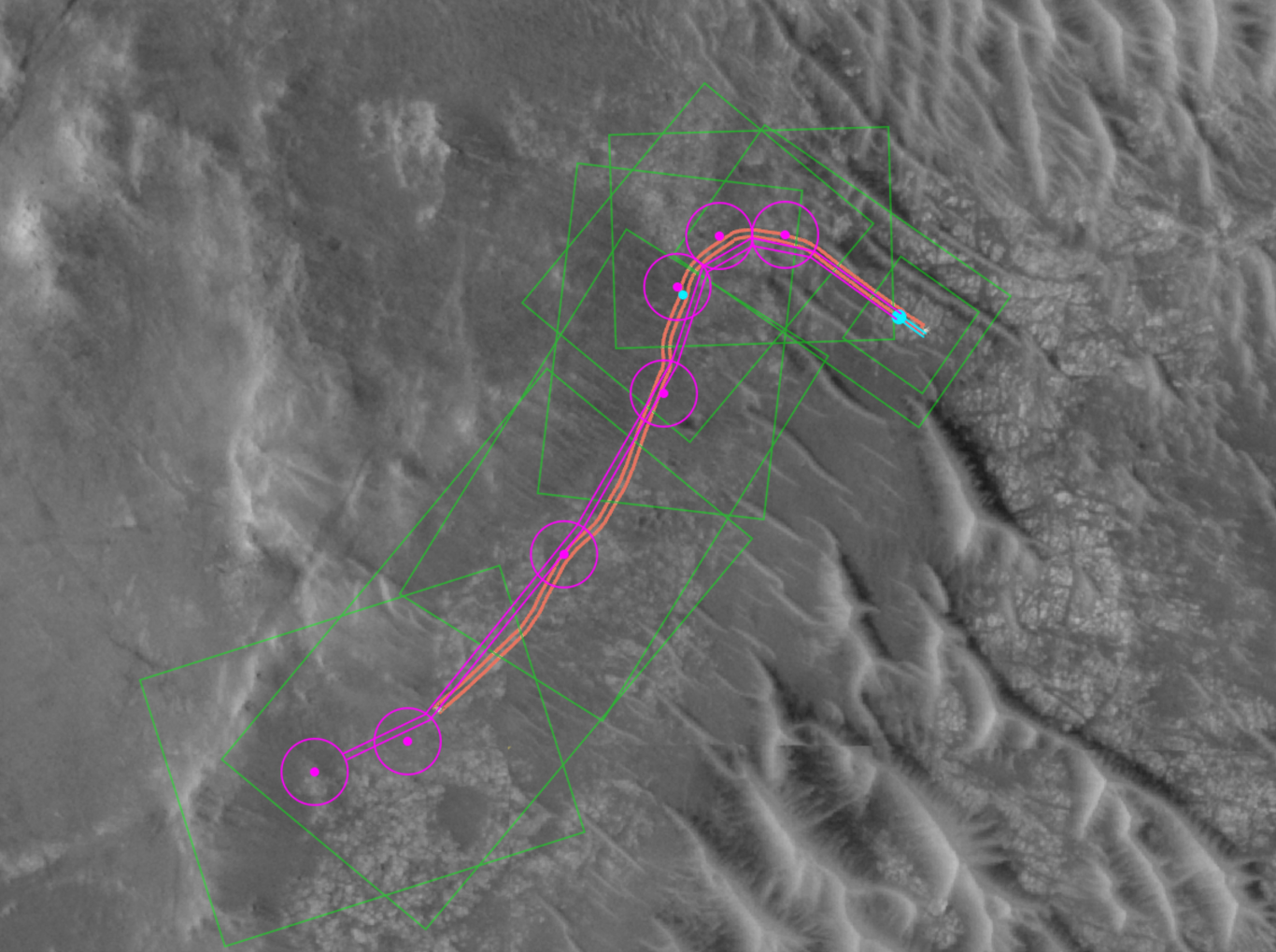
This orbital image depicts the AI-planned (in magenta) and actual (orange) routes the Perseverance Mars rover took during its Dec. 10, 2025, drive at Jezero Crater. The drive was the second of two demonstrations incorporating generative AI into rover route planning. | Source: NASA/JPL-Caltech
NASA said it hopes that the technology it has tested with Perseverance can have benefit many different areas.
“Imagine intelligent systems not only on the ground at Earth, but also in edge applications in our rovers, helicopters, drones, and other surface elements trained with the collective wisdom of our NASA engineers, scientists, and astronauts,” said Matt Wallace, manager of JPL’s Exploration Systems Office. “That is the game-changing technology we need to establish the infrastructure and systems required for a permanent human presence on the Moon and taking the U.S. to Mars and beyond.”
Since it landed on Mars, Perseverance has worked to collect rock samples of the planet, which NASA hopes to eventually bring back to Earth as part of the Mars Sample Return (MSR) campaign. However, this campaign, which was originally planned to launch in 2027, is currently uncertain.
In May 2025, the Trump administration released its NASA budget proposal for fiscal year 2026, in which it planned to cancel the MSR program. Last month, Congress confirmed that the MSR will not be funded, effectively cancelling the mission.
The MSR campaign, however, was a joint project between NASA and the European Space Agency (ESA). It’s unclear how or if the ESA will proceed without NASA.
