
Warsaw, Feb 2, 2026, 17:00 CET
New studies report the first direct methane detection in an interstellar object and a larger-than-expected nucleus for comet 3I/ATLAS
The findings come from December observations by the James Webb and Hubble space telescopes, released in preprints
Scientists are still racing to interpret data as the comet fades while exiting the inner solar system
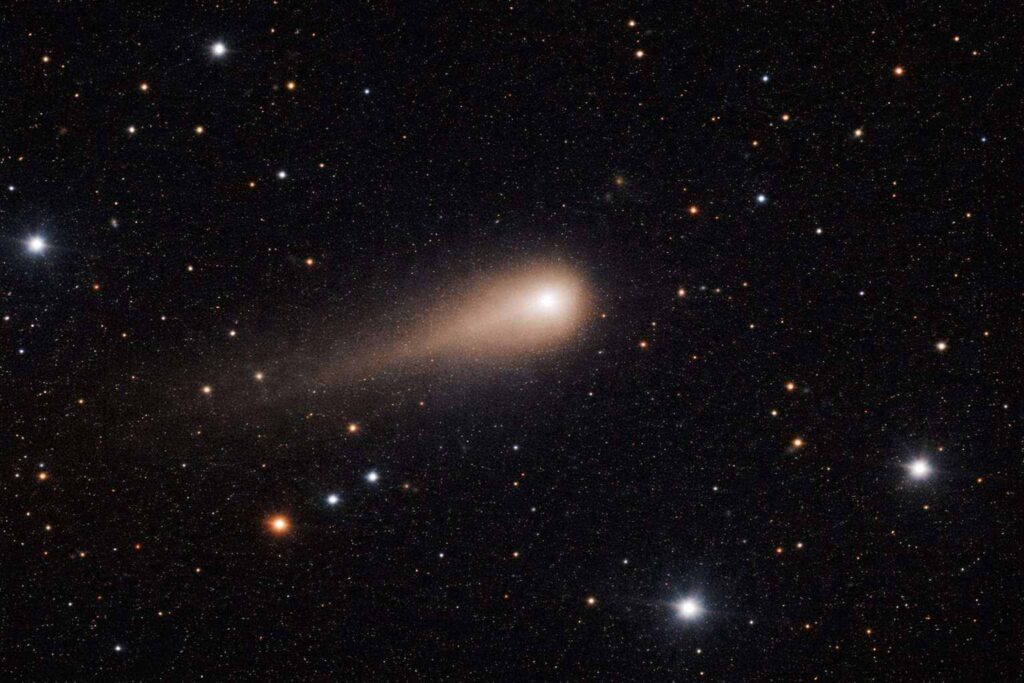
Two research teams studying the interstellar comet 3I/ATLAS say they have directly detected methane in its gas cloud and estimated its nucleus to be about 2.6 km (1.6 miles) across — a rare set of measurements for an object born around another star, according to papers posted on arXiv. (arXiv)
Why it matters now is simple: there have only been three confirmed interstellar visitors observed inside the solar system, and each one offers a short, fading chance to test ideas about how planets and comets form elsewhere.
3I/ATLAS is already on the outbound leg, and the new chemistry and size constraints are the kind of details researchers use to compare an outsider against “normal” comets shaped by our own sun.
In the James Webb study, researchers said they used the telescope’s Mid-Infrared Instrument, or MIRI, to take spectra — essentially a chemical fingerprint — after perihelion, the comet’s closest point to the sun. They reported methane and saw signatures tied to water and carbon dioxide, along with a nickel line. (arXiv)
The Webb team said the methane production lagged behind water, a pattern they argued fits a picture in which methane near the surface was depleted earlier, leaving the telescope to pick up methane emerging later from below. They also reported outgassing — gas escaping as ices warm — fell over the span of about two weeks.
The separate Hubble analysis used a “nucleus extraction” technique to pull the solid core’s signal out of the brighter coma. The authors estimated an effective radius of about 1.3 km, assuming a comet-like albedo — the fraction of light reflected — of 0.04. (arXiv)
The same paper said the comet’s changing brightness could be consistent with a stretched nucleus, with an axis ratio of at least 2-to-1, and a rotation period of at least an hour, though it cautioned those inferences depend on what is driving the variation.
Avi Loeb, a Harvard scientist who has written frequently about 3I/ATLAS, called the nucleus estimate the key number, writing that “the nucleus is inferred to have an effective diameter of 2.6 (±0.4) kilometers.” (Medium)
The comet was first spotted in July 2025 by the ATLAS survey’s telescope in Chile, and it drew global attention as NASA and others tracked it with multiple instruments. NASA officials previously dismissed speculation it was anything other than a comet; Nicola Fox called it “our friendly solar system visitor,” while Chris Lintott said, “The idea that 3I/ATLAS could be an alien spacecraft is simply nonsense.” (Reuters)
More data may still be coming. The European Space Agency has said its Jupiter mission Juice observed the comet, but expects the science data to arrive only in February because the spacecraft is using its main antenna as a heat shield and sending information at a slower rate. (European Space Agency)
But there is a downside scenario for the new claims: both studies are preprints, meaning they are posted online before peer review, and several key quantities are model-dependent. The Hubble size estimate hinges on an assumed albedo, and interpreting methane production depends on how scientists model heating, dust, and gas flow in an active coma.
Even so, the Hubble authors said their statistics imply more objects like 3I/ATLAS probably slipped through older surveys before astronomers caught 2017’s ‘Oumuamua and 2019’s Borisov — a reminder that this kind of visitor may not be as rare as it once seemed, only harder to see.
NASA captures sharpest-ever image of interstellar comet 3I/ATLAS