
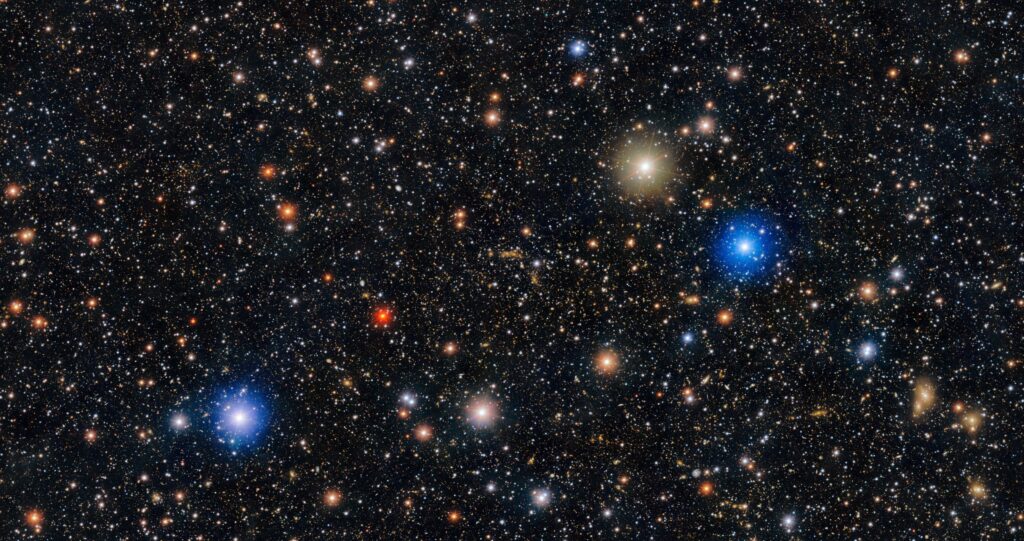
The international Dark Energy Survey (DES) collaboration has published the results of a six-year experiment, which are twice as accurate as previous ones. For the first time, four different methods of studying dark energy have been combined in a single study, providing the clearest picture to date of how this mysterious force shapes our Universe. The results are published in Physical Review D.
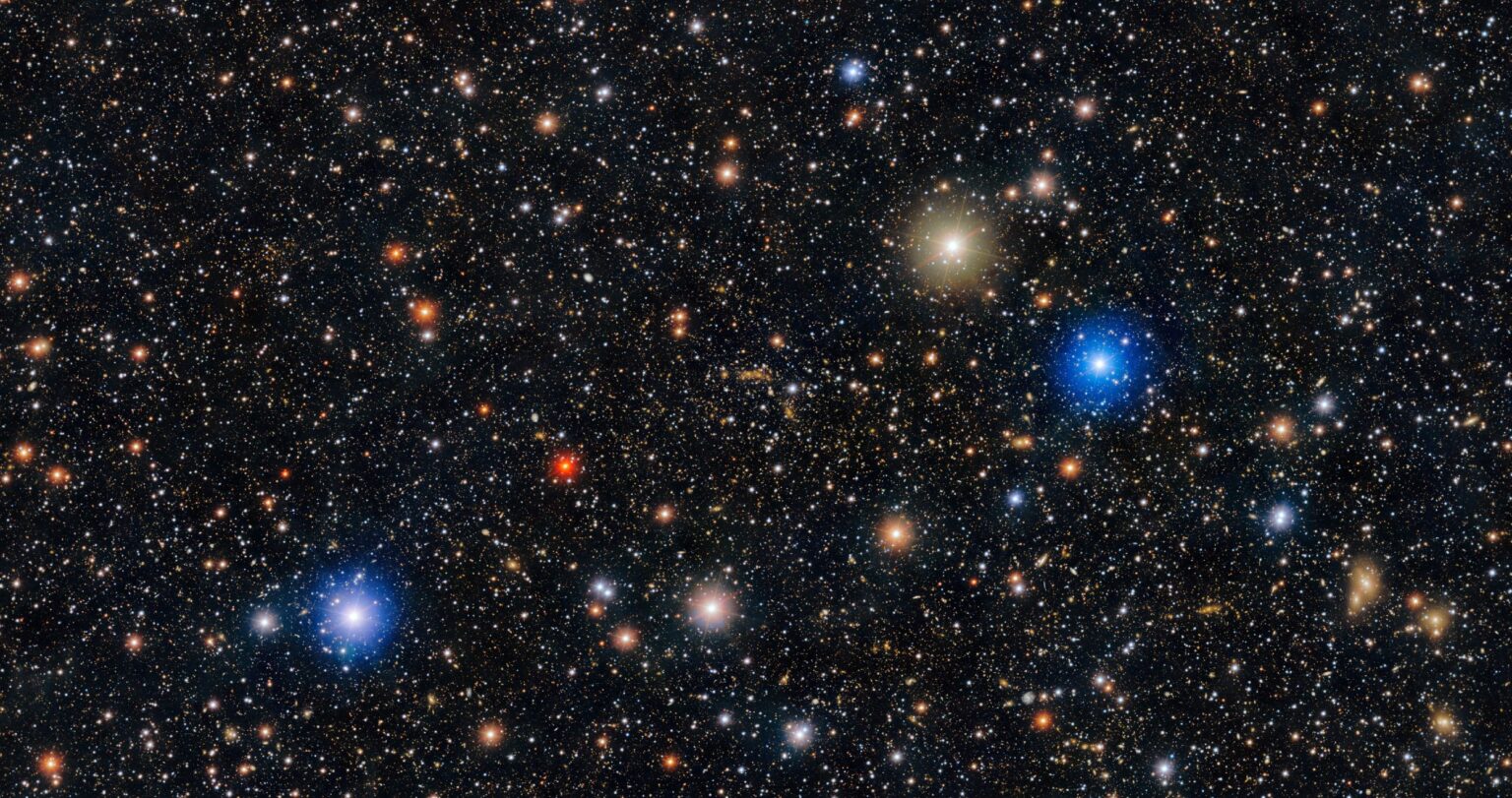 The Bullet Cluster consists of two galaxy clusters. One moves through the other at a distance of approximately 3.7 billion light-years from us in the constellation Carina. These galaxy clusters act as gravitational lenses, amplifying the light of background galaxies. This phenomenon makes the Bullet Cluster compelling evidence for the existence of dark matter. Source: NSF NOIRLab
From 2013 to 2019, scientists used the unique 570-megapixel Dark Energy Camera on the 4-meter Victor M. Blanco telescope in Chile to conduct nearly 760 nights of observations. They collected data on 669 million galaxies, covering one-eighth of the night sky. This massive undertaking took years to complete, and now the world can see the results.
Four keys to the mystery
The core of the research is a combination of four probe methods:
Weak gravitational lensing.
Clustering of galaxies.
Study of Type Ia supernovae.
Analysis of baryon acoustic oscillations.
Their simultaneous use made it possible to recreate the distribution of matter and dark energy over the last 6 billion years with incredible accuracy.
Unbreakable mystery of acceleration
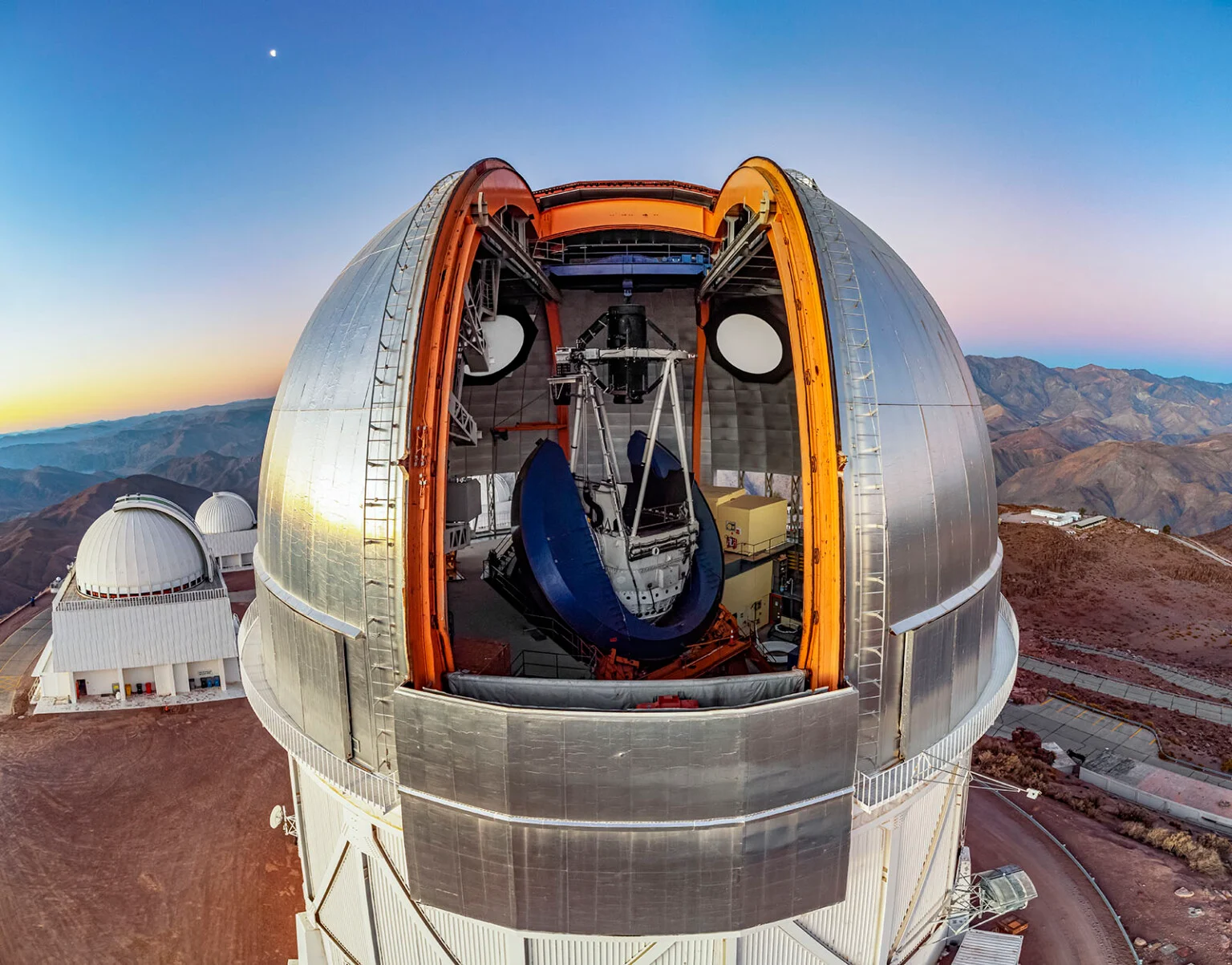 Victor M. Blanco’s 4-meter telescope at the Cerro Tololo Inter-American Observatory (CTIO), NSF NOIRLab program. At the bottom left are the 1.5-meter SMARTS telescope and the 0.9-meter SMARTS telescope (furthest back). Credit: CTIO/NOIRLab/NSF/AURA
The discovery of dark energy caused a sensation when it became clear that the expansion of the Universe was not slowing down due to gravity, but accelerating under the influence of an unknown force. Today, it accounts for about 70% of the total mass-energy of the cosmos. However, its nature remains one of the greatest mysteries of physics.
New DES data strongly supports the standard cosmological model (ΛCDM), which includes dark energy and cold dark matter. However, scientists have discovered one interesting parameter that does not quite match the predictions. This does not refute the model, but points to possible new discoveries. “Something still doesn’t add up,” leaving space for future research.
Path to future discoveries
DES laid the foundation for a new era. The baton will be passed to the Vera Rubin Observatory, which will begin a decade-long survey of the sky using the world’s largest camera. It will catalog billions of galaxies, providing data for even more accurate tests.
“DES has been transformative, and the NSF–DOE Vera C. Rubin Observatory will take us even further,” concludes Chris Davis of the NSF.
This work is a historic step in understanding the fundamental laws of the cosmos. It has not only provided the most accurate model of the expansion of the Universe, but has also shown the way to unravel its ultimate mystery.
Earlier, we reported on how scientists created the most detailed map of the distribution of matter in the Universe.
According to petapixel.com