


Published
02/02/2026 às 11:36
Um celestial body coming from outside our cosmic neighborhood It is traversing the Solar System silently, but at a speed that has caught the attention of the world’s largest observatories. The interstellar comet 3I/Atlas is traveling at an impressive 57 kilometers per second relative to the Sun, making it the fastest object of its kind ever detected by science.
Unlike asteroids and comets that have orbited the Sun for billions of years, this interstellar comet is only a temporary visitor. It entered our region of space, will make a brief passage, and then disappear forever into the void between the stars.
Humanity has observed billions of comets, but almost all of them belong to our own Solar System.
— ARTICLE CONTINUES BELOW —
See also other features
Bottlenose dolphins have been teaching humans to fish for over a century, signaling the exact moment to cast the net, increasing catches by up to four times, and revealing a rare animal culture that is now at risk of disappearing off the Brazilian coast.

A man uses the ingenious technique of pouring cement into old boots to create decorative pieces, a table stand, and even a plant pot.

A “bomb cyclone” could move over the eastern United States in the coming days, bringing intense snowstorms, winds of up to 65 km/h, a sharp drop in temperature, and record-breaking cold.

The idea of a helicopter lifting buildings might seem excessive, but this machine, created in the 1960s by the United States, carries over fifteen tons, has a strange shape, absurd strength, and still impresses military and civilian engineers today.

3I/Atlas, on the other hand, is only the third confirmed object that came from another star system. Before it, only 1I/’Oumuamua, in 2017, and 2I/Borisov, in 2019, had been identified.
This new visitor not only reinforces the idea that interstellar objects cross our path more frequently than previously thought, but also brings an even more extreme characteristic: speed.
While the ‘Oumuamua traveled at 26 km/s and the Borisov at 33 km/s, the 3I/Atlas reached 57 km/s, more than double the speed of the first case.
That high speed is a direct clue to its violent origin.
Record speed and a cosmic ejection
The fact that the interstellar comet 3I/Atlas is moving so fast indicates that it was ejected from its home system by an extreme energy event. Astronomers believe that this type of object can be launched into deep space after gravitational interactions with giant planets or even stars.
When this happens, the comet is literally flung out of the star system where it was born, beginning a journey that can last millions of years through interstellar space.
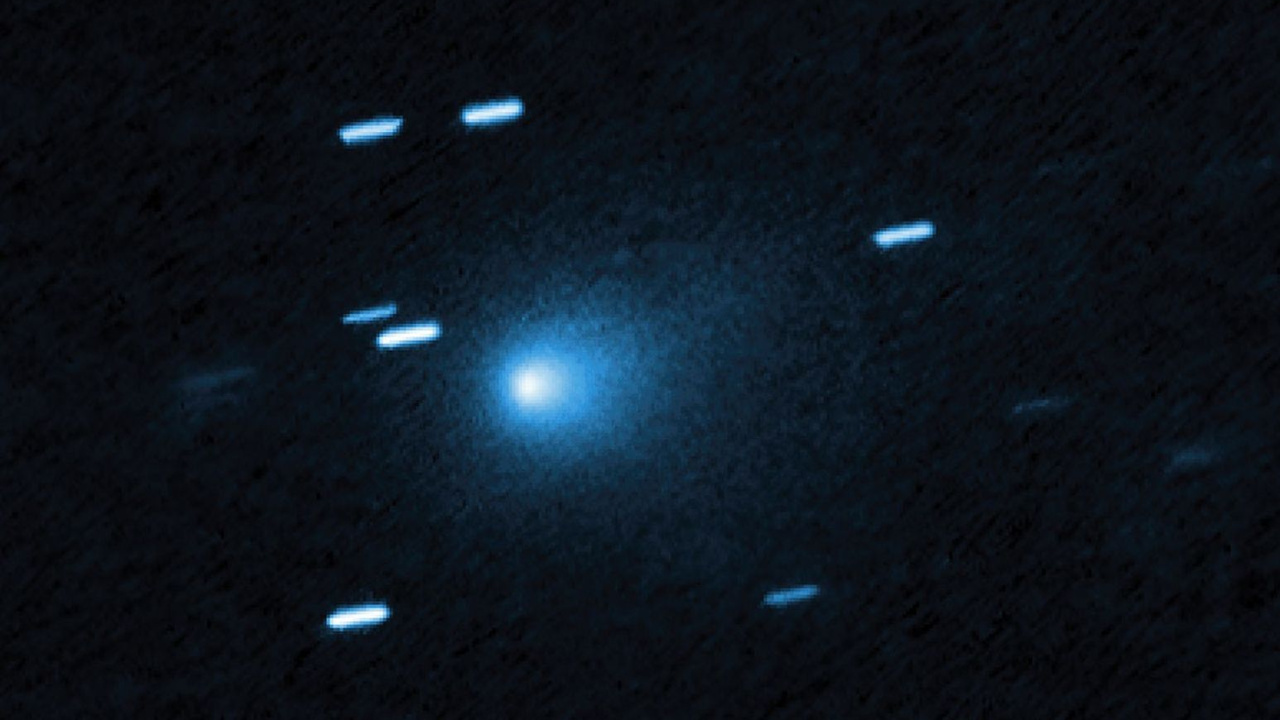 Source: NASA
Furthermore, its speed is so high that it easily surpasses the so-called escape velocity of the Sun. In other words, solar gravity is unable to capture it. It is simply passing through, like a cosmic projectile crossing a road.
The trajectory that proves he came from abroad.
What definitively confirms that 3I/Atlas was not born here is the shape of its orbit. Astronomers measure something called orbital eccentricity. When this number is greater than 1, the object follows a hyperbolic trajectory, that is, an open curve that does not return to its point of origin.
Planets, asteroids, and comets in our Solar System follow closed, generally elliptical orbits. However, the interstellar comet 3I/Atlas follows a path that enters, curves near the Sun, and then exits permanently.
To ensure this, an international network of telescopes has been monitoring the object since its discovery.
With each new measurement, the calculations are refined. Thus, scientists eliminate the possibility of it being merely a comet from the distant Oort Cloud, which also has long orbits but is still bound to the Sun.
In the case of 3I/Atlas, the data leaves no doubt: it came from outside the Solar System.
One of the greatest scientific interests lies in the composition of interstellar comets. Through spectroscopy, astronomers analyze the light reflected by the coma and are able to identify which elements and molecules are present.
Hydrogen, carbon, and oxygen should be present. However, what really matters are the proportions between them. An excess of carbon monoxide relative to water, for example, may indicate that the comet formed very far from its parent star, in an extremely cold region.
Furthermore, scientists are searching for complex organic molecules, which may provide clues about how the ingredients of life spread throughout the galaxy.
Each piece of data collected transforms 3I/Atlas into a kind of time capsule from another star system.
Do you believe that interstellar comets like 3I/Atlas may hold clues about the origin of life beyond Earth?