
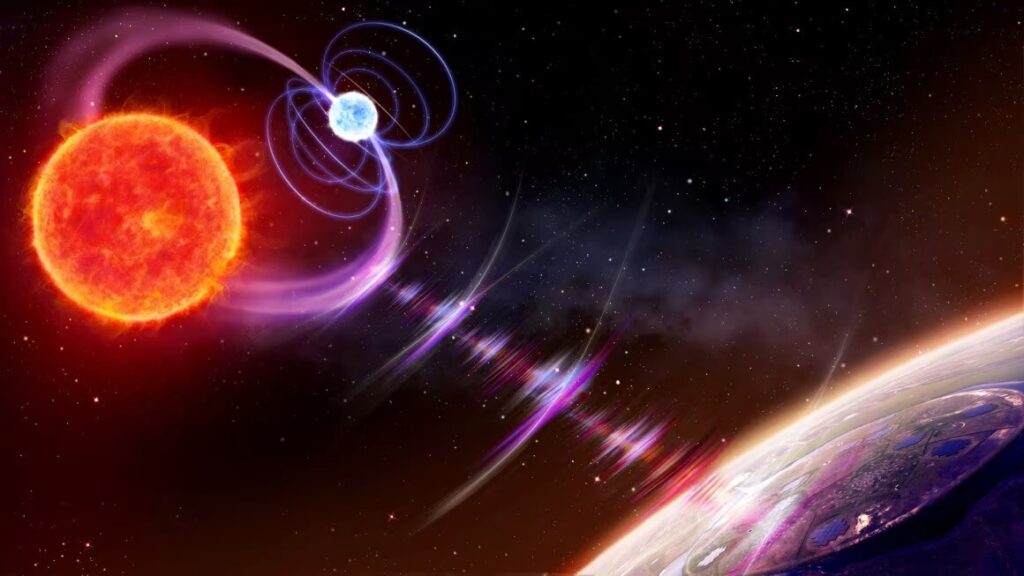
Scientists used several radio telescopes at once to understand where the slow radio pulses come from. They found that their source is pairs consisting of white and red dwarfs.
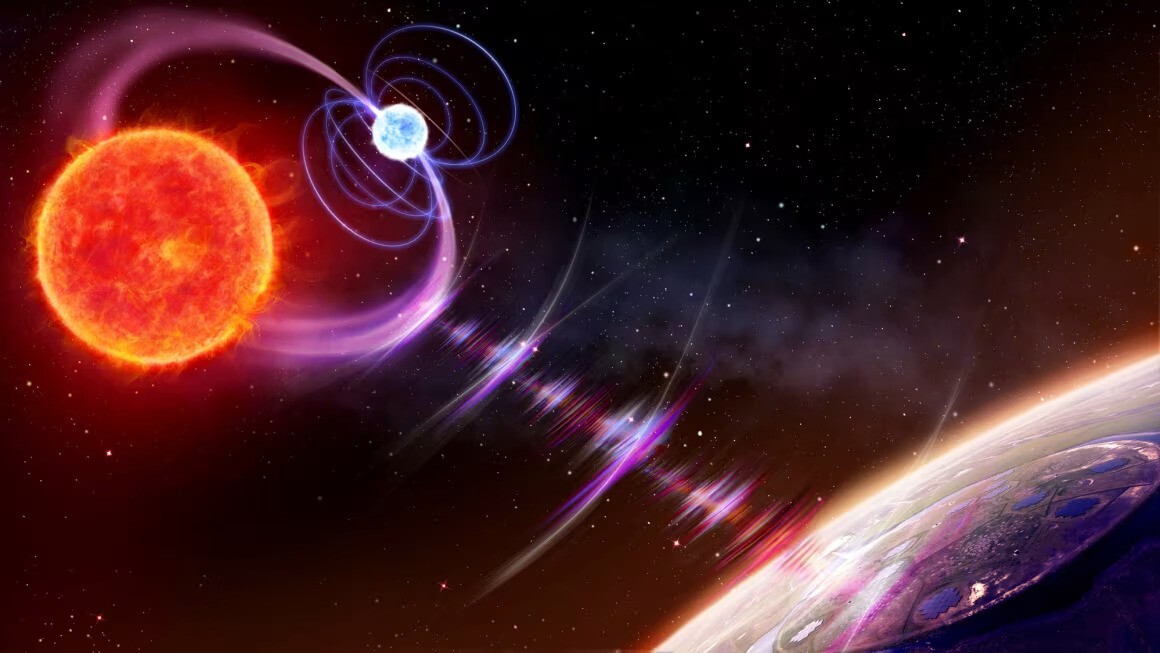 What is the source of slow radio pulses? Source: edition.cnn.com
Slow radio pulses
An international group of scientists has solved the mystery of slow radio pulses that seem to come from nowhere. They have been puzzling astronomers for several years, but in a new study published in the journal Nature Astronomy, their source has finally been identified.
Since Nikolai Kardashev first considered the question of what a signal from extraterrestrials would look like to Earth astronomers in 1964, scientists have discovered many periodic sources of radio emission. These are called transients.
Transients vary in both period and frequency. The combination of these two parameters creates several dozen varieties of periodic signals that scientists encounter. The sources of some of them are known, while others are not.
These transients are observed in the radio range — on waves longer than visible light. Their periodicity can range from several minutes to several hours. Their traces were first discovered in archival data back in 1988, meaning that these phenomena have actually been observed for quite some time.
Mystery
Slow radio pulses are far from being the most powerful transients known to astronomers, and cannot be compared to gamma-ray bursts. In addition, the directions from which they originate are well defined. The only problem is that no objects that could be the sources of such signals are observed in the visible range in these areas.
Slow radio pulses are very similar to those coming from pulsars. However, the periodicity of the latter is measured in seconds and milliseconds, and this cannot be changed. A neutron star cannot rotate any slower, and it is precisely such objects, when paired with a normal star, that generate the same signals that can be used as the most accurate clocks.
However, the idea is that the source of slow radio pulses must be some kind of pair of objects that are too faint in the optical range to be observed from a great distance. White dwarfs and red dwarfs are best suited for this role.
Pairs of dwarfs
Red dwarfs have a diameter ranging from one-tenth to 40% of the Sun’s. White dwarfs are closer in size to Earth. At the same time, like neutron stars, they are the final stage in the evolution of stars and are actually the more massive members of the pair.
Like neutron stars, white dwarfs can have powerful magnetic fields, and in close binary systems, they can even undergo accretion of matter. Scientists know of at least one such system that is a source of periodic radio signals, albeit with a periodicity close to that observed in pulsars.
But could it be that the sources of all slow radio pulses are similar systems? In 2025, two of them were indeed proven to be close pairs of white and red dwarfs. However, most of them are too far away for direct identification.
And now scientists have used three ground-based radio telescopes to study the source of slow radio pulses GPM J1839-10. It is located 15,000 light-years away from us and cannot be seen in visible light.
However, analysis of the radio signal shows that the pulses appear in groups of 4–5 every nine hours. This time interval can hardly be explained other than by the period of rotation of the two stars in the system. Thus, the hypothesis about the nature of this transient has been confirmed once again.
According to phys.org